
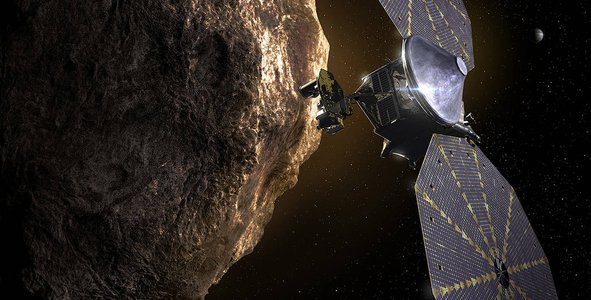
NASA’s Lucy Mission to the Trojan asteroids will survey eight asteroids in six independent orbits around the Sun to help unravel the history of the solar system. Your challenge is to illustrate the diversity Lucy will explore by creating a work of art in the medium of your choice, including, but not limited to painting, drawing, pottery, sculpture, 2D or 3D computer-generated products, music, film/video, written or spoken word, dance, or textile.
Summary
Details
Background
The Trojan asteroids are outer solar system bodies that orbit the Sun “in front of” and “behind” Jupiter at the same distance from the Sun as the gas giant. Thanks to the combined gravitational influences of the Sun and Jupiter, these Trojan asteroids have been trapped in stable orbits around what are known as the Lagrange Points for billions of years.
Planet formation and evolution models suggest that the Trojan asteroids are likely remnants of the same primordial material that formed the outer planets, and thus serve as time capsules containing information about the birth of our solar system over four billion years ago.
Over its 12-year epic journey, the Lucy spacecraft will fly by and carry out remote sensing on a record number of asteroids: one main-belt asteroid and seven different Trojans, representing the swarms of asteroids leading and trailing Jupiter. Lucy will survey surface geology, surface color and composition, mass and densities, sub-surface composition, as well as satellites and rings. By visiting several asteroids, Lucy seeks to survey the diversity of the Trojans and bring our understanding of the formation of the solar system into sharper focus.
Objectives
Your challenge is to illustrate the diversity that Lucy will explore by creating a work of art in the medium of your choice, including (but not limited to) painting, drawing, pottery, sculpture, 2D or 3D computer-generated products, music, film/video, written or spoken word, dance, or textile.
Your work should communicate, inform, and/or inspire others about asteroid exploration.
Keep in mind:
- Your solution must be an original work by you (apart from any NASA material), meaning that you are the work's principal creator, and you must have the right to submit it to the NASA International Space Apps Challenge (in other words, you cannot submit work that is copyrighted by someone else). Your work must have been created after October 1, 2021.
- Your solution must not contain any third-party work, even if you have permission or a license. In addition, the solution must not infringe on any third party's intellectual property rights or privacy rights. Refer to the Media Usage Guidelines for information regarding the use of NASA content.
- If your final artwork is not audio or video, please include scans or images that display your work.
- Include links to original NASA source files and materials that you used to develop your solution.
- Your Project “Demo” must adhere to the official limits listed in the Project Submission Guide (which will be posted here on September 15). However, your final audio or video work can last up to but not longer than five minutes in total length.
Your solution must adhere to the following format types:
- Images: JPEG format / 300 Dots per Inch (DPI) resolution
- Video: MP4 format / H.264 codec / 1080p resolution
- Audio: MP3 format
- All other media should be submitted using one of these three formats.
Potential Considerations
When developing your solution, you may (but are not required to) consider the following:
- Consider how you can incorporate at least one original NASA image, video, audio clip, or other data source into your solution.
- The art may either contain the original source (in full or in part) or be derived from /inspired by the original NASA source material.
- Consider the following questions as you create your project:
- Does the work provoke an emotional response?
- Does the work show a mastery of craftsmanship?
- Does the work exemplify creative excellence that pushes the boundaries of making or storytelling?
- Does the work show a high level of technical, conceptual, and aesthetic innovation and display an exceptional level of creative vision?
- Does the work show an exemplary use of original NASA material?
- Does the work show an exceptional level of creative vision and execution?
- Does the work capture a creative expression?
- Does the work explore new ideas or techniques?
- Does the work offer a fresh perspective?
- The Lucy Music Soundscape is a public collection of original music inspired by NASA’s Lucy mission and may provide additional inspiration, audio content, or avenues for sharing your final project. However, there is no requirement that musical submissions use the Lucy Motif. For more information, visit the Lucy Music Soundscape project.
- Consider the current scientific understanding about Trojan asteroids as you create your project, for example:
- What we know and don’t know: The Lucy Mission is the first mission to the Trojan asteroids. It is slated to launch in October 2021 and will not reach its first Trojan target (Eurybates) until August 2027! Traveling over four billion miles in total, Lucy will complete its mission with a flyby of the binary pair Patroclus and Menoetius in March 2033. While scientists currently have data on albedo (the total amount of light reflected off the surface), rough shapes and physical dimensions, as well as data from the spectrum of light that reflects off of these bodies, Lucy will be collecting and transmitting far more precise data back to Earth over the next 12 years.
- Lagrange Points: The points in space where the gravitational forces between two large objects balance one another are known as Lagrange points. Each planet has five Lagrange points in relation to the Sun. Trojan asteroids are caught near the most stable of these points known as L4 and L5. Thanks to Jupiter’s large size (and substantial gravity) the Jupiter Trojan swarms contain more than a million asteroids, trapped in their orbits since the early formation of the solar system. For one suggested explanation of how the Trojans got stuck in Jupiter’s Lagrange points in the first place, research the Nice Model.
- Asteroid Classification and Spectral Data: Asteroids are classified into various types (C-type, P-type, D-type, etc.), based on how they reflect light, in particular according to the shape of the spectrum that the asteroid reflects. Interestingly, we do not know for sure if asteroid types correspond to the underlying physical properties of the asteroids, such as composition. The Lucy Mission will be the first ever to fly by a P- or D-type asteroid and will help us to learn more about how spectral types correlate to close-range physical properties. For more information on asteroid classification see this overview on the Lucy Mission website: Asteroid Taxonomy.
- Lucy’s Asteroid Targets: Lucy will fly by one C-type asteroid (Eurybates), two D-type asteroids (Leucus and Orus), and three P-type asteroids (Polymele and both members of the Patroclus-Menoetius binary). Lucy will also fly by Queta, a satellite of Eurybates. For detailed information on each of the asteroid targets, review Mission Targets from the Lucy Mission website.
- Chronicle of a Collision? Eurybates is the largest remnant of a catastrophic asteroid collision (an extremely rare event among the Trojans). Queta, the satellite of Eurybates, was only recently discovered by Lucy mission scientists and is thought to be a smaller fragment of that collision. The close-range data collected from each of these bodies provides an exciting opportunity for insight into the effects of asteroid collisions. For more details on the discovery of Queta, see NASA’s Lucy Mission Confirms Discovery of Eurybates Satellite.
- Why Trojans? Most asteroids in the main belt and inner solar system are C-types, M-types, and S-types. Trojan asteroids, much like other outer solar system bodies, are P- or D-types, reflecting very little light. A closer look at the Trojan asteroids seeks to:
- Provide insight into the spectral diversity of bodies in our solar system.
- Examine these ancient time capsules to uncover secrets about the formation of the outer solar system.
- Shed light on additional comparisons or contrasts between bodies in the main belt and outer solar system and perhaps even illuminate the history of the inner solar system and our own planet.
- Not a Trojan: Lucy will also fly by one main-belt asteroid, Donaldjohanson, a C-type body that formed in a massive collision only 130 million years ago (practically yesterday in terms of solar system history!). Lucy will survey Donaldjohanson as the spacecraft flies by on its way out to the leading swarm of Trojans, but this asteroid should not be mistaken as a Trojan asteroid.
- Potential keywords you can search include: solar system object image data, D-Type asteroid spectra, P-Type asteroid composition
For data and resources related to this challenge, refer to the Resources tab at the top of the page. More resources may be added before the hackathon begins.
NASA does not endorse any non-U.S. Government entity and is not responsible for information contained on non-U.S. Government websites.