 Nada Ashraf Alshafey
 Nada Ashraf Alshafey
 Nada Ashraf Alshafey
 Nada Ashraf Alshafey
It all starts with our existence, Trying to figure out why and when ? So we dicided to change the idea about SMD's sciences and how to make people realizing the true importance of learning and understanding the world ! By talking about something important like Water on the moon. We also believe that Everything is connected we just need to analyse carefully.
And One day we will figure out how small we are how big are our dreams.
Water on the moon is a very essential topic to talk about. Our mission here is to find a connection between NASA's sciences to attract more audience and be to encourage other people to be engineers or scientists in this exciting field.
The importance of the challenge comes from the vital role of convincing others about taking part in this massive step for humanity and to tell the new generations about the efforts exerted in this field. In addition, we want to make people aware of what is the meaning of Humanity Sustainable presence .
1- The use of facts when we talk about the sciences to convince others
2- An attractive to our connection story
3- If we use another branch of science outside NASAsciences, we should have a link to one of SMD'S branches .
NASA'S sciences collaborate together to make use of the water existed on the moon. As it is very curial in providing Artemis 3 with fuel to be launched to the Red Planet. Earth sciences and planetary sciences help us to define the source of this water and its location on the moon. Heliophysics helps us to be aware of the danger of science radiations on the moon which affect our moon because it has a very thin atmosphere, Exosphere. As mentioned in NASA Astrophysics overview ,Astrophysics provides spectral images for the surface of the moon. It also helps in defining the concentration of water on the moon and the place where the missions sent can land on . Biological and physical science will help us in many points :
· turning ice on the moon to liquid.
· Extracting hydrogen and oxygen from the water.
· Studying microbial life on the moon and the Mars
 Materials & methods:
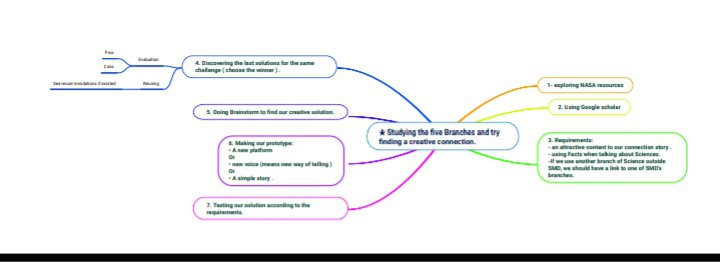
As a team we started our work with making a mental map using Mindomo app :
 ter making our plane, I , the leader, started to give roles to team's members. We searched together in every science and topics connected to our challenge but in different resources. Each one of us used different type of resource; we watched videos, read articles, and listhening to some important broadcasts about this topic. We used NASA's resources in knowing more about SMD's sciences and discovering more about the Artemis mission and the importance of water as a source of the fuel and on of the basics of life on other planets like mars.
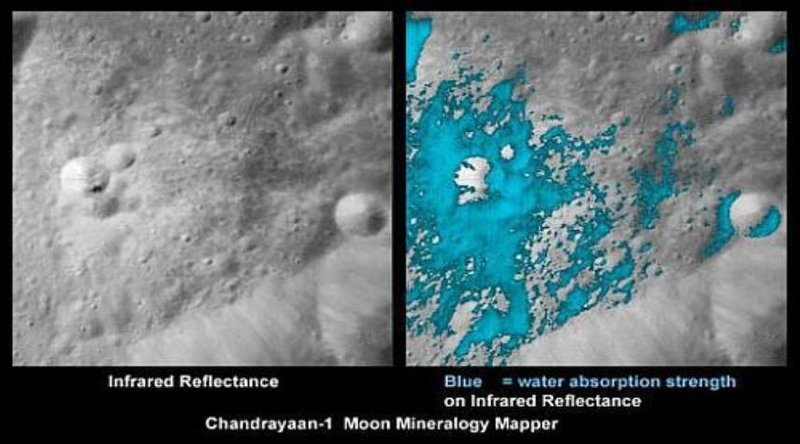
The journey of exploring water on the moon has started along time ago. During the initial exploration of the Moon, and the analysis of all the returned samples from the Apollo and the Luna missions, we thought that the surface of the Moon was dry. But after the IndianChandrayaan-1in 2008, Astrophysics scientists detected hydroxyl molecules spread across the lunar surface and concentrated at the poles. Missions such as Lunar Prospector, LCROSS, and Lunar Reconnaissance Orbiter, have not only shown that the surface of the Moon has global hydration, but there are actually high concentrations of ice water in the permanently shadowed regions of the lunar poles.
But what if we really succeeded to beat all cruel obstacles such as the Sun's radiations on the moon, the frozen water, and the solar wind ?
The answer is easy! We will be able to have a liquid water to use it in drink, as a fuel to our journey or may be we can start planting the moon an make our colonization!
No one can deny that searching for water in the moon is the core to achieve a sustainable presence in the space and to enable humans to take the first step in an other planet, Mars.
Using earth science, we can know more about how we deal with the layers of our moon to reach moon and make use of minerals there. Earth science's scientists discovered that volcanoes on the moon are inactive which means that no more gases and water vapor are released.
Planetary science gives us a hand, too. It helps in choosing the best place to extract liquid water from ice and the appropriate place for VIPER (Artemis 2 which will alnd on the moon on 2023 to give us an answer to some questions like what form water is in? where it came from? And more) to land on. Planetary scientists decide that the appropriate location for VIBER will be the Nobile region of the south pole to:
· provide sunlight to it in order to be charged .
· have earth visibility for communication from the moon to the earth.
 Coming to heliophysics it helping us to pay attention to the effects of solar wind and the Sun's radiation which effects robots and humans in deep holes in the moon because of the static electricity. In addition, it enables us to know more about micrometeoroids that hit the surface of the moon and make waves which, in turn, release vapor and atoms of Na.
But what about Astrophysics? It enables us to use physics theories to discover the results of the low gravity of our moon which effects the amount of fuel needed to make Artemis reach the mars. It also provides us with spectral images to the locations of water on the moon and spectral information.
So you, Sir , may ask me about the the mechanism of turning water into fuel! In this point we will use biological and chemical sciences by using water electrolysis techniques:
2H2O à O2 + 2H2

knowing that the water is existed in the sunlight challenged our knowledge and it gives us the chance to try figure out the true explanation so it gives us the chance to imagine what if there was another places that fall of water on the moon?!
When our knowledge improve, will we find that the moon
is actually full of water in other hidden places....
Well we can't say yes or no but we can just imagine … may one day all doors will open!
References :
· Water in lunar anorthosites and evidence for a wet early Moon:
https://www.nature.com/articles/ngeo1735
· SOFIA Detects Water on the Moon:
https://www.sofia.usra.edu/multimedia/science-results-archive/sofia-detects-water-moon
· Micrometeoroids:
Nada Ashraf Alshafey