
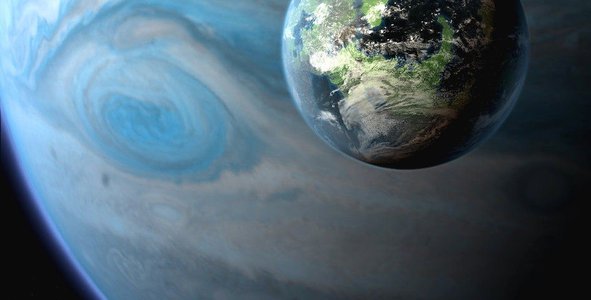
High-Level Project Summary
Build Training data sets and use it for deep learning Algorithm for Exomoon detection using Transit method, by focusing on mining data of selected list of confirmed gas-giant exoplanets in the habitable zone.
Link to Project "Demo"
Link to Final Project
Detailed Project Description
First, we filler only the confirmed gas & Ice-giant exoplanets in the habitable zone, which were discovered via transit method using NASA’s Exoplanet Exploration website
https://exoplanets.nasa.gov/discovery/exoplanet-catalog/
Once we create a list of at least few hundreds selected exoplanets
Use Mikulski Archive for Space Telescopes (MAST) portal APIs to download light curve for our list of exoplanets
https://mast.stsci.edu/portal/Mashup/Clients/Mast/Portal.html
Examples of such exoplanets such as HIP 41378 e and HIP 41378 d
Use Python and ‘lightkurve 2’ library to import, manipulate and plot the light curves
For each exoplanet
Run simulating function for exoplanet
Generate 42 new light curve patterns
Append (modified data set)
Divide the data set into training and testing sets
Build Neural network model & run it on the training sets
Run model on testing sets
Evaluate the models
Measure the accurse and generate the confusion matrix
Hyperparameter tuning
Rebuild/modify the data sets
Run the model with higher precision on real data (the pre-selected Exoplanets, such as HIP 41378 e and HIP 41378 d)
Publish results
Space Agency Data
NASA’s Exoplanet Exploration website
Mikulski Archive for Space Telescopes (MAST) portal APIs
Hackathon Journey
We started with the Idea of finding the real Pandora moon.
We believe the data is our there, waiting to be discovered, it was just the matter of 'digging' and finding it
We highlighted the necessary steps in our process from conception to publishing results
We started drawing the potential configurations of different orbits location of possible exomoons
wrote pseudo code in python for generating the new data sets
These datasets will be divided into training and testing
we began (we'll finish it later) build two machine learning model (ANN, and SVM) and train them on our data sets
Then comes the evaluation of the models
Once we satisfy with our models, we'll run it on a selected set of exoplanets (gas-giants in the habitable zone)
We'll publish any potential discovery in a paper and submit it to peer-review journal
References
Movie Avatar
NASA’s Exoplanet Exploration website
Mikulski Archive for Space Telescopes (MAST) portal APIs
Lightkurve library

Tags
#Exoplanets #Exomoon #SaudiSpaceAppsChallenge
Global Judging
This project has been submitted for consideration during the Judging process.