
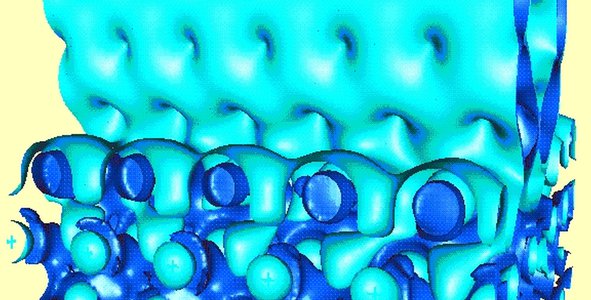
The design of novel alloys via predictive computational modeling is progressing by leaps and bounds, but the numerous open-source tools available for materials science modeling are often difficult to use and interpret. Your challenge is to develop a graphical user interface (GUI) that allows easy and seamless use of these tools.
Summary
Details
Background
NASA uses alloys to construct many of its mission elements, including space launch system (SLS) components, engines, and even nuclear thermal propulsion (NTP) and international space station (ISS) microgravity materials research. The large-scale structures that comprise space stations and habitats, spacecraft that use NTP, and other items ranging from engine nozzles to Hall ionic thrusters all depend on materials design and development as does advancing the state of the art. The success of each element depends on the characteristics of the alloy selected, the alloy’s performance in the intended environment, its printability and weldability, and the joining method used— e.g., a selective melting process (fusion welding and 3D selective laser melting [SLM] printing and the related direct energy deposition [DED] methods) or a solid-state joining process.
Materials science and predictive modeling of alloys are challenging topics. However, methods to design novel alloys via predictive computational modeling are progressing by leaps and bounds! Coupling computational alloy design with iterative synthesis and characterization/testing of alloys has reduced the time to produce a novel alloy to a year or two when it used to take over a decade! Many readers will recognize this as the integrated computational materials engineering (ICME) approach.
These rapid advancements depend on computational calculations regarding the thermodynamic and even the atomistic interactions of alloys and materials. Solutions are iterated to determine the optimal configurations and materials for additive manufacturing (3D printing) and for welding and joining on Earth and for in-space manufacturing of large on-orbit and Lunar structures.
Over the past decade, computational materials science modeling tools have been developed at national laboratories such as the U.S. National Institute of Standards and Technology (NIST) and Sandia National Laboratories, at NASA and by teams at world-class universities. These applications consist of quantum mechanical and molecular dynamics calculations tools, Monte Carlo and stochastic statistical methods, and thermodynamical calculation tools. Many of these tools are freeware and licensed under the General Public License (GPL) or open-source licensing schemes.
However, most of these open-source tools rely on complex command line interfaces and scripting languages and are very unique which limits their accessibility to the general community of materials engineers and scientists. To use these tools, one usually has to know several specialized programming languages, install special libraries, use third-party software tools or even specially built materials databases. Then, one has to execute massive parallel job queues—all to run a computationally simple model.
Use of these open-source tools could be increased if they could be used to run model after model, for material after material in a seamless, effortless way, and be able to switch the calculation method employed from one bundled resource (e.g., quantum) to another (e.g., Molecular Dynamics, Monte Carlo, Thermodynamics, etc.) to another at quite literally the push of a button. Furthermore, it may be helpful if such open source tools could be configured to be able to display and manipulate the various outputs just as effortlessly.
Here is where GUIs applications may be useful. An application with easy-to-install, bundled wrappers for required libraries and dependencies with a GUI (i.e., drop-down menus and push-button computing) could increase the use of existing open-source materials science modeling tools. The GUI can be for each individual approach and freeware or can incorporate several approaches. The application could also be for workflow between approaches.
Objectives
Your challenge is to develop an interactive GUI application, or multiple GUI applications, that enable easy, user-friendly utilization of existing, open-source, materials science and engineering modeling software suites. Your tool may seamlessly integrate all the elements required to use these software suites, including install packages with all dependencies, databases, and third-party resources/freeware.
Potential Considerations:
As you develop your GUI, you may (but are not required to) consider the following:
- Your GUI could interface with the following materials science modeling computation packages:
- MUST alloys computational kit
- ATAT alloys theoretical automated toolbox (Brown University and Massachusetts Institute of Technology)
- OpenCalphad freeware package (NIST), PyCalphad is also freeware.
- Your GUI could bundle together several approaches and packages with open-source fundamental atomistic packages, graphing and plotting utilities, and even Machine Learning/Artificial Intelligence (AI) packages. The GUI design and development burden for atomistic packages and even Machine Learning Packages and Plotting Packages is nearly identical to the above example packages.
- Specific examples of atomistic packages: Your GUI could also seamlessly integrate with the above, freeware atomistic density functional theory (DFT) (e.g., atomistic quantum and classical molecular dynamics, etc.) applications such as SIESTA and LAMMPS and with graphing/plotting freeware such as ParaView (Los Alamos freeware) and gnuplot, etc.
- Potential keywords you may search online: Integrated computational materials engineering (ICME), density functional theory, molecular dynamics, graphical user interface (GUI), application programming interface (API), phase field, micress, machine learning, tensor flow, computational materials discovery, alloys design
For data and resources related to this challenge, refer to the Resources tab at the top of the page. More resources may be added before the hackathon begins.
NASA does not endorse any non-U.S. Government entity and is not responsible for information contained on non-U.S. Government websites.