
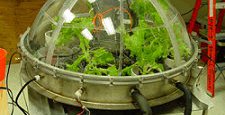
A viable food system for long-duration exploration missions does not yet exist, but it will be necessary to maintain crew health and performance. Your challenge is to design a deployable crop production system capable of supporting the nutritional requirements of a crew of 4-6 on a transit mission to Mars and back to Earth.
Summary
Details
Background
Food is the first line of defense to maintain astronaut health and performance. Pre-packaged food has been used to meet astronaut food requirements since the start of the space program and will continue to serve as the foundation of the food system on early exploration missions. However, missions to Mars could last up to three years. In that time, the key nutrients and vitamins (such as Vitamins B1, C, and K) in currently available versions of pre-packaged foods will begin to lose efficacy and the food may also suffer a decline in palatability and acceptability.
While there are several options to supplant the exploration food system, most require significant technology development and additional complex infrastructure. Plants—and crop plants in particular—have been shown to adapt well to the spaceflight environment and have been grown and consumed by a number of crews on the International Space Station (ISS). The hardware required to grow plants in space has also been developed and demonstrated to a reasonable extent. While challenges remain, the addition of crop plants as a means to provide additional nutrition to the crew diet is considered a viable option to reduce the risk currently associated with developing an exploration food system.
Current crop growth systems on the ISS include Veggie and the Advanced Plant Habitat (APH). Both of these facilities were designed as research facilities to investigate fundamental science issues associated with plant growth in space. Veggie is a relatively simple and basic system open to the cabin environment, while APH is a far more complex facility with a large number of sensors and closed environmental control. However, neither facility was designed to be an operational crop production facility for the purpose of supplying the crew with supplemental fresh produce.
To support an exploration food system with crops, new approaches will need to be addressed that both build on our current plant growth experiences and adapt them to meet new missions and operational and environmental constraints.
Objectives
Your challenge is to design a supplemental crop production system that supports a crew on a long-duration exploration mission to Mars and back to Earth, or on a mission to an early surface habitat on the Moon or Mars. Your solution could take into consideration whether the system could be stowable when not in use and you should specify the size of the crew you are planning to support. The earliest missions NASA is considering would include between 4 and 6 persons.
In planning your system, consider other constraints of space flight that will figure into creating an efficient and working system. For example, weight and space on the mission vehicle is an important consideration. In the outbound phase of the mission, pre-packaged food may meet all of the crew’s nutritional requirements and that may take up significant volume on the Mars transit vehicle when the mission begins. As a result, allocating space for a fully deployed supplemental crop system at the onset of the mission may not be the most efficient solution to meet food system requirements. It may be on the return journey that nutritional supplementation from crops is more important and at that point you may consider using space that had been allocated to the prepackaged food which will have been consumed.
Similarly, a crop production system intended for use in an early surface habitat on the Moon or Mars may also benefit from the volume efficiency associated with a deployable system.
Also, consider the transit environment. You should consider the potential implications of operating within the deep-space radiation environment and exposure to high energy Galactic Cosmic Radiation (GCR) and Solar Particle Events (SPE). Consider mission and vehicle constraints since it would be preferable to have systems that are mass-efficient, reliable, easy to maintain and operate, and that can be stowed when not required to optimize the use of volume early in the mission.
Potential Considerations
As you design your system, you may (but are not required to) consider the following:
- Stowage volume
- System mass
- Option to use soft wall construction
- Use of highly reliable components to minimize logistical spares
- Option for the growth area to be visible for crew, if desired
- Minimizing resources for operation
- Sanitation and use of easy-to-clean components
- Whether the growth area is open or closed to the vehicle environment
- Recycling the transpired water back to the crops (i.e., close the water loop)
- Including a basic thermal control system
- Whether the system can retrieve water and/or O2 in system prior to shut down
- Whether the system can supply CO2 as plants grow
Useful features of the greenhouse include:
- The ability to meet the requirements of crop production both in microgravity and partial gravity to serve two operational roles
- Incorporation of a high level of autonomy with minimal required crew interactions
- Capability to reprocess nutrients from waste streams
- Use of in situ resources (water, atmosphere, etc.) where available
- If deemed necessary, incorporation of radiation shielding option to store seeds and/or plants
- Viability as a kit for deployment in arid regions on Earth
For data and resources related to this challenge, refer to the Resources tab at the top of the page. More resources may be added before the hackathon begins.
NASA does not endorse any non-U.S. Government entity and is not responsible for information contained on non-U.S. Government websites.