
High-Level Project Summary
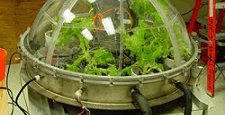
We designed a prototype of a functionable crop production system to be used both in space and on Mars. It is meant for plantation in those situations with simplicity, practicality and high level of autonomy. This solves the challenge by implying a sustainable system where plants can be grown in space with simple requirements and less manual interference. We believe that through our system, we can plant crops for the astronauts and space travelers, which adds more elements to their meals and even contributing for their psychological benefits. On Earth, the ambition of our system is to help those in harsh conditions such as drought and flood to grow edible growth to assist mankind survival.
Link to Project "Demo"
Link to Final Project
Detailed Project Description
4 mins presentation video: https://www.youtube.com/watch?v=IkeBH5awz4o

Our project is used to plant crops in space to provide healthy fresh food for astronauts.
What it does
It provides a suitable environment for the plant to grow by meeting all living requirements of plants.
How it works
- Full spectrum led light: Provides the full spectrum of visible light that is needed by plants to carry out photosynthesis and growth. Besides that, it can generate ultraviolet lights to provide sanitation so the vegetables grown are not infected by bacteria and can be consumed safely.
- PONDS(Passive Orbital Nutrient Delivery System): Provides the growing medium of crops with reusable synthetic soil. PONDS system consists of a small water reservoir, the crops are watered automatically by the means of diffusion. When the soil lacks water, water from the reservoir gets into the soil through diffusion.
- AWG system ( Atmospheric water generator): Extracts the water transpired by the crops before opening the system so that water is not lost to the surrounding.
- The Bio-KESsystem: Converts the ethylene produced by the plants into carbon dioxide, and also recirculates the carbon dioxide produced by astronauts, achieving maximum production carbon dioxide supply to plants.
- The Control Panel consists of various control systems such as timer switch, temperature sensor and humidity sensor. Helps in maintaining the system in regular condition. -Timer switch: Used to switch the full spectrum led light on or off at preset timing, such as on at day and off at night). When the temperature is too high, the air fan will turn on automatically. -Humidity sensor and -Temperature sensor: Used to detect humidity level and temperature inside the system which helps users to monitor condition inside the system.
- Soft rubber valve: Acts as the port to connect crop production systems with either AWG or Bio-Kes system when necessary in use.
- Temperature control fan: Used to regulate the system temperature. When temperature reaches a certain level , the air fan is turned on automatically and operates continuously until the system returns to regular temperature.
- Lead shielded layer of system: Blocks the ultraviolet (UV) radiation and charged particles from entering due to Galactic Cosmic Rays and events such as solar particle events and low secondary radiation due to interactions between radiation and the shield material.
- Aerogel layer: Good heat insulator which limits the heat transfer between system and surrounding,to prevent sudden increase or decrease in temperature.
- Dome shaped system roof: Able to converge the light from both sun and full spectrum led light so that the plants can absorb maximum light energy for photosynthesis.
- Luggage shaped storage: Used to store AWG and Bio-Kes systems when they are not in use. There are also wheels to provide greater mobility.
Benefits
- Maintaining health of astronauts
- In early space exploration missions, astronauts consume nutrients from pre-packaged food and tablets. But there would be problems such as expiration of food during a long space transit mission. With our crop production system, astronauts may grow vegetables in the spaceship and they can have a constant and steady supply of nutrients. This maintains the astronaut’s health, preventing diseases such as scurvy and sepsis.
2. Saving space
- There is limited space in a spaceship, as they must carry equipment in it for research purposes. By using our crop production system, astronauts can now pack seeds and grow them in a spaceship, which can save a lot of space as seeds are small.
3. Keep our astronauts happy
- Pre-packaged space food is often wet food, where most astronauts say it tastes like stale bread. Vegetables can provide the crunchy texture that most would crave for. Having fresh food can also boost the crew member’s morale, maintaining their mental health.
4. What do we hope to achieve
- We wish our crop production system can be used in spaceships to plant fresh and delicious vegetables that are able to maintain the health of crew members. Not only that, saving space can also provide a more comfortable working space to our astronauts, and also make them feel not so distant from Earth. We also hope that our crop production system may help in time of need, or even colonize Mars when modified into a large crop production system.
Space Agency Data
Generally, we get our data from NASA and many other sources. We appreciate all the precious articles published by them. The open data really helps us a lot.
Some of the sources of space agency data we used include, but not limited to, NASA Veggie Project, NASA Advanced Plant Habitat, NASA PONDS (Planetary Orbital Nutrient Delivery System), International Space Station, NASA PESTO (Photosynthesis Experiment and System Testing and Operation), NASA Advanced AstrocultureTM.
Last but not least, the experiment results from the associations and agencies also demonstrate a lot more about the behavior of microbes and plants, properties of materials and so on, enabling us know more about the similarity and differences of growing plants in space and on Earth.
Hackathon Journey
It's the first time for all of us to take part in a hackathon. All of us have gone through thick and thin together. Thankfully, all the issues managed to be solved before the event officially launched. All of us were cheerful when we have unanimous decision on the topic and content selection.
The inspiration for our team to choose this challenge is by the relativeness of providing food source to our daily life. Furthermore, we are grateful to have a opportunity to explore more about space travel.
Our approach in the project development is by divide and conquer. All of us tried our best to contribute our individual opinions on the project. We experienced conflicts due to our different opinions but reconciled and put our differences aside, and that is life for you. Then, we had our discussion to identify the pros and cons of each designing elements. Last but not least, we incorporate all of our ideas to form our united solution.
Throughout the whole hackathon journey, the greatest thing we have learned is to never give up in exploring knowledge beyond our current field of study. For students like us, space sounds rather disconnected to us. After joining the hackathon, we have a brand new acknowledgement of the universe. Eventually, we developed our interest to know more for aerospace scientific study.
In sum, we would like to express our gratitude to all the teammates that cooperated to produce a prototype after spending countless hours doing research. Not to be forgotten, a massive thank you to the event organizing team and all the space agencies that provides the opportunity and tools to realize our dreams of trying out new things.
References
1. https://2021.spaceappschallenge.org/challenges/statements/have-seeds-will-travel/details
2. https://dictionary.cambridge.org/dictionary/english/deployable
3. https://www.nationalgeographic.org/encyclopedia/crop/
4. https://dictionary.cambridge.org/dictionary/english/transit
5. https://image.gsfc.nasa.gov/poetry/venus/q2811.html
6. https://www.issnationallab.org/iss360/nasas-iss-research-summary-week-of-september-25-2017/
7. https://www.nasa.gov/content/growing-plants-in-space
8. https://www.nasa.gov/sites/default/files/atoms/files/advanced-plant-habitat.pdf
9. https://www.youtube.com/watch?v=lM3uaR0dltQ&t=2s
10. https://stats.oecd.org/glossary/detail.asp?ID=2408
11. https://www.nasa.gov/pdf/284275main_Radiation_HS_Mod3.pdf
12. https://www.nature.com/articles/s41598-017-01707-2/tables/3
13. http://www.shelter-dome.com/benefits-growing-food-under-dome-shaped-greenhouse/
15.https://www.nasa.gov/mission_pages/station/research/experiments/explorer/Investigation.html?#id=1159
16. https://www.nasa.gov/sites/default/files/atoms/files/veggie_fact_sheet_508.pdf
17. https://www.nasa.gov/feature/seed-film-brings-new-way-to-grow-plants-in-space
18. https://www.nasa.gov/sites/default/files/atoms/files/plant_habitat-04.pdf
19. https://www.merriam-webster.com/dictionary/irrigation
20. https://meridian.allenpress.com/jeh/article/10/2/63/79095/Arcillite-Effect-on-Chemical-and-Physical
21. https://ntrs.nasa.gov/api/citations/20110015824/downloads/20110015824.pdf
22. https://www.youtube.com/watch?v=YFdwv9yrxD0
23. https://www.nasa.gov/feature/the-shape-of-watering-plants-in-space
24.https://www.nasa.gov/mission_pages/station/research/experiments/explorer/Investigation.html?#id=7884
25.https://www.nasa.gov/mission_pages/station/research/experiments/explorer/Investigation.html?#id=7581
26.https://www.nasa.gov/mission_pages/station/research/experiments/explorer/Investigation.html?#id=215
28. https://images.nasa.gov/details-KSC-20200304-PH-NAS01_0001
29. https://techshot.com/aerospace/technology/ponds/
30. https://www.ekompany.eu/en/controlled-release-fertilizer-how-does-it-work/
31.https://www.gardeningknowhow.com/garden-how-to/soil-fertilizers/fertilizer-numbers-npk.htm
33.https://www.ledinside.com/news/2015/8/astronauts_sample_taste_space_grown_veggies_From_led_systems
34. https://www.youtube.com/watch?v=YFdwv9yrxD0
35. https://thecounter.org/vertical-farming-terroir-flavor-square-roots-kimbal-musk/
36. https://science.nasa.gov/science-news/science-at-nasa/2000/ast13nov_1
37. https://spinoff.nasa.gov/spinoff2001/er1.html
38.https://www.nasa.gov/mission_pages/station/research/experiments/explorer/Investigation.html?#id=20
39. https://www.elprocus.com/a-memoir-on-humidity-sensor/
40.https://www.nasa.gov/mission_pages/station/research/experiments/explorer/Facility.html?#id=2036
41. https://www.implexx.io/temperature/leaf-temperature-sensor/
42. http://indoorgrowzone.com/air-circulation-in-a-grow-room-and-its-benifits/
43. https://www.nasa.gov/smallsat-institute/sst-soa-2020/thermal-control
44.https://www.nasa.gov/mission_pages/station/research/experiments/explorer/Investigation.html?#id=598
46. https://mars.nasa.gov/all-about-mars/facts/
47. https://www.iea.org/reports/direct-air-capture
49. https://esharawater.com/blog/how-does-an-atmospheric-water-generator-work/
50. http://www.genaq.com/water/
Tags
#Have-seeds-will-travel #Space-travel #SpaceAppsSarawak #Miri #Senior
Global Judging
This project has been submitted for consideration during the Judging process.