Awards & Nominations
AstraSeed has received the following awards and nominations. Way to go!
Global Nominee

AstraSeed has received the following awards and nominations. Way to go!
As team AstraSeed, we have identified three main nutritional problems that astronauts face during their time in space, and as a solution to these problems, we have created a portable farming system called Viens. Below you can see the three main problems we identified:• Foods taken to space lose their vitamin and mineral values over time and cannot adequately meet their nutritional needs.• Lacking of adequate and optimum environment for agriculture in space.• As packaged foods lose their taste and freshness over time, the efficiency astronauts get from the food decreases.With our project, we are finding solutions to these problems.
According to the data from the space agencies such as NASA, we have seen that approximately 10,800 kilograms of food are needed to meet the needs of a team of 4-6 people on a trip to Mars and back. We believe that it would not be efficient to store so much food in spacecraft, that's when we started looking for ways to develop a sustainable and fast farming system. With the help of our project, which we named Viens, we are planning to produce an alternative solution for agriculture in space.
Viens is a versatile, easy-to-use device that can be adjusted by astronauts for light, heat, irrigation, etc. focused on cultivating multiple plant species. Before putting the plants in the device, there is a preparation phase. In this preparation stage, the plants are sprouted in another environment where they can go through the process of striking, and after this process, they are ready to be placed inside of our device. Liquid fertilizer or other supplements to the plant are added to a tank that is separate from the water tank. Immediately afterward, it is checked on the screen whether the conditions in the device are suitable. Factors such as the CO2 ratio and the temperature have great importance here. If there is a problem with our controls, necessary adjustments should be made using the control panel. After making sure that there is no problem, the device is ready for operation. The pump in the liquid tank provides a regular flow of liquid fertilizer and supporting material. Thanks to RGB LEDs, the plant gets the most efficient light it needs.
While creating our agricultural system, we had to take into account many negative aspects and minimize them. As we research, we have seen that there is not enough space in the rockets that we can use as big farming space, so we designed the portable farming system. We created the project in a way that we can get as many products as we can grow at once.
Considering that the mass capacity that spaceships can carry is also limited, we had to choose the materials light but effective such as aerogel and carbon fiber. In the same way, since the durability of these materials we use is higher than other materials, their maintenance would not be very troublesome. Thus, we have both reduced the mass of the system as much as possible and created a durable product.
The two of the most important issues that we had to consider in our project were gravity and water resources.
The limited water resources in space made us think a lot. At this point, we decided to design our product with the principles of hydroponic and aeroponic systems. According to our research, these systems use up to 98% less water than traditional soil farming systems. Another purpose of taking the hydroponic system as a basis is to conclude that it is more efficient to give the supplements to the plants from their roots, according to the researchers.
As a solution to the gravity problem in space, we used a pump system to both circulate the water and make sure that the water is transmitted to the roots. This way we avoided over-watering and made sure that the excess water was reused for the plants. In addition, we delivered fertilizer and other additional resources required for the growth of the plant in liquid form to the plants with this pump system. We have added a small tank to our project so that we can keep these supplements such as liquid fertilizers separate from the water tank.
Considering that plants need light to grow, we provided the light source for our project with RGB LED lights. As stated in the sources of space agencies such as NASA and ESA, it has been determined that there is an increase in the growth rate of plants at wavelengths between red and blue (preferably magenta). Considering this information, we preferred to use purple/magenta light, which is the most efficient light wavelength, in our project.
In the heat insulation and heating part, we placed the heater system in an environment where aerogel and carbon fiber materials are. Thus, we saved both heat and energy.
Thanks to the microcontroller and other sensors, we were able to constantly monitor the environment of the plant. In addition, we have developed a control panel system so that factors such as fertilizer, water, amount of light, and wavelength of light can be adjusted by astronauts.
Tools:
• Screwdriver
• Screws
• Drill
• Grinding Machine
Coding Languages:
• Python
Hardware:
• Aerogel
• Aluminum
• LCD Led Screen
• Pipes
• RGB LED
• CO2 Sensor
• (IR) Thermo Sensor
• Microcontroller
• Rasberry PI
Software:
• Arduino IDE
• SolidWorks
• SketchUp Pro
•While developing our project, the space agency that influenced us more than others was NASA. When we read about the previous experiments on NASA's website, we started to have ideas about what we can do. After some time talking about what we can do, we started to research aeroponic and hydroponic systems.
•We received information from NASA about previous plant growing experiments in space.
•We received information from NASA about the diet of astronauts and more information about the spacecraft. (Such as capacity, electricity resources, etc.)
•We received information from ESA about the Gravi-1 project and products suitable for growing in space.
On our journey to the Space Apps Challenge Hackathon, we learned not to give up. We had hard times, mostly because the hours we were active as a team did not match. As a result, we had to create a project in a shorter time than the time given to us. Despite this, we succeeded in local elimination with the right crisis management and task sharing. Since we had very little time, we had to pull an all-nighter. We were sleep-deprived, but we have wanted to participate in this Hackathon for a long time and the result we obtained shows that it was worth it.
The first day we formed our team, we were talking about which challenge we should choose. It took several elimination rounds before we could choose one of the twenty-eight challenges. In the end, we decided to choose the 'Have Seeds Will Travel' challenge, which we see as a more difficult and more important problem than the others.
On the way to reaching a solution, we first had to examine and analyze the difficulties. Then there was the stage of collecting information and the stage of evaluating the information. After a certain project was formed in our minds, we focused on the negative aspects of the project and thought of ways to fix it as much as we could.
Even though we had problems as a team, we worked hard on this project. All of our team members put a lot of effort into the project. First of all, I would like to congratulate my esteemed teammates and thank them all. Afterward, we would like to thank the esteemed NASA Space Apps Challenge creators and local leaders for bringing us together with such a Hackathon where we gained experience.
#farming, #seeds, #mechanics, #science, #biology, #space, #spaceappschallange
This project has been submitted for consideration during the Judging process.
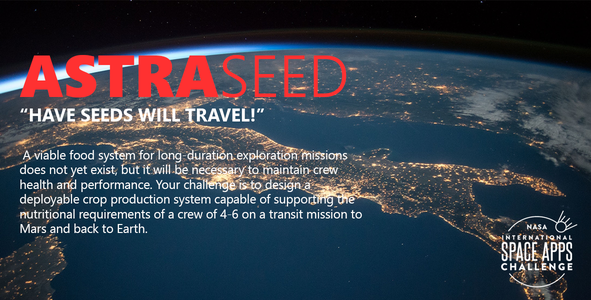
A viable food system for long-duration exploration missions does not yet exist, but it will be necessary to maintain crew health and performance. Your challenge is to design a deployable crop production system capable of supporting the nutritional requirements of a crew of 4-6 on a transit mission to Mars and back to Earth.