
High-Level Project Summary
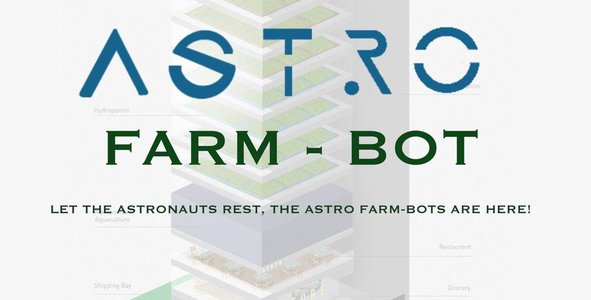
Our idea is to construct the first closed space farm that is controlled and managed by ground support experts using robots for sowing and harvesting. The farm will operate autonomously using artificial intelligence and without the interference of astronomers. The robot will be programmed to plant, monitor, inspect, and report about the plants periodically. Finally, according to the astronauts' need for minerals and vitamins the robots will plant the plants accordingly.
Link to Project "Demo"
Link to Final Project
Detailed Project Description
Our idea is to instruct and create the first closed space farm that is controlled and managed by ground support experts using robots for sowing and harvesting. The farm will travel with plants to Mars through a system that helps plants grow in an automated manner using artificial intelligence and without any interference from astronauts, The robot will be programmed to grow plants and provide them with the necessary food at the specified times
The robot will be designed with two ROBO-ARMS that will help him harvest the planted seeds and veggies that will get the needed heat and light from led lights placed on certain places all over the farm.
It also uses artificial intelligence to predict the percentage of the astronauts' need for proteins and minerals by placing a scanner on the farm.
The scanner uses the barcode on the pre-packed foods to analyze the remaining percentage of minerals and nutrients left for The astronauts, and when it reaches a specific percentage (e.g. 70%) the bot starts to plant and harvest the plants and veggies that are rich with that mineral / protein.
The farm planting system has a storage space that is placed on the side part of the farm, following that with the help of pumps we will push the calcined clay to go sideways and through the pipes, and with the help of the injection system the clay will be able to go back to the main storage space, particularly in the recycling part.
After being recycled it will go back to the storage part, where the pipes will be blocked by a partition until the next need of clay and will only flow through the pipes again when the bot commands it to.
Using the data given from NASA, we will be using seeds that are embedded to a tape or film to allow them to travel independently.
The tapes will be stored in the bottom part of the farm, and placed on the planting stream by the bots.
Our project will benefit astronauts in way that will help them focus more on their main researches and reports, as where the farm reports will automatically be synced to the ground support experts on earth by using the AI device.
We hope to achieve a sustainable, fully independent and autonomous farming system which is fully operated by robots and artificial intelligence, also using a barcode scanning device to analyze the remaining percentage of minerals and nutrients left for The astronauts by scanning the pre-packed foods, and when it reaches a specific percentage (e.g. 70%) the bot starts to plant and harvest the plants and veggies that are rich with that mineral / protein.
Furthermore, we will be using the following devices:
⁃ AI
⁃ Barcode scanning device
⁃ Robo-Arms
⁃ Clay Pumping device
⁃ Clay Storage / recycling space
⁃ Pipes and partitions
⁃ Handle
⁃ Led lights
Future plans are to minimize the size of the farm, Increase production efficiency and use less energy.
Space Agency Data
We used the following data to study how Nasa is trying to plant in the space.
we studied the materials to be used in the space to help plant the veggies and all types of plants.
These data inspired us by helping us visualize and refine our thoughts to come up with an innovative solution
Hackathon Journey
The experience was rich in information about planting in space. we learned that there is always a solution to any problem no matter how complicated it might seem. and with team work, anything problem can be solved.
What inspired your team to choose this challenge? We wanted to help the astronauts to have a safe travel to Mars with an planting system fully of nutrients they need. we searched for the root problem and tried to find the best approach to solve the proble. by teamwork and a lot or research.
References
- (2021). Retrieved 1 October 2021, from https://www.nasa.gov/sites/default/files/atoms/files/advanced-plant-habitat.pdf
- Growing healthy food in space and in remote areas. (2021). Retrieved 1 October 2021, from https://asc-csa.gc.ca/eng/sciences/food-production/growing-healthy-food-in-space-and-remote-areas.asp
- (2021). Retrieved 2 October 2021, from https://images.nasa.gov/details-KSC-20160321-PH-KLS01_0006
- (2021). Retrieved 2 October 2021, from https://images.nasa.gov/details-KSC-20200121-PH-KLS01_0078
- (2021). Retrieved 2 October 2021, from https://www.nasa.gov/sites/default/files/atoms/files/veggie_fact_sheet_508.pdf
Eating in Space. (2021). Retrieved 2 October 2021, from https://www.nasa.gov/audience/foreducators/stem-on-station/ditl_eating
Tags
#Space, #Agriculture, #Farming, #Sowing, #harvesting, #Plant_Pillow, #Colonization, #Bots, #Viggies, #Planting, #Food, #Astronaut, #Nutrients, #Future
Global Judging
This project has been submitted for consideration during the Judging process.