Awards & Nominations
Cosmic Soil has received the following awards and nominations. Way to go!
Global Nominee

Cosmic Soil has received the following awards and nominations. Way to go!
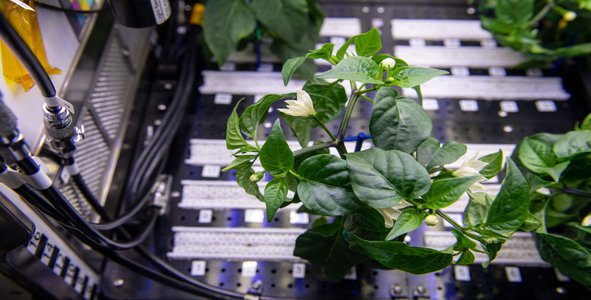
Growing vegetables in space is possible. We know that from Veggie. During VEG-01 3 out 6 plant pillows were harvested and good to eat. But this isn’t enough for a mission to mars. We think we have found the solution. With this solution we will be able to grow more vegetables and grow more varieties.Developing a highly modular and customizable approach to growing food in space. We focus on an easy to setup module that also takes up minmal space while stored through the use of a inflateble enclosure. Other key aspects include ease of use, reusability and relibility.
On a journey to the red planet the strongly limited volume inside a spacecraft will be one of the hardest challenges for the engineers as well as the crewn on board to deal with, so when designing our plant growth module we made sure to minimize the use of space while it's in storage but didn't want to give up on the advantages of a closed, controlled and well thermoly insolated enviourment. So we decided to incooperate an inflatebale enclosre. Now that's why, but how does it actually work? The enclosure consits out of 5 indivudal panels where each pannel is constructed from a clear plastic foil that forms double walled pockets, which when inflated are strong enough to keep their shape, in microgravity as well as in partial gravity like here on earth, the moon or mars. You probably are familiar with that concept already because this is basicly the same way an airmatress works.


While the edges between the back, side an top panels are firmly melted together during production to form an air tight seal and hold the panels together, the method of holding the bottum edges to the base is equally simple and functional: It's a clasp locker or better known as a zipper. This results in a seal thats thight enough to change CO2 levels inside the CosmicSoil Growth Modul (CSGM) while beeing extremly fast and reliable to setup.
Working in Zero-G is not easy. Stuff floats away, dirt doesn't settle on the floor and water is most definitely not an abundance. As a result accessibility is a key feature. Not only can the front side of the enclosure be folded up after the 3 edges surrounding the front panel are just unzipped but the whole tray can be removed to be worked on. For this it's as easy as turning the 4 restrainer by 90° and lifting the tray straight up.
 However that’s not the end we also made sure that the mounting points for mounting the CSGM to the ship and connectors are easy to reach as well. The mounting points are behind the tray making them easy to work on by just removing the tray. And the connectors, which will allow the transfer of water, electricity and potentially Air/CO2, are located on the right hand side for a seamless installation.
This system was designed with modularity in mind. Each CosmicSoil Growth Module features a 6,000cm² tray and 250Liter of sealed of volume for plants to grow. So you don’t have to commit on going all the way from the start. As more space gets available you can start for example with setting up only 1 or 2 CSGMs. And as time goes on increase that number. All of this is of course only possible through the small packing volume, which allows easy storage of the modules.
The Base as we like to call it is the central part of our CosmicSoil Growth Module. It houses all the essaintal systems to keep the plants alive without continuous supervision by the crew. This way production can be maximised.
Here is what’s inside:

Did you know that most operating systems have built in 3d viewers nowadays?! So just download the stl or obj file to view them.
You want to improve the idea? Sure! We included the fusion file as well so you can make changes to your liking without starting from scratch. (A Fusion360 license is required, but there is a free one)
You can also find all the pictures and copys of the demo and final project here:
https://github.com/g2721/CosmicSoil
By having a number of modules we hope that this will give the ability to grow more vegetables whilst being able to control the factors required for growth and maximising yield.
We have selected 5 vegetables that will benefit astronauts travel to Mars. This is based on several factors:
Growing a wider variety of vegetables will provide astronauts the nutritional requirement they need. Having 5 vegetables such as: Kale, Spinach, Lettuce, Sweet potatoes, and Cabbage can give astronauts the nutrition required. From 17 essential Vitamins and Minerals over 75% of them can be achieved using just the vegetables on their own.
Using a 120cm x 60cm x 15cm growing tray we will have an area of 7200cm^2. Below shows approximately how many can be grown if there was one type of plant in one growing tray:
The statistics below is an approximate calculation of how much 1 person requires to have one portion of vegetables:
Using the above data for a 2-month period the following amount would need to be grown for the crew:
Data covering 2 months was used as 4/5 of the plants would take approximately 2 months to fully grow.
The number of modules required altogether would be approximately 15, that is if all the vegetables were grown. Kale being the plant requiring the most number of modules.
However, if Kale was removed this would this would bring the number of modules required to approximately 9.
This would require the following amount of water (over 2-month period):
TOTAL WATER = 6,551 mL
Kale = 26,000 µmols
Lettuce = 7,000 µmols
Cabbage = 3,000 µmols
Spinach = 26,000 µmols
Sweet potato = 13,000 µmols
TOTAL LIGHT = 75,000
During the design process we incorporated as much knowledge from previous experiments as possible. Most of the data that is currently available comes from the Advanced Habitation Module and VEGGIE. Both generated invaluable data which is not only the foundation for our proposal but for a Mission to Mars itself. For more information on which specific sources were used, check out the references.
It has been a fun and challenging experience, where we all have got to meet individuals from various backgrounds.
That having a variety of people who are good in their own unique skills has really made this Space Apps challenge more of a reality in a very short amount of time.
We all were and still are inspired by Space. A crewed mission to mars still seems like a fantasy. But we would like to be individuals who in years to come want to look back at this challenge and know that we contributed on helping mankind expand into the Universe.
Our ideas were based of existing projects and data currently present. We then thought about how these systems could be improved so they can be used on all space missions.
At the start of the challenge we set some rules in order to promote inclusivity. We would not judge others ideas but give them the opportunity to express their ideas. Later on when it came to focussing on specific tasks we reminded team members that this is our goal and we agreed on this when we had our discussions. This was done in a professional manner.
The whole team has done a brilliant job. Thank you to all the team members that have helped in this challenge. And of course our amazing local leads.
#CosmicSoil
This project has been submitted for consideration during the Judging process.