
High-Level Project Summary
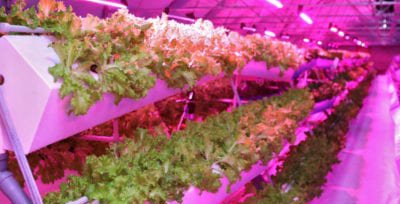
We developed an aeroponic based foldable and deployable crop production system. which acquires a small amount of space and at the same time it's able to cater to the nutrition requirements of a crew of 4 members. This system meets requirements of crop production in both micro gravity and partial gravity and as an added benefit all the chambers are made out of radiation protective and chemically stable materials. This has two special CO2 refill methods (zeolite, Lithium Hydroxide Canisters). The system is controlled with basic thermal sensors along with added humidity, EC Sensor , pH and water level sensors, which will benefit the process of monitoring.
Link to Project "Demo"
Link to Final Project
Detailed Project Description
During long duration missions (3 years), astronauts need sufficient nutrition for their daily requirements. The packaged foods do not meet the adequate supply of nutrition to the astronauts. And also it can't be stored for long time. As a solution for that, we have designed an efficient deployable crop production.
- This is catering to the nutritional requirements of a crew of four members on long duration space missions.
- The foldable structure and light weight of the system has provided answers to the stowage problem in space crafts.

- There is no suitable environment in a space and limitation in storage, so we can't use sunlight, soil and other stuffs as we use in Earth.
- Therefore this is an aeroponic based crop production system, which proves to reduce water usage by 98 percent. And
aeroponic systems have shown higher nutrient, vitamin and mineral uptake.
- This system works even in microgravity and partial gravity conditions.

- There are nine chambers in each set which is inter-connected via a foldable tube. This can be arranged in the way you want, either horizontally or vertically or even in any other manner. The upper part of a chamber is made out of polyethylene and the bottom part(base) is made out of stainless steel. Polyethylene consists of more hydrogen atoms, therefore it is radiation protective. And also polyethylene is chemically stable and anti-toxic material.
- The nutrient solution is being pumped by a motor creating enough pressure for the nutrition enriched water to go up in the tubes. Here we use a mechanism called high pressure aeroponic (HPA). The closed nutrition reservoir contains the nutrient solution is anti-corrosive.
- Inside a chamber there are several seed holders made out of polyester that will carry the seeds.
- When the nutrient solution enters the chamber, it is misted through mist nozzles(5 to 50 microns) to the base of the seed holders( or the roots).Likewise the nutrient solution goes in a loop through every chamber and finally back to the supply tank.
 Every chamber has an attached system of LED lights(blue and red) , temperature, CO2, light intensity and humidity sensors inside. In the nutrition reservoir( outside the chambers) are the pH and water level sensors which will be controlled by an automated monitor system.
- The amount of water dispersed in the reservoir is controlled by a repeat cycle timer. This can be done by two methods :
- Misting for 5 minutes and off for 5 minutes.
- Misting for 15seconds and off for 5minutes.
- Over misting will lead to rotting of root system and finally the death of entire crop.
- This system carries four types of plants
kale
Lettuce
Soybean
Strawberry


- Therefore one set which consists of nine chambers is enough to complete the food requirements of four astronauts.
- Because we can harvest and plant again in the same chambers.
- As an option, we could burrow another set of chambers since the storage volume is less.
- CO2 can be refilled by the method zeolite.
- Exhaled CO2 can be converted to O2 again by lithium hydroxide method.
- The polyethylene cover can be removed when cleaning the chamber.
- Aluminium containers can be used to store the seeds.
Space Agency Data
https://www.youtube.com/watch?v=lM3uaR0dltQ&list=PL37Yhb2zout05pUjr7OoRFpTNroq_wd9f&index=8
https://www.nasa.gov/content/growing-plants-in-space
https://www.nasa.gov/sites/default/files/atoms/files/veggie_fact_sheet_508.pdf
https://www.nasa.gov/sites/default/files/atoms/files/advanced-plant-habitat.pdf
We have gone through those links to get the idea of crop production system.
The concept Veggie was helpful for us to understand the theory and to get further ideas.
Hackathon Journey
- All the members in our team is participating for the very first time in NASA space apps challenge.
- Together with a 12 year youngster, and a bunch of college students it has been a ride of roller coaster. Despite the age differences we have helped each other in the process of overcoming the challenge.
- Communicating our ideas with each other, respecting the opinion of fellow team members, navigating through the guidance of the senior members and above all learning through the failed attempts were some of the important things we learned.
- An article that was published on a kids paper few years back, about the future of space and food inspired me to further explore the possibilities and push the boundaries a little bit further.
- Starting off with the challenge topic, the first step of mapping our way to the solution was finding answers to the question of deployable crop production system with low stowage space.
- And the answer was inspired by folding techniques of origami that we learned as kids.
References
https://www.youtube.com/watch?v=lM3uaR0dltQ&list=PL37Yhb2zout05pUjr7OoRFpTNroq_wd9f&index=8
https://www.nasa.gov/content/growing-plants-in-space
https://www.nasa.gov/sites/default/files/atoms/files/veggie_fact_sheet_508.pdf
https://www.nasa.gov/sites/default/files/atoms/files/advanced-plant-habitat.pdf
Tags
#seeds #plants #crop production #polyethylene #space #astronauts #microgravity #partialgravity #growth chambers #sensors #agriculture
Global Judging
This project has been submitted for consideration during the Judging process.