Awards & Nominations
Green.com has received the following awards and nominations. Way to go!
Global Nominee

Green.com has received the following awards and nominations. Way to go!
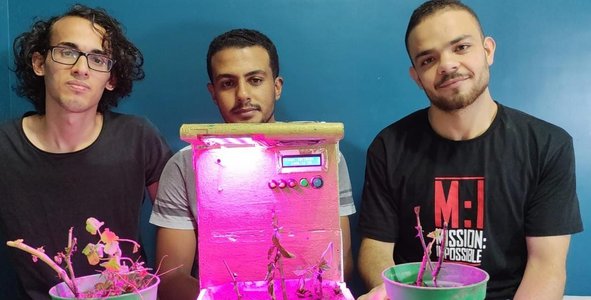
This project is an artificial simulation of plants’ natural environment which will facilitate cultivating these plants in any environment, even in space!Our project depend on a lot of factors:Lighting : we control lighting through RTC to control time, or through a DR, or by using the potentiometer.The soil humidity : we use a soil sensor to detect the soil humidity level and the watering pump act accordingly.Temperature : we use a temperature sensor to determine the temperature degree and use the vent fan to control it.I believe this project will be of great benefit to space journeys.
The project is artificial lighting for plants in red and blue because the plant needs the wavelength of red and blue light for the photosynthesis process
The lighting is controlled by the desired operating time and the desired extinguishing time as the plant needs darkness to rest and breathe, so the light is turned on for about 12 hours. And the light is controlled by an LDR that senses the surrounding environment so that if there is actual light, the artificial light will be turned off.
Another way is using a potentiator that acts as a voltage divider, according to its degree. The degree of illumination intensity of the LEDs changes.

Through the temperature and humidity sensor, the ventilation fan is controlled so that if it exceeds 30 degrees Celsius, the plants are ventilated or the fan is controlled by a potentiometer according to the degree of change, the intensity of the fan changes.

Through the soil sensor, the degree of soil moisture is known, and if it is dry, the pump works to irrigate the plant

There is a sensor in the water tank to know the water level in it, and when the water level decreases, an alarm works and the sound ends when the water is filled again

The timing is displayed on the LCD screen in the first row, and if the pump, fan or LED is turned on, an alert will be displayed on the second row of the screen.
When you press the push button, the values of each sensor are displayed in succession in the first row of the screen, and when finished, the timing is displayed

A circuit was made to feed the sensors and all parts of the project with electricity (5v, 12v, GND)


https://www.nasa.gov/content/growing-plants-in-space
My team and I faced some problems, including designing the appropriate model for the project, because we were unable to devise a shape that suits all sizes of plant growth from small to large, and the problem of water leakage and insulation, and making the electronic circuits in a safe place away from the risk of water leakage if it happened. And we designed the project with what we have available from simple pieces of wood
Among those problems, we also met in the programming of the project, such as the RTC programming, as we faced great difficulty in programming and adjusting the time correctly, to control the irrigation time and turn on the lighting for the plant.
Also, the problem of LDR, we faced a problem in adjusting the photosensitive sensitivity in the correct way that the plant needs
But our biggest problems and fears are the lack of time. The project we worked on needed a little more time to get the best results.
In this project, we learned how to search for information from more than one source and to benefit as much as possible from any information provided to you
Work under pressure and lack of time and come out with satisfactory results for all
https://www.nasa.gov/content/growing-plants-in-space
#arduino #plant #hardware #water #vertical_farming
This project has been submitted for consideration during the Judging process.