
High-Level Project Summary
We focused on the phrase “The things that the astronauts miss out are the textures of the food, the crunchiness of things like lettuce and typical salads” in the challenge video. To solve this problem, we created GENeSi,which stands for "Globular Ecosystem Near Spaceship":the salad bar for astronauts. We developed an automatic crop system, protected by radiations using water, plastic materials and aerogel; water is provided by a recycling system and lights are the efficient LEDs.This system can be useful during the journey to and on Mars. It is important because it provides astronauts a varied power supply and can be replicated during other missions; it uses eco-friendly technologies.
Link to Project "Demo"
Link to Final Project
Detailed Project Description
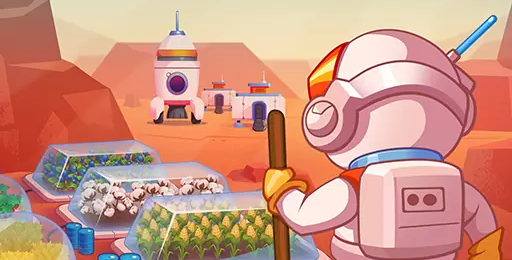
Astronauts bring the seeds with them in space and, during a long journey, they let the seeds sprout in a system of led and carts inside the spaceship, similar to the Veggie system created by the NASA. Once the astronauts lend on the planet, they install the external semi-globe which is a fully automated plant growth facility: inside it, there is a tree-shaped guide to allow the transportation of the carts with the plants from the spaceship to the ends of the branches.
The structure is characterized by 2 semi-spheres one inside the other: between the 2 spheres a pump inserts the water needed to protect the plants from the radiations. The upper estimate for a dose received by unshielded astronauts outside the magnetic field of the Earth, as in a mission to Mars, is about 10 R/hour, so, to reduce this level to lower than Earth background radiation, a 1 meter thick layer of water is required. It is possible to use the urine of the astronauts, which is rich of water, to fill the space between the 2 semi-spheres and, considering a crew made up of 5 people, we estimated that 8-9 months would be required to collect the amount of urine required for this purpose.
In reality, in order to reduce the needed amount of water or urine, we thought about using plastic and superconducting materials to produce a magnetic shield able to deflect cosmic rays.
As for the material, we chose aerogel which is an optimal thermal insulator and which can be made so thin to become an elastic material that can be stored in a very easy way and can be inflated on the planet. Besides, to avoid wastes in terms of material and space, the carts used in the system on board the spaceship are the same used in the external system and the other parts of the onboard system can be easily folded and stored to be used again.
In addition, all the pre-packaged food needed for the astronauts' nutritional necessity can be made from materials to be used as fertiliser for cultivation, in addition to compost.
The entire growing environment is monitored by a system of sensors that control lighting, humidity, CO₂ and temperature.
The on-board lighting system uses LED technology, while once on the Martian surface the lighting is also supported by solar light transport via fibre optics and an antenna positioned outside the globes.
Temperature control uses the technology already used in JSK's greenhouses on Earth, which draws in air from above and, depending on the required temperature, cools, heats and dehumidifies it; the air is then returned to the environment.
Irrigation is based on a system of water recirculation: the water is used to irrigate the plants and, thanks to the fact that the semisphere is a closed ecosystem and the transpiration of plants is of the 95% of the absorbed water. Considering radish,rocket or arugula and considering 12 carriages in each dome with 12 plants in each carriage, we estimated that the need amount of water to irrigate the plants is 7.53 l.
Our idea would have a huge impact on both (experimental or scientific) and commercial space missions in particular in this epoch when we hear more and more talking about the colonization of planets like Mars and the cislunar city. Obviously it is impossible to think about living an ordinary life in space eating only prepacked food and this is why our project could be really useful; it also has a positive impact on astronauts' psychology, they can spend their time for crop and find other living beings in the outer space!
The possible improvements for the future could be:
- targeted studies for the materials in order to realize an elastic structure like thin aerogel with also good capabilities to deflect cosmic rays;
- finding a new way to use the Martian atmosphere like producing water in loco;
- using the Martian soil with their nutrients for the growth of plants;
- analysing the specific plants which carry more nutrients and can survive in the GENESI environment.
The software used during the development of the project were:
- Catia for the creation of the 3-dimensional assets such as the carts or the shelves
- Blender for the rendering of the animation presented in the demo
- Adobe Premiere for the post-rendering improvements such as the insertion of some texts during the animation
Space Agency Data
NASA's sources about "Veggie" and "A.P.H." were a nice start point: we understood which technologies had already been developed and studied materials,Martian conditions and had many brainstorming sessions focused on these sources. By reading the resources on the https://www.nasa.gov/ we noticed that different technologies already exist, so we have searched for a way to merge them. We have been searching for them from NASA,ESA but we have also found important information about Martian soil.
Hackathon Journey
Our Space Apps experience was amusing and engaging: we worked as a team and focused on the project, making mistakes and overcoming all the obstacles together-unity is strength! We all are Aerospace Engineering students, working together is an essential skill because humans need everyone's contribution to face problems, different points of view mean a complete global vision.
Many of us had already took part to the Hackathon (2019 and 2020 editions) ,we love adrenalin: we seek solutions in a short time. We chose this challenge because we all are fascinated by the colonization of Mars, but we need to understand how to reach this purpose if we want to become an interplanetary species; after a brainstorming session, we noticed that the same technologies can be used on our Planet (for example, the light sensors) or on the Moon-our lunar companion : mission to Mars was more challenging, moreover all those technologies developed on Mars can be used on the Moon. We are young students sensible to our species and the future of Earth.
We split into groups : some studied the hard conditions on Mars and thought how to realize the crop system, according to the laws of physics; some drew the system and how it could be placed on Mars. These groups were not separated, but indispensable for each other.
We resolved setbacks comparing ourselves, looking for sources (books,net) and combining our knowledge: big problems are decomposed in little problems,solved one at a time- the so-called top-down approach.
References
https://www.koppertcress.com/it/travel-stories/innovatieve-kas
https://www.nasa.gov/sites/default/files/atoms/files/veggie_fact_sheet_508.pdf
https://www.nasa.gov/sites/default/files/atoms/files/advanced-plant-habitat.pdf
https://www.nasa.gov/feature/goddard/real-martians-how-to-protect-astronauts-from-space-radiation-on-mars
https://www.esa.int/Science_Exploration/Human_and_Robotic_Exploration/Exploration/Mars
https://knepublishing.com/index.php/KnE-Energy/article/view/358/955
https://www.nasa.gov/press-release/nasa-releases-plan-outlining-next-steps-in-the-journey-to-mars
https://www.cnet.com/news/nasa-upgrading-iss-system-that-turns-astronaut-pee-into-drinking-water/
https://llis.nasa.gov/lesson/881
https://www.nasa.gov/pdf/143163main_Space.Food.and.Nutrition.pdf
https://www.nasa.gov/feature/goddard/2019/how-nasa-protects-astronauts-from-space-radiation-at-moon-mars-solar-cosmic-rays
https://www.sciencedirect.com/science/article/pii/S1110982321000016
https://www.nasa.gov/topics/technology/features/aerogels.html
https://www.nasa.gov/audience/forstudents/postsecondary/features/F_Food_for_Space_Flight.html
https://www.nasa.gov/vision/space/travelinginspace/25aug_plasticspaceships.html
https://www.sciencedaily.com/terms/evapotranspiration.htm
https://www.koppertcress.com/it/travel-stories/innovatieve-kas
Tags
#Mars #green #automation #interplanetary #economicimpact
Global Judging
This project has been submitted for consideration during the Judging process.