
High-Level Project Summary
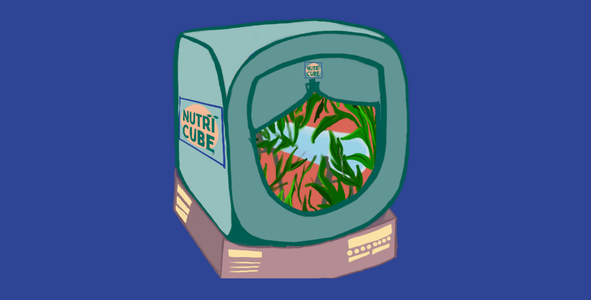
We designed a stowable and stackable semi-closed looped system for growing vegetables and mushrooms, which will provide key nutrients and protein to crew members during their long-duration exploration missions. NutriCube is a packed kit that’s easy-to-install and would include a maintenance guide for astronauts. As packaged foods are consumed, and space availability increases, there is opportunity for NutriCube gardens to be installed.
Link to Project "Demo"
Link to Final Project
Detailed Project Description
NutriCube is a packed kit that comes in a form of a tray, and can be installed easily. In addition to this design benefiting the astronauts on their missions, this can be a deployable kit for those on earth where climate change is affecting crop production. We want to propose a viable solution to this challenge, which can move on to the research and testing phase.
*How it works:
- Base Components
The base design fulfills two main purposes. The first is storage. Prior to utilization, all of the various components are collapsed and stored in the base assembly. Internally, the base itself is planned to house the Nutri-Cube control system including power distribution and injector automation. Once constructed, sensors will be able to be monitored, fans speed controlled, and water distributed, all externally from the base.
- Air Distribution
The air distribution system is intended to provide a cycle of continuous airflow in order to prevent stagnated gases, tackle excess moisture capture, aerate both leaves and root systems, and mitigate any excess heat from the bulb assembly or sensor package. As previously shown, the main structure of the Nutri-Cube is built on the idea of growing inward, and utilizing a 3-D space in a microgravity environment. A fan assembly would move air through the cylindrical section and over the LED bulb, to a moisture capture plate, to cycle back around the root system and water distribution network, back into its starting position. Relative to the system access location, these fan assemblies would be part of the forward and aft support structure in order to provide continuous airflow.
- Water Distribution
The water distribution system will be based on an injector assembly with tubing, locking mechanisms, and bladders including a reservoir bladder. Starting from the reservoir bladder, the connecting tube to the injector piston is unlocked, fluid is drawn into the injector, then the connecting tube is locked. Pathways to the selected plant rack bladder are unlocked to fill or replenish one at time. This plant rack bladder would interact directly with the constructed plant racks similar to the Plant Water Management (PWM) hydroponic methodology tested on the ISS. This bladder section would then be monitored for Ph levels, Total Dissolved Solids (TDS), and Electrical Conductivity (EC).
- Control System
Sensors included throughout the inside of the NutriCube would allow a Control System to help determine automatic functions. This would range from internal humidity, temperature, and airflow, to soil moisture content and water nutrient levels. While controls would be provided on the base, the idea would be to automate functions where able.
*Tools and software:
- With regards to resources and tools available to assist in the development of this design, we have used Canva, Procreate, and Photoshop in order organize ideas, and showcase our design.
- If selected for future development, a CAD suite such as SolidWorks would be utilized to ensure design feasibility.
Space Agency Data
- Much of the knowledge gained from NASA resources used for this project had to do with learning about what farming systems currently exist, and learning the effects of fluid dynamics in a microgravity environment. The resources listed on the NASA Space App Challenge page for ‘Have Seeds Will Travel’ were crucial to understanding conceptual information. Additionally, much of the information regarding exploration of fluid dynamics concepts on various NASA webpages were able to concisely express the difficulties in microgravity design.
- Specifically, the NASA page on ‘How Do You Water Plants in Space?’ page which discussed omni-gravitational hydroponics and the ‘Water in Space: How Does Water Behave in Outer Space?’ page from USGS were both utilized to understand the properties necessary for a water distribution network.
Hackathon Journey
The Space Apps experience showed us that with open source data, creativity, innovation, and collaboration, we can bring together new ideas to solve challenges that seem otherwise impossible. Our team is made up of creatives, builders, farmers, engineers, and space enthusiasts. We first approached the challenge with creativity--we thought of the abstract design of what it could look like and how it could be stowable. Then, we started getting into the logistics and science aspect of the flow. We had a lot of questions we did not have answers to, but thanks to the common questions and answers in the Subject Matter Expert chatrooms, we were able to work it out.
- Mandy would like to thank The Urban Wild program for the agriculture technology knowledge and inspiration.
- Kiera would like to thank Katelyn Hertel (local lead) for assisting in team formation.
References
Resources:
- “Advanced Plant Habitat.” Edited by Kirt Costello , NASA, NASA, https://www.nasa.gov/mission_pages/station/research/experiments/explorer/Facility.html#id=2036.
- “ECLSS.” Edited by Lee Mohon, NASA, NASA, 10 Mar. 2020, https://www.nasa.gov/centers/marshall/history/eclss.html.
- Environmental Control and Life Support System (ECLSS), NASA, 23 Aug. 2017. https://www.nasa.gov/sites/default/files/atoms/files/g-281237_eclss_0.pdf. Accessed 3 Oct. 2021.
- “Growing Plants in Space.” Edited by Anna Heiney, NASA, NASA, 12 July 2021, https://www.nasa.gov/content/growing-plants-in-space.
- Johnson, Michael. “Giving Roots and Shoots Their Space: The Advanced Plant Habitat.” NASA, NASA, 10 Apr. 2018, https://www.nasa.gov/mission_pages/station/research/Giving_Roots_and_Shoots_Their_Space_APH.
- Monje, Oscar, et al. “Hardware Validation of the Advanced Plant Habitat on ISS: Canopy Photosynthesis in Reduced Gravity.” Frontiers in Plant Science, vol. 11, 2020, https://doi.org/10.3389/fpls.2020.00673.
- Novikova, N. D. “Review of the Knowledge of Microbial Contamination of the Russian Manned Spacecraft.” Microbial Ecology, vol. 47, no. 2, 2004, pp. 127–132., https://doi.org/10.1007/s00248-003-1055-2.
- Siceloff, Steven. “Recycling Water Is Not Just for Earth Anymore.” NASA, NASA, 23 Oct. 2010, https://www.nasa.gov/mission_pages/station/behindscenes/waterrecycler.html.
- United States, Congress, NASA. Advanced Plant Habitat Fact Sheet, NASA. https://www.nasa.gov/sites/default/files/atoms/files/advanced-plant-habitat.pdf. Accessed 3 Oct. 2021.
- United States, Congress, NASA. Veggie Fact Sheet, NASA. https://www.nasa.gov/sites/default/files/atoms/files/veggie_fact_sheet_508.pdf. Accessed 3 Oct. 2021.
- “Water in Space: How Does Water Behave in Outer Space?” Water in Space: How Does Water Behave in Outer Space?, NASA, https://www.usgs.gov/special-topic/water-science-school/science/water-space-how-does-water-behave-outer-space?qt-science_center_objects=0#qt-science_center_objects.
- Weislogel, Mark. “Q: How Do You Water Plants in Space? A: Omni-Gravitational Hydroponics.” NASA, NASA, 28 Sept. 2021, https://science.nasa.gov/technology/technology-highlights/how-do-you-water-plants-in-space.
- Zabel, P., et al. “Review and Analysis of over 40 Years of Space Plant Growth Systems.” Life Sciences in Space Research, vol. 10, Aug. 2016, pp. 1–16., https://doi.org/10.1016/j.lssr.2016.06.004.
Tags
#agriculture, #farming, #futureoffood, #water, #innovation
Global Judging
This project has been submitted for consideration during the Judging process.