
High-Level Project Summary
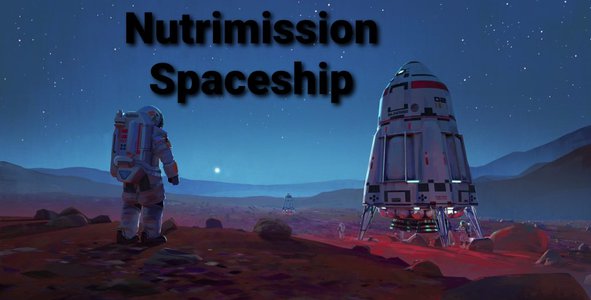
We developed a deployable system, inspired from the scissors lift mechanism, foldable while traveling to Mars, and expanded on-site. The concept of our system is to set up a hydroponic recovery drip system in a transparent collapsible shelter protected from radiation and in which the environment is similar to the one on earth. Our foldable greenhouse, planting mechanism, and equipment kit are lightweight, space-saving, and don't require much crew interaction. Furthermore, our system uses in-situ resources to produce the energy required by the electric components. Nutrimission will bring alongside fresh vegetables and vitamins, a mental and a physical performance boost for the crew.
Link to Project "Demo"
Link to Final Project
Detailed Project Description
Our system provides the optimal conditions for plants growth in extreme conditions where plants survival is impossible. Our main idea is to build an airtight greenhouse protected from radiation, and where temperature, moisture, percentages of O2 and CO2, and pressure will be optimal and controlled by the crew. But providing these conditions come with various challenges, that we overcame in our design: Support Design
- The idea of the project is to use the mechanism of a scissors lift as a solid support, due to the fact that this mechanism can be deployed into a compact shape when travelling to mars, and easily expanded on site
- The support is manufactured from hollowed aluminum, since aluminum has relatively low density compared to other metals, strong, and it is not affected by the Martian conditions
- A PVC pipe with holes along its length is placed between each two nodes of the scissors support to plant the seeds inside, since PVC is a polymer that has a low density and is not affected neither by UV light nor by dust
- The whole system (scissors support + PVC pipes) will be covered by a nylon transparent shield
- The shield, in its turn, is covered by thermal blankets from the outside for two reasons: limit the heat losses occurring between the inside of the greenhouse and the cold environment on mars, and reflect the radiation coming from the outside since this blanket is highly reflective
- Small areas are not covered by thermal blankets, so the growth area can still be visible for the crew through the transparent shield
- The ground of the greenhouse is made from aerogel because it is an excellent insulator and it has a low mass
Planting and Cultivation
- Planting and cultivation are based on hydroponics
- The main crops are: Kale, Lettuce, tomatoes that can help the crew preparing fresh salads and provide them by the key nutrients and vitamins
- The PVC pipe will be filled by a growing medium like coconut coir or clay pellets
- Water and nutrients are delivered for the crops by the means of pipes connected to a reservoir
- The remaining water that is not absorbed by the crops is drained back through narrow pipes to the water reservoir
Lighting
- The lighting is provided to the plants using led lights, therefore providing the required bandwidth of light necessary for the plants growing
- Moreover, led lights have relatively low power consumption
Electricity Generation
- Electricity should be provided for all the electric components of the system (pumps, fans, led lights, sensors)
- Foldable solar panels are used when UV light from sun radiation is available on the mars surface
- Foldable wind turbines are effective when dust storms are happening, taking advantage of the wind velocity while UV light is blocked
- Therefore, a hybrid system composed from solar panels and wind turbines is used, so this system can generate electricity in the different weather conditions dominating on mars
Heat Generation
- Heat generation is a basic issue for the thermal control inside the greenhouse
- Parabolic solar collectors are effective for this purpose, because the parabolic mirror of this concentrator can be divided into many parts, so it doesn't take large space on the spaceship, and helps heating the oil to the required temperature
- Synthetic oil can be filled inside the receiver (copper pipe)
- The oil is transmitted from the outside into the greenhouse by thermally isolated pipes, and there the heat is transmitted by convection through a heat exchanger and a fan
- A part of the heated oil is stored in an isolated tank to continue providing heat during night
Pressure Control
- The pressure is maintained at a constant level by blowing air from the mars environment to the inside of the greenhouse
- In this way, CO2 is also supplied to the plants for a good photosynthesis
Humidity control
- Since a dehumidifier requires a high electrical energy mainly in the compressor, the condensation of air moisture can be replaced by a natural process: blowing the moist air by a fan from the indoor to the outdoor through a copper pipe (heat exchanger). Having the outdoor space cooler, the moist of the air will be spontaneously condensed and driven to the reservoir. But this process will require to heat back the air that has been condensed in the outer space, thus requiring a larger surface for the parabolic concentrator for heating
Sensors
Sensors will optimize the temperature, the pressure, the O2 and the CO2 levels and the humidity inside the tent.
Many benefits accompany our model. The ability to plant and cultivate plants on long journeys to other planets will enrich the crews diet and vitamins and calories intake, resulting in a mental and physical performance boost.
We hope to develop a more sustainable planting system capable of accommodating a larger variety of plants and maybe even trees. This would be the first step of revolutionizing space travel, in hopes of allowing the colonization and terraforming of other planets. This could be the key that would lead us to making new horizons a home us, humans.
The tools and apps that we used in our project are: - Autodesk Inventor
-Autodesk Autocad
-Gimp
-Adobe Photoshop
-Microsoft PowerPoint
-Microsoft Word
-OpenShot Video Editor
Space Agency Data
We used a lot of data from Space Apps partner space agencies. For example, the heat blankets that cover our shelter are inspired from the thermal blanket that was put on Cassini spacecraft, this technology was developed by NASA research team. In addition to that, the deployable solar panels used in our project, for generating electrical energy are as well inspired from the the research and the prototypes developed by the space agencies and are being used on spacecrafts in space travel. Besides this data, the insulant foam (polyurethane) used as a laying ground for the tent is used by the space agencies in space shuttles on the external tank of fuel. Finally, LED above the plants in our system, are developed and used on the ISS.
Hackathon Journey
Space Apps hackathon was an amazing experience personally from the point of view of our team. We learned a lot of new things and we went through a lot of fun and joyful experiences. The developing of the project was based on team work and collaboration, which unified us as a team on a mental level. Setbacks and challenges were a big part of our journey within these 48 hours, but as a team we turned these setbacks into opportunities in favor of our project. I would like to thank the volunteers that helped us succumb the challenges 24/7 during the hackathon and a special thanks for the people that made this opportunity possible for the brains of Lebanon.
References
The data and resources that we used:
https://www.jpl.nasa.gov/news/press_kits/mars_2020/launch/mission/spacecraft/perseverance_rover/
https://www.nasa.gov/centers/kennedy/home/plant_growth.html
https://www.nasa.gov/mission_pages/station/research/10-074.html
https://solarsystem.nasa.gov/missions/cassini/thermal-blankets/
https://www.nasa.gov/vision/earth/livingthings/25feb_greenhouses.html
https://mars.nasa.gov/mro/mission/spacecraft/parts/thermal/
https://www.nasa.gov/pdf/63758main_TPS_FACT_SHEET.pdf
https://mars.nasa.gov/all-about-mars/facts/
https://www.parabolicsolartrough.com/
https://gardeningheavn.com/hydroponic-drip-system/#:~:text=Drip%20hydroponic%20system%20is%20a%20type%20of%20hydroponic,roots%20are%20kept%20moist%20but%20not%20over%20watered.
The tools that we used: -Autodesk Inventor
-Autodesk Autocad
-Gimp
-Adobe Photoshop
-Microsoft PowerPoint
-Microsoft Word
-OpenShot Video Editorols that we used:
Tags
#agriculture #space #mars #space_travel #colonization #terraforming #vegetables_in_space #hydroponics #have_seeds_will_travel #space_agriculture
Global Judging
This project has been submitted for consideration during the Judging process.