
High-Level Project Summary
We focused on the plant growth in Mars environment, where radiation and hypersalinity characterize the environment conditions. The relevance of the project lies in 2 points: increase the travel duration and the psychological benefits of the crew, who stay in remote places with isolated conditions, via the improvement of the resistant capabilities of plants and the development of a Bioregenerative life-support systems (BLSSs). Considering that, we plan to improve plant resistance to radioactive and hypersalinity conditions by introducing the DSUP gene of Ramazzottius Varieornatus into the plants and bacterias/fungi individuals (mentioned in the detailed description).
Link to Project "Demo"
Link to Final Project
Detailed Project Description
Our prototype BLSSs (SEPHYM’s kit), is made to be a portable and stowable kit for 2 crew members. It has the capacity to contain 9 pots, monitor the plant status using sensors and suministre the needed water and light.
The plants elected are Solanum tuberosum, Lactuca sativa, Brassica oleracea, Solanum lycopersicum, Allium cepa, Raphanus sativus var. longipinnatus, Eruca vesicaria sativa, Cucumis sativus, Allium sativum and Spinacia oleracea. They would be brought with some bacterias such as Rhyzobacteria, Bradyrhizobium diazoefficiens and Bradyrhizobium japonicum, that could help them to fixate the nutrients.
In order to allow them develop in the Martian environment, they would be modified by introducing them the tardigrade gene DSUP using Agrobacterium as a vector. So, given that the crops would be inside the living unit (the one presented in the project of Mars-ONE), they would have the adequate temperature, but won’t be protected from the soil radiation and hypersalinity, since we are planning to use Mars’ soil to growth. There is where DSUP takes place protecting the DNA from damages caused by that conditions.
Managing the light that the plants would receive, we would also improve their productivity in space combining different light wave longitudes and reduce the effect of microgravity, since as shown in https://doi.org/10.3389/fpls.2019.01529, blue light reduce significantly the effect of gravitrophism in the plants.
We can say that our project’s result won’t only have a physical positive effect by giving a good nutrient sources (functional effect), instead of that, this would be a complete health service, since it will also help the crew feel a little as in home (emotional and psychological effect) by sensing the texture, smells, tastes, freshness etc., and reminding them their associated experiences with relatives, cultures or places.
Finally, because of the composition of the BLSS, we could say that it allows a circular flux of the matter and energy, since they are exchanged between all the organisms (bacteria’s makes disposable the nutrients for the plants, that transforms them and could serve as food for humans; humans and plants generate some residuals that are used as nutrients by the bacterias), so we can have an almost auto-sustainable prototype that could make the necessary food while being in Mars.
More details are presented in our web-page: webcloudonline.co
Impact: Each kit is made for 2 people, from where they can get food that meets their nutritional requirements. The system can still be improved with the support of an engineer for the design of the BLSSs in order to increase its efficiency. It solves a big problem: limit the time of the trips only by the availability of food. In short term, only the astronauts would use it; but in long term, it can help to the colonization of Mars and the cultivation of crops even when the soils are acidifying due to climate change.
Creativity: novel applications of the DSUP gene.
Validity: relays on the financing of the project to execute the tests
Relevance: optimization of space, cultivation (less space when making modifications on the Earth), improving the BLSSs with the support of mechatronic engineers, it is user-friendly (kit format).
Integration of resources: Products - made a web page. Resources and NASA datasets - as reference for the prototype and crop election.
Space Agency Data
NASA data
- Monje O, Richards JT, Carver JA, Dimapilis DI, Levine HG, Dufour NF and Onate BG (2020) Hardware Validation of the Advanced Plant Habitat on ISS: Canopy Photosynthesis in Reduced Gravity. Front. Plant Sci. 11:673. doi: 10.3389/fpls.2020.00673
- Monje O, Richards JT, Dimapilis DI, Tellez-Giron GM, De Mars M, Dufour NF, Levine HG, and Onate BG (2018). Hardware Validation Test of the Advanced Plant Habitat. Available at https://ntrs.nasa.gov/api/citations/20180008565/downloads/20180008565.pdf
- Monje Mejia, O. A., Richards, J. T., Dimapilis, D. I., Dufour, N. F., Levine, H. G., Onate, B. G., ... & Demars, M. (2018, October). Hardware Validation Test of the Advanced Plant Habitat. In American Society for Gravitational and Space Research (ASGSR) 2018 Meeting.
Open-source space based data
- Monje, O., Richards, J. T., Hanson, D. T., Turpin, M. M., Moinuddin, S. G. A., Costa, M. A., ... & Onate, B. (2019). New perspectives for watering substrate-based root modules in microgravity in the advanced plant habitat (APH).
Hackathon Journey
Our experience
In some way, it was a little difficult since we found about the challenge some days before it started, so the time was our principal limitante; even though, we appreciate this experience to show us how can we do an effective teamwork in a short lapse of time to propose a solution. First of all, the principal experience was to connect the raw data and find a way to generate a solution for an actual issue. The assessor help, the talks and the other team members’ commentaries helped us to amplify our panorama. Additionally, we learned the basics about making and managing a web-page to show a detailed advance of our project to the people.
Our inspiration
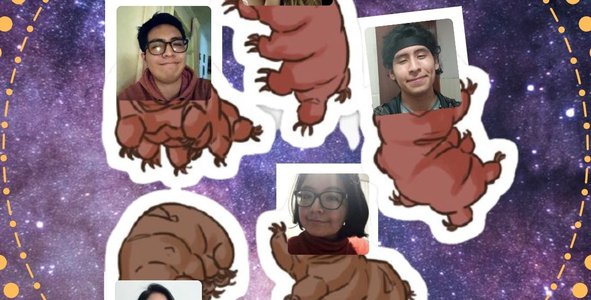
We can say that one of our members (Rolando) was our first motivation to choose this challenge, because he was investigating about tardigrades since 2018, and he found about an unexplored gene (DSUP) with high applicability potential in transgenics to improve organisms resistance to extreme conditions as hypersalinity and high radiation. Coincidentally, Mars’ environmental conditions were as the one previously described.
With that in mind, we began to investigate more about the physiological implications behind, previous studies and projects, and promising organisms so we could reunite the needed information to make an innovative project that could extend space travels and improve at least a little the psychological condition of the astronauts in the space by making them feel as in home.
References
- Bychkov, A., Reshetnikova, P., Bychkova, E., Podgorbunskikh , E., & Koptev, V. (2021). The Current State and Future Trends of Space Nutrition from a Perspective of Astronauts' Physiology. International Journal of Gastronomy and Food Science, 100324.
- Chavez, C., Cruz-Becerra, G., Fei, J., Kassavetis, G. A., & Kadonaga, J. T. (2019). The tardigrade damage suppressor protein binds to nucleosomes and protects DNA from hydroxyl radicals. Elife, 8, e47682.
- Zvanarou, S., Vágnerová, R., Mackievic, V., Usnich, S., Smolich, I., Sokolik, A., ... & Demidchik, V. (2020). Salt stress triggers generation of oxygen free radicals and DNA breaks in Physcomitrella patens protonema. Environmental and Experimental Botany, 180, 104236.
- Kirke, J., Jin, X. L., & Zhang, X. H. (2020). Expression of a tardigrade Dsup gene enhances genome protection in plants. Molecular Biotechnology, 62(11), 563-571.
- Westover, C., Najjar, D., Meydan, C., Grigorev, K., Veling, M., Chang, R., ... & Mason, C. (2020). Engineering Radioprotective Human Cells Using the Tardigrade Damage Suppressor Protein, DSUP. bioRxiv.
- Ricci, C., Riolo, G., Marzocchi, C., Brunetti, J., Pini, A., & Cantara, S. (2021). The Tardigrade Damage Suppressor Protein Promotes Transcription Factor Activation and Expression of DNA Repair Genes in Human Cells in Response to Hydroxyl Radicals and UV-C Exposure.
- Perla Llorente, L. (2018). Análisis de la radiación en Marte mediante el software OLTARIS (Bachelor's thesis).
- Mínguez-Toral, M., Cuevas-Zuviría, B., Garrido-Arandia, M., & Pacios, L. F. (2020). A computational structural study on the DNA-protecting role of the tardigrade-unique Dsup protein. Scientific reports, 10(1), 1-18.
- Wamelink, G. W. W., Frissel, J. Y., Krijnen, W. H. J., & Verwoert, M. R. (2019). Crop growth and viability of seeds on Mars and Moon soil simulants. Open Agriculture, 4(1), 509-516.
- Van Den Burg, B. (2003). Extremophiles as a source for novel enzymes. Current opinion in microbiology, 6(3), 213-218.
- Kiss, J. Z., Wolverton, C., Wyatt, S. E., Hasenstein, K. H., & van Loon, J. J. (2019). Comparison of microgravity analogs to spaceflight in studies of plant growth and development. Frontiers in plant science, 10, 1577.
- Okamoto, K., Yanagi, T., Takita, S., Tanaka, M., Higuchi, T., Ushida, Y., & Watanabe, H. (1996, August). Development of plant growth apparatus using blue and red LED as artificial light source. In International Symposium on Plant Production in Closed Ecosystems 440 (pp. 111-116).
- Kong, Y., Stasiak, M., Dixon, M. A., & Zheng, Y. (2018). Blue light associated with low phytochrome activity can promote elongation growth as shade-avoidance response: A comparison with red light in four bedding plant species. Environmental and Experimental Botany, 155, 345-359.
- Perla Llorente, L. (2018). Análisis de la radiación en Marte mediante el software OLTARIS (Bachelor's thesis).
- Herranz, R., Vandenbrink, J. P., Villacampa, A., Manzano, A., Poehlman, W. L., Feltus, F. A., ... & Medina, F. J. (2019). RNAseq analysis of the response of Arabidopsis thaliana to fractional gravity under blue-light stimulation during spaceflight. Frontiers in plant science, 10, 1529.
- Monje O, Richards JT, Carver JA, Dimapilis DI, Levine HG, Dufour NF and Onate BG (2020) Hardware Validation of the Advanced Plant Habitat on ISS: Canopy Photosynthesis in Reduced Gravity. Front. Plant Sci. 11:673. doi: 10.3389/fpls.2020.00673
- Monje O, Richards JT, Dimapilis DI, Tellez-Giron GM, De Mars M, Dufour NF, Levine HG, and Onate BG (2018). Hardware Validation Test of the Advanced Plant Habitat. Available at https://ntrs.nasa.gov/api/citations/20180008565/downloads/20180008565.pdf
- Monje Mejia, O. A., Richards, J. T., Dimapilis, D. I., Dufour, N. F., Levine, H. G., Onate, B. G., ... & Demars, M. (2018, October). Hardware Validation Test of the Advanced Plant Habitat. In American Society for Gravitational and Space Research (ASGSR) 2018 Meeting.
- Monje, O., Richards, J. T., Hanson, D. T., Turpin, M. M., Moinuddin, S. G. A., Costa, M. A., ... & Onate, B. (2019). New perspectives for watering substrate-based root modules in microgravity in the advanced plant habitat (APH).
Tags
#seeds #space_travel #genetic_modication #Mars_station
Global Judging
This project has been submitted for consideration during the Judging process.