
High-Level Project Summary
Space travel is hazardous without a crop growing system onboard; astronauts may starve when the mission’s delayed. That’s what S2S will solve! S2S is an automatic crop production greenhouse system connecting Earth, Moon, and Mars. We’ll grow lettuce, cabbage, sweet potatoes, and Taiwan Red Quinoa with it. With temperature/moisture, nutrient solution, and light/CO2 control systems, we’ll transform astronauts’ metabolites to nutrient solution with nitrification. Conducting regression analysis on our data, we can predict the plants’ growth; using the database of Azure, we can apply our outcome to agricultural greenhouses in Earth’s polar regions, providing a solution to food and climate crisis.
Link to Project "Demo"
Link to Final Project
Detailed Project Description
I.Why Are We Doing This?
Providing astronauts with strong food supply during space missions has long been a huge challenge for space agencies around the world. To reach Mars, astronauts have to survive a seven-month-long space journey, according to the 2020 NASA Mars mission. It can be hazardous if lacking an onboard food production system. Should the mission meet with some delays, our astronauts will starve to death on their return journey. Aiming at destinations beyond Mars, the mission will last a lot longer, and thus it will take up plenty of mass and volume of the spacecraft just to store their food. Therefore, building a sufficient, fresh, adaptive onboard food production system for astronauts is necessary.
Besides, devices that transform astronauts’ metabolites into food have never been put into practice in real space missions. Becoming the first, we will build an automatic food production system that connects Earth, Moon, and Mars, associating the core concept of NASA’s Artemis program: “from Moon to Mars”. Our data set can also contribute to the research of greenhouse environment under zero gravity and microgravity, which is difficult to be conducted on Earth.
Last but not least, our experience of growing crops with automatic greenhouses in harsh environments can help people on Earth grow crops in harsh environments, too! If our data can be used in cultivating crops in polar regions or deserts, it may provide some possible solutions to the food crisis, or even the energy crisis on Earth! Therefore, we are doing this.
II. The Greenhouse Device
A. Overview
The S2S(Seed To Space) device can automatically produce crops for astronauts. Built on spacecraft and relay stations(shown in section III), it can produce food efficiently with little space so that the astronauts’ life won’t be affected.
In outer space, high energy Galactic Cosmic Radiation (GCR) and Solar Particle Events (SPE) can pose serious threats to plants. To cope with this, we will use plastic-filled tiles that are used to bolster radiation protection on our devices to correspond to target radiation and rays .
Space in a spacecraft out of Earth is a precious resource. To minimize the volumn our devices occupy, we came up with the idea of nested design. A S2S planting box consists of nine identical pieces of cubes with the side length of 20 centimeters. When in space, the pieces will be piled up like a pillar. This way, no space will be wasted with these piles, making a high efficiency use of space and volume. The figure is shown below:

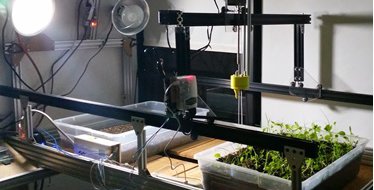
The device prototype is illustrated in the below figures:
(a)Sensor:
 (b)The main system:
 Our prototype has been built and tested. The prototype video link can be found in “LINK TO FINAL PROJECT”.
B. The Crops We Plan To Grow
We will plant lettuce, Brassica oleracea(Cabbage), sweet potatoes, and Taiwan Red Quinoa in the S2S system. Below we will explain why we choose these crops:
(a) Lettuce: Lettuce can provide our astronauts with rich vitamin A and K, and it is also an important source of iron and folic acid, which are particularly essential to female astronauts.
(b) Brassica oleracea(Cabbage): Cabbage contains many essential nutrients to human body, including vitamin C, which plays an important role in astronauts’ health.
(c) Sweet potato (and its leaves): Both its root and its leaves are edible, and hence sweet potatoes can bring more calories to astronauts with limited space and mass. When harvesting, astronauts will consume and store all the leaves and most sweet potatoes, while leaving some sweet potatoes for the next growing schedule. Sweet potato leaves are rich in vitamin B, protein, and minerals such
as iron and zinc, giving our astronauts multiple benefits at a time.
(d) Taiwan Red Quinoa(Chenopodium formosanum): It’s a native species in Taiwan and used to be a key component of the diets of Taiwanese indigenous peoples and remains culturally and culinarily significant. It contains abundant protein so that astronauts can maintain their muscle health.
C. The Control Systems
Our main system utilizes environment control system to adjust carbon dioxide(CO2) concentration, transforms astronauts’ metabolites into liquid nutrients with the process of nitrification with our nutrient solution system, and atomizes it with high-voltage static electricity sprayers to overcome the constraints of zero gravity and microgravity and provide our crops with sufficient carbon and nitrogen source.
To provide our crops with carbon source, we extract carbon dioxide(CO2) gaseous
molecules produced by the respiration of astronauts from the cabin with gas
pumps. Then, we blend CO2 gaseous molecules with our environment control system
and direct them into our growing chambers.

To provide our crops with nitrogen source, we blend astronauts’ metabolites, nitrification enzymes, and liquid water in our atomizer to produce nutrient solution. Nitrification enzymes can catalyze the nitrification process, which is a crucial process in the nitrogen cycle, oxidizing the ammonia molecules(NH3) in astronauts’ metabolites into nitrites(NO2-), and then oxidize them again into nitrates(NO3-), which can be absorbed and utilized by plants, and serve as the plants’ nitrogen source. The atomizer can collapse the liquid nutrient solution molecules, overcome the constraints of zero gravity and microgravity with plants’ transpiration process, and produce the small molecules absorbable by our crops’ roots. Finally, to conquer the zero gravity or microgravity environment in outer space, we utilize fans as the controller of air flow to regulate the direction of the diffusion phenomenon, accurately, evenly spraying the nutrient solution of small molecules on the roots,so that the medium can absorb the fertilizer and become humus soil. If the molecular diameter after atomization is small enough, it can be directly absorbed by plants. By controlling the strength and direction of the air flow, we can control the amount of absorbable nutrient solution the plants receive.

(a) Temperature and Moisture Control System
The system monitors the cultivation environment with temperature and moisture
sensors as well as anemometers, and uses technological zeolites to control the
temperature and moisture condition, with the assistance of heating and
ventilating devices. When the moisture level is higher, the zeolites will
absorb the water vapor; when it is lower, the zeolites will heat up and release
water vapor to the environment. Meanwhile, the heaters and the fans will
control the temperature as well as keep the cycle working. Compared to
traditional condensation heating equipment, a zeolite moisture-control system
can save 60% of the volume as well as more than 30% of mass, and therefore it
is a very efficient method.
(b) Nutrient Solution System
The system uses metabolites fermentation purification devices and flow distributing
valves to prepare nutrient solution with proper concentration. The feedback
system recycles the residual liquid and atomizes it. Besides, it sterilizes the
residual liquid with sterilization devices to prevent microorganisms from
thriving.
(c) Light and CO2 control system
The system uses PWM(pulse width modulation) to control the strength and color(wavelength) of the LED(light emitting diode) light according to the crop growth data from image analysis and systematic statistical analysis(explained in section III). Furthermore, it will monitor CO2 concentration in the environment with gas sensors, and add an appropriate amount of CO2 to the air accordingly to increase the rate of photosynthesis.
III.Overall Arrangement: The Relay Stations
Aside from the S2S devices onboard spacecraft, we also plan to build several relay stations in outer space equipped with the device. A relay station will also produce crops with S2S, exchange organic matters and food it grows with spacecraft, and provide the astronauts with essential matters, such as water and oxygen. Aside from being a crucial part of the S2S project, our relay stations will also serve as rest stations for space travel and conduct space science research.
Connected with one of NASA Artemis program’s core concepts: from Moon to Mars, we will
set up relay stations on the International Space Station(ISS), Moon surface,
and Mars surface, constructing a close automatic food production network
between Earth, Moon, and Mars. Astronauts set off on their journey on Earth,
moving toward the Moon, and exchange resources with the relay station on its
surface. Then, they will set off on their journey again toward Mars, all with
the company of S2S. Considering the gravitational field strength differs on
different stations, we plan to grow different crops on each station and
spacecraft and conduct different experiments.
The relay station on the lunar surface can serve as the base of human’s Moon
exploration( a little bit like the simplified version of the lunar city in the
novel Artemis); constructing this station can also be one of the final goals of
the Artemis program. The one built on the Martian surface can become the first
base of mankind on Mars(similar to the advanced version of the Hab in the movie
The Martian), too! Unfortunately, due to the lack of time in the hackathon
event, we haven’t figured out the details of the construction of the relay
stations. V. Our Contribution: Data Analysis
During a journey to Mars with our device, S2S, onboard, we will need to constantly gather real-time growing data feedback and do statistical analysis on them. By doing so, we can assist our astronauts to predict the growing condition of crops in the future and thus conduct necessary adjustments accordingly, such as increasing water supply, providing less CO2, or even postponing the harvest time. We can even adapt the space of cultivation according to different phases of plant growth. In particular, an effective statistical analysis plays a vital role, and regression analysis is one of the most common analysis methods. By inducing a proper regression analysis formula, we will help astronauts and other personnel judge the condition and make important adjustments. Our analytical data can also serve as a reference in future greenhouse planting projects.
For the growth needs of different crops, we can find out the equation for estimating the growing extent based on regression analysis through the method of environmental control, and after Lasso and Ridge regression, we can sort out the factors that affect the growth of the crop and the rank of importance.
For a specific crop, we will focus on several variations that have the potential to affect crop growth, such as pH, temperature, moisture, and light, one at a time. For different levels of a specific variation, we will take the number of days after the seed is planted as X-axis, the growing extent as Y-axis, and conduct linear regression analysis on X-Y. (growing extent: we define the growing extent of a seed as 0, and the growing extent of a harvestable crop plant as 100.)

For a specific crop, further analysis can be conducted:
A.With Ridge regression, we can know the rank of the importance(the impact on the crop’s growth) of every variation.
B.With Lasso regression, we can find out variations that don’t have significant impact on the specific crop and thus eliminate them to establish a more simplified regression model of the specific crop.

By conducting Ridge and Lasso regression over and over again, we can build regression models for every crop. With the help of various cloud computing platforms, we can do comprehensive research on different crops’ growth in microgravity individually. We will conduct regression analysis, and use the database of Azure and AWS(Amazon Web Services). Finally, we can utilize our data on future automatic greenhouse planting projects in outer space, on other planets or moons, and even in polar regions and deserts on Earth, which are usually considered barren. This may serve as a possible solution to the food crisis, or even the energy crisis on our planet.
Besides, by observing the spectrum of light reflected by the plants with electromagnetic spectrum analysis equipment, we can assess the growth and health condition of the plants.
V. The Tools We Use In Our Project
A. Hardware:
Arduino Mega 2560, barometer, fan, switching power, Uvsensor, gas sensor, LED, air pump, liquid pump, atomizer, pH, EC, dissolved oxygen and water temperature sensors, Jetson Nano.
B.Software:
Microsoft Azure, Microsoft Windows, Arduino IDE, linear regression, Lasso Regression, Ridge Regression, Yolo V4 object detection algorithm, Tensorflow, OpenCV, Scikit-learn.
C.Coding Language:
Python 3, C/C++.
Space Agency Data
Mainly, we focused on this article on the NASA official website to learn about various related technologies. The team happens to have a master's degree in agricultural automation, and there are also members who have applied AI & IoT technologies to open farmland to obtain a doctorate degree.
1.Growing Plants in Space
https://www.nasa.gov/content/growing-plants-in-space
Besides, we found the following articles published by NASA.. Learning about the past of space agriculture inspired some of our creative ideas of future space agricultural devices.
2.Space Agriculture Planted in History
https://blogs.nasa.gov/kennedy/2017/04/06/space-agriculture-planted-in-history/
3.Agriculture for Space: People and Places Paving the Way
We also looked up two of the most significant space plant growing experiments conducted on the ISS. Some of our crops are selected according to these information.
4.Veggie Fact Sheet
https://www.nasa.gov/sites/default/files/atoms/files/veggie_fact_sheet_508.pdf
5.Advanced Plant Habitat(APH)
https://www.nasa.gov/sites/default/files/atoms/files/advanced-plant-habitat.pdf
Our concept of constructing an automatic food production network between Earth, Moon, and Mars was inspired by the NASA Artemis Program.
6.NASA Artemis program
https://www.nasa.gov/specials/artemis/
This page gave us many ideas of dealing with the radiations in outer space:
7.Real Martians: How to Protect Astronauts from Space Radiation on Mars
https://www.nasa.gov/feature/goddard/real-martians-how-to-protect-astronauts-from-space-radiation-on-mars
Hackathon Journey
The challenges that we encountered in planning this work are not technically impossible to be solved; the most difficult part is the limitations of the requirements themselves! According to different environments, the design rules must be reversed.
The gravity that we are accustomed to limits our understanding of farming work, as well as the need to cooperate with spacecraft and space navigation. Fortunately, one of our team members is a space engineering expert. He provided a lot of useful information. A breakthrough can be made in conceiving the infrastructure.
Through our 48-hour-long hackathon journey, we had a lot of fun and gained a lot. Every team member came to our team with professional knowledge or talent, ranging from agriculture to Internet of Things, from electronic design to film clipping, but we always collaborated with each other. Though sometimes our thoughts may disagree, we always came up with a more creative solution by discussing.
References
Chien-Hung Lai, Yuh-Shyan Hwang, "A wireless sensing device for open farmland and its back-end system design", IEEE 30th Wireless and Optical Communications Conference (WOCC), 2021 , Taipei.
Folta K M, Childers K S. Light as a growth regulator : controlling plant biology with narrow-bandwidth solid-
state lighting systems. Hort Science, 2008, 43(7) : 1957-1963.
Gangolli S D, van den Brandt P, Feron V J, Janzowsky C, Koeman J H, Speijers G J. Nitrate, nitrite and N-nitroso
compounds. European Journal of Pharmacology : Environmental Toxicology and Pharmacology, 1994,
292(1) : 1-38.
Goins G D, N C Yorio, M M Sanwo, C S Brown. Photomorphogenesis, photosynthesis, and seed yield of wheat
s grown under red light-emitting diodes (LEDs) with and without supplemental blue lighting.
1997,48 : 1407-1413.
Tags
#NASA #Artemis #greenhouse #automatic #farmbot #nitrification #plants #crops #Mars #relaystation
Global Judging
This project has been submitted for consideration during the Judging process.