
High-Level Project Summary
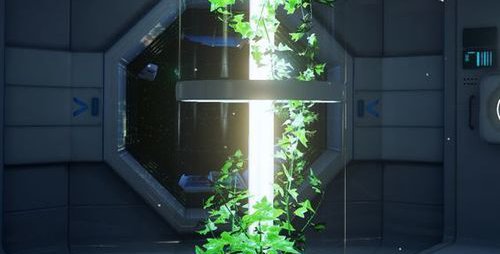
SEEP (Space Enclosed Environmental Plantation) Module is an in-space plantation for crops to provide supplemental nutrients through fresh plant produce to feed a human crew of 6-7 on a transit mission to Mars. There is extensive use of collapsible structures for compact packing during launch and deployable once directed on a trajectory to destination anywhere in the solar system.
Link to Project "Demo"
Link to Final Project
Detailed Project Description
The SEEP module is a collapsible pressurized system that acts as a plantation in a micro-gravity environment easily accessible to astronauts. SEEP is capable of supporting the growth and production of vegetable crops for consumption of an astronaut crew of 6-7 for a transit mission to Mars. The module consists of fold-able and collapsible parts to accommodate and isolate different varieties of plants from one another.
Compact nursery:
The Proper germination of the seeds is vital for a plant to grow properly for which a separate nursery is being used which consist of the following parts with their description
Nutrient supply: Facilitates the transportation of water and Nutrient to Nursery
Data Interchange: enable the interchange of parameters (Temperature, Humidity) measured by respective sensors from the nursery compartment to the central computer and from central computer to nursery
Power supply: Power supply to LEDs of Nursery for Artificial suitable Environment.
Display: This is a detachable display that can reflect the environmental parameters (Temperature and Humidity) inside the Nursery along with their corrected values by Central Computer.
LED Control: This is a backup system for the Central Computer that enables manual control of LEDs (Intensity and Colouring) inside the Nursery.
Transparent Envelop: is a see-through door through which seeds can be placed and germinated seedlings can be extracted out.
Plant Support Base:
The Plant support base(PSB) is a system to accommodate and support the nutritional needs of the seedlings and facilitate their growth to full-grown crops. The system uses Hydroponics to irrigate the plants. The irrigation system is inspired by the micro-gravity coffee cup realized and invented in the year 2008 by NASA astronaut Don Pettit, which works on the principle of capillary channel flow with some modification to support multiple plants with their respective root and shoot lengths. The modified changes include multiple acute-angled cross-sections from the micro-gravity cup are merged together to form a single unit for a row of plants, in such a way that only one input channel of water and nutrients is required to irrigate the plants. The structure accommodating roots is a converging collapsible bellow connected to the pipe supplying necessary nutrients and water. The acute-angled corner of the cross-section helps essential fluid to rise along the length of the bellowed acute-angled end to the roots of the plant. The whole apparatus is made of transparent HDPE which is flexible on the top of the acute-angled corner to accommodated seedlings of variable sizes.
The irrigation system is housed on a tray containing stands to hold it in place. Above the tray are the shoot organs of the plant which are in a controlled environment with red, blue, and green LEDs for photosynthesis. The tray is enclosed all the way to the LED panel with a transparent collapsible enclosure for isolation and independent plant environment (Temperature, humidity, etc.) control for optimum growth of the plant. The environmental control system and avionics is directly based on the system and instruments in Advanced Plant Habitat(APH) currently onboard the ISS. Each tray accommodates a separate variety of crops. The independent modular design of each tray allows for multiple very different varieties of crops requiring very different growth conditions to be cultivated at the same time.
The Capillary root irrigation unit, the tray in which it is housed, and the isolation unit along with the LED panel and collapsible bellow enclosure from unit forms an independent plant module. Due to its collapsible structure, the entire unit can be folded in to compact tray-like module which is easy to store and save enough volume when not in use thus saving enough storage volume while packing payload for launch to orbit. 4-5 plant modules can be placed along the length of SEEP’s pressurized volume according to the produce required.
The Plant module can be slid along the support structure of the curved walls in the internal side of the pressurized Main module to make room for the growth of different root and shoot sizes over the period the crop growth. The storage of produce from plants is housed in compartments on top and bottom of the SEEP’s pressurized volume adjacent to the plant modules.
Space Agency Data
https://www.nasa.gov/sites/default/files/atoms/files/veggie_fact_sheet_508.pdf
https://www.nasa.gov/sites/default/files/atoms/files/advanced-plant-habitat.pdf
https://www.nasa.gov/mission_pages/station/research/experiments/explorer/Investigation.html#id=7581
https://time.com/3844967/international-space-station-coffee-cups-espresso-data-fluid-systems-science/
Previously conducted experiments on advanced fluid systems really helped in our project
Hackathon Journey
It was a great journey with ups and downs. We learned a lot of things we didn't know before. Brought our interest back in Botany.
Thank you, NASA!!!
References
https://www.nasa.gov/sites/default/files/atoms/files/veggie_fact_sheet_508.pdf
https://www.nasa.gov/sites/default/files/atoms/files/advanced-plant-habitat.pdf
https://www.nasa.gov/mission_pages/station/research/experiments/explorer/Investigation.html#id=7581
https://time.com/3844967/international-space-station-coffee-cups-espresso-data-fluid-systems-science/
Tags
#ARTEMIS #MARS #SPACEFOOD #HABITAT #Hydroponics
Global Judging
This project has been submitted for consideration during the Judging process.