
High-Level Project Summary
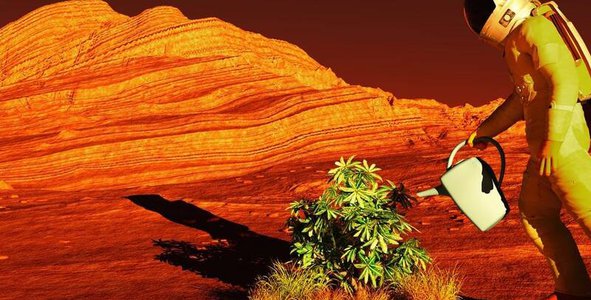
Curiosity pushes humans to explore everything that is strange, so some explorations of other planets are complicated, and we thought that they would be our refuge when the resources on Earth run out like Mars, so we need tricks to extend the life of plants on this planet. In order to grow, a plant needs the right soil, water, light, and the right climate. We found that it is possible to save water from carbon dioxide, by adding sodium hydroxide. We will add some elements to increase fertility such as phosphate, nitrogen. Using a led and some nanoparticles and greenhouses to solve the problem of alternative light and climate changes. It will be an available, and easy to apply the solution.
Link to Project "Demo"
Link to Final Project
Detailed Project Description
In the interest of the safety of astronauts and the difficulty of sending them enough food throughout their trip to Mars and the loss of minerals and nutrients in it, also according to the population increase and the increase in the consumption of resources on our planet in large proportions, colonizing Mars will be a solution in the future for the inhabitants of the Earth to live, so our project aims to provide conditions Suitable for cultivation on Mars.
There are many problems facing agriculture on Mars.
first: the availability of carbon dioxide in large quantities in the atmosphere and the lack of oxygen needed for plants. To solve this problem, we will use a device that produces oxygen by using intense heat to separate oxygen atoms from carbon dioxide particles that NASA manufactured called The Mars Oxygen In-Situ Resource Utilization Experiment (MOXIE).
Second: The problem of the lack of liquid water needed for agriculture on Mars, so we will make a reaction between carbon dioxide and sodium hydroxide, which results in water and sodium carbonate, which is a good material for the soil and helps increase production, so we will use the resulting water for irrigation and sodium hydroxide to fertilize the soil.
2NaOH+CO2= Na2CO3+H2O
Third: The soil of Mars loses the nutrients needed for agriculture, so we will provide it with fertilizers that contain potassium.
nitrogen, and phosphate, in addition to the sodium carbonate produced by the previous reaction.
Fourthly: The problem of climate changes on Mars and the lack of moderate temperatures necessary for agriculture, so we will make greenhouses to provide a good climate for plants and store heat from the sun to benefit from it in low temperatures. If the weather is too cold, we will use led to give the plants alternative light to grow and we will use nanoparticles to make
the light more efficient.
this project has many benefits as it will help astronauts to get healthy food with the essential minerals because it was difficult for them to take a lot of food with them necessary for long expeditions. In addition, it will be a good step in colonizing mars in the future due to the increase of population on earth.
We hope that farming on Mars will be easier than people imagine and that it will produce plants that are as nutritious as those grown on Earth. In addition, we want to make it easy for astronauts to find good food such as that on earth.
Space Agency Data
When we start researching about life on Mars, the first things that encourage us to complete this project until the end were two research papers from NASA,
The first of them was titled "Study looks more closely at Mars' underground water signals"
It was talking about some of the scientists who received signals from a radar instrument reflected off the red planet's south pole that reveals a liquid lake in 2018, and after that, this situation repeats much time with several groups of scientists.
The second research was titled "NASA's Insight Mars lander gets a power boost"
We found that they made solar panels to produce energy
These two research gave us hope that we can exception our idea on reality.
Through our journey in solving the water problem we use (Chemistry Advisor App) to get the chemical reactions that produce water and other chemical matter that doesn't affect Mars' environment, in the end, we reached our chemical equation
2NaOH + Co2 = Na2Co3 + H2o
We found a website called Plastic Europe, which helped us a lot in solving the climate change problem, while checking it out we got the idea of the greenhouse which will provide the planets a standard climate even if exposed to weather fluctuations.
Hackathon Journey
NASA space apps are a great experience that we have benefited from it a lot. We learned a lot during the hackathon, the first and the most important thing that we learned is team collaboration as alone we can do so little; together we can do so much. The hackathon is only 48 hours, so we need to submit our project in this little time, so we distributed tasks among us according to each member's skills. Working together was very helpful as we were able to finish the work in a short time. The second thing that we learn is research skills as we learned to search incredible sources to get the right information. In addition, we learned much new information about space especially mars planet.
What inspired us to choose the challenge of having seeds will travel! Is the importance of astronauts' life on mars, as they need a resource of food on mars, so they can go for longer explorations also, food is important if people go to live in mars this will solve many problems on earth such as an outage of resources and overcrowding.
We were just about to develop our project, but we needed soil similar to mars soil we can get it from places with severe climate conditions, but there is was no time. Many setbacks and challenges faced us during the hackathon such as time as the time was so little, and we solved it by collaboration and by working hard. We also faced some challenges during our research as we cannot find the information that we need we solved it by searching incredible resources such as NASA, google scholar, books, and research papers.
We want to thank our physics teacher because she supports us and tells us about credible sources that we can search for it.
References
https://books.google.com/books?hl=ar&lr=&id=U-M_AQAAMAAJ&oi=fnd&pg=PR15&dq=mars+exploration&ots=4sk2P9g4P1&sig=MbXIuR2zWyC92j2vY6_HSCRnvhc
https://ieeexplore.ieee.org/abstract/document/1655790/
https://ui.adsabs.harvard.edu/abs/1992mars.book..818O/abstract https://link.springer.com/article/10.1007/s11214-015-0139-x
https://www.sciencedirect.com/science/article/pii/S0301462299001428
https://journals.ekb.eg/article_111728.html
http://erepository.cu.edu.eg/index.php/cutheses/article/view/4751
https://agupubs.onlinelibrary.wiley.com/doi/abs/10.1029/97JE01160
https://agupubs.onlinelibrary.wiley.com/doi/abs/10.1029/93JE02500
https://ascelibrary.org/doi/abs/10.1061/(ASCE)0893-1321(2006)19:3(169)
Tags
#mars, #plants, #water, #oxygen, #sunlight
Global Judging
This project has been submitted for consideration during the Judging process.