
High-Level Project Summary
Our main focus is to make a sustainable system in order to make the farming process lasts longer to help people in space ships and we are willing to make a well designed agriculture system that is easy to use and to apply changes to it
Link to Project "Demo"
Link to Final Project
Detailed Project Description
We will use vertical farming to maximize the area of farming in the space craft.
We will use drip irrigation system to minimize water loss. We will try to build a sustainable sanitation system and recycle the water waste if existed.
Also we will try to purify urine and use it as a source for watering the farm
Space Agency Data
Idea
We all know that it is difficult to monitor and increase the cultivated area in space, so we decided to do a research on how to solve this problem, and after collecting a lot of information, we came to maximize the farming area in space through vertical farming, we used smart agriculture technologies to monitor and analyze the plant state and its growth rate and we made an app to control the parameters of the farm such as temperature, humidity, waterlevel, and air concentration. After taking all these conditions into consideration, the cloning can easily reach the cultivated area, analyze it and reach the ways of developing it.
Problem :-
A viable food system for long-duration exploration missions does not yet exist, but it will be necessary to maintain crew health and performance. The problem and challenge is design a deployable crop production system capable of supporting the nutritional requirements of a crew of 4-6 on a transit mission to Mars and back to Earth.
Backgraound :-
The previous solutions to this problem were few and were not of the required quality to solve the problem, so there were problems with photography, cameras, and others
Methode and project overview :-
We will use vertical farming to maximize the area of farming in the space craft.
We will use drip irrigation system to minimize water loss. We will try to build a sustainable sanitation system and recycle the water waste if existed.
Also we will try to purify urine and use it as a source for watering the farm
• A CubeSat is a square-shaped nanosatellite
(10 cm x 10 cm x 10 cm—roughly the size
of a Rubik's cube), weighing about 1 kg [1].
• The advent of CubeSats has empowered
the vision of using a satellite constellation
to provide seamless Internet coverage
across the globe and space [1-4].
• This vision, known as the Internet of Space
(IoS), is the key enabler of the Internet of
Things (IoT).
A space-based IoT communication platform
requires an infrastructure that will fit its
various applications [1].
● The infrastructure requires a network of
satellites in the Equatorial plane, ground
stations, and IoT terminals that are
interconnected.
● These variations in requirements can be
used by different satellite design.
Value proposition :-
Our main focus is to make a sustainable system in order to make the farming process lasts longer to help people in space ships and we are willing to make a well designed agriculture system that is easy to use and to apply changes to it.
Role of every member :-
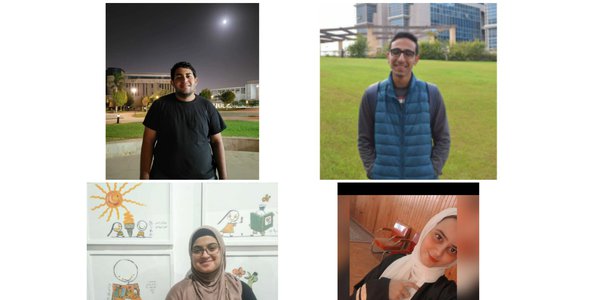
Menna tarek &Shama mohamed & omnya adel ...."researcher "
Ammar Ahmed &abdullah galal ... "Technical"
Salma .. "vedio editor"
Steps we followd :-
First we did a comprehensive research on the problem and the previous solutions to it and the disadvantages of these solutions, then we thought about reaching a solution that avoids all the flaws and solves the problem until we reach our idea and then the video was manufactured and we started working on the prototype .
Partcipates :-
Menna Tarek
Menaa.201811@stemmenof.moe.edu.eg
01021604208
Shams Mohamed
Shams.2018111@stemmenof.moe.edu.eg
0 102 912 6913
Omnya adel
Omnya.2118108@stemmenof.moe.edu.eg
01559955609
Salma Alwardany
S.alwardany@nu.edu.eg
0 112 883 6277
Abdallah galal
Ab.Galal@nu.edu.eg
0 102 764 1006
Ammar Ahmed
amm.ahmed@nu.edu.eg
0 102 657 1087
Hackathon Journey
It helped me to add a new touches to my project
References
References:-
[1] A. Narayanasamy, Y. A. Ahmad, and M. Othman, “Nanosatellites constellation
as an IoT communication platform for near equatorial countries,” IOP
Conference Series: Materials Science and Engineering, vol. 260, p. 012028,
2017.
[2] C. S. Agency, “What is a CubeSat,” Canadian Space Agency, 27-Nov-2018.
[Online]. Available: https://www.asc-csa.gc.ca/eng/satellites/cubesat/what-
is-a-cubesat.asp. [Accessed: 31-Aug-2021].
[3] “CubeSats,” ESA. [Online]. Available:
https://www.esa.int/Enabling_Support/Preparing_for_the_Future/Discover
y_and_Preparation/CubeSats. [Accessed: 31-Aug-2021].
[4] E. Howell, “Cubesats: Tiny Payloads, huge benefits for space research,”
Space.com, 19-Jun-2018. [Online]. Available:
https://www.space.com/34324-cubesats.html. [Accessed: 31-Aug-2021].
[5] N. Saeed, A. Elzanaty, H. Almorad, H. Dahrouj, T. Y. Al-Naffouri, and M.-S.
Alouini, “CubeSat communications: Recent advances and future challenges,”
2020.
Tags
#space #plants
Global Judging
This project has been submitted for consideration during the Judging process.