
High-Level Project Summary
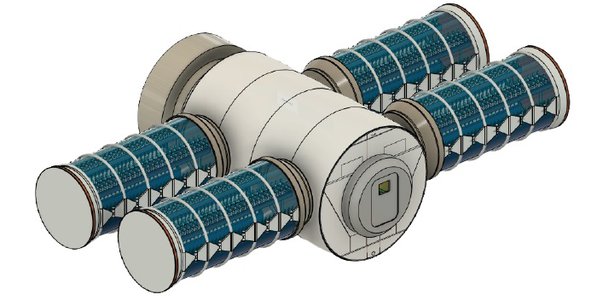
Mars is a planet of great interest. To conduct simulation experiments of bioregenerative life support systems on the ground is critical with the lack of deployable food production systems for long missions. The project discusses the design of a closed distributed ecosystem comprising a parent and four sub deployable growth chambers incorporated with mixed hydroponics and aeroponics system, urine nitrogen recycling, and use of Martian soil for higher plant cultivation for long-duration missions. Pressurization, air revitalization, temperature and lighting control is done by an onboard processor with setpoints for a total pressure of oxygen, carbon dioxide, and nitrogen concentration at 11 Psi
Link to Project "Demo"
Link to Final Project
Detailed Project Description
Selection
The project discusses the design of a closed distributed ecosystem comprising a parent and four sub deployable growth chambers. A trip to Mars would take 23 months, 9 months to get there, 5 months there, and 9 months to get back. For such a long mission we selected five groups of plants which are protein and carbohydrates-rich. In our plant group, we selected two high protein-rich plants (Soybean, and green pea) , a nutrient and vitamin-rich leafy vegetable (Russian Kale), and carbohydrate and nutrient-rich plants like (Potato and beetroot). The designed module will support batch cultivation where 3 months of stock can be grown at one time that would improve the growth rate and will help to grow for 9 months of plants in the cyclic state. For getting healthy yields and reduce water consumption we adapted aeroponics to grow potato and beetroot; the remaining plants will be grown using hydroponics. After successful travel to mars, de-chlorinated martian soil mixed with fertilizers and nitrogen fixtures will be used to grow tomato, corn, radish and rice.
Pressurized Plant Cabinet Design and Working
The closed pressurized eco-system was created to grow healthy plants. The cabinet is 7 meters in length and 4 meters in diameter integrated with four sub deployable/ foldable chambers of 2.4 meters in diameter and 4 meters in length( deployed length) which would be maintained at a total pressure of 11Psi with an air concentration of carbon dioxide at 7.6 Psi with Oxygen at 2.3Psi and Nitrogen at 1.1 Psi during day time. The internal concentration will change during the night time i.e with a concentration of oxygen at 7.4 Psi and 2.5 Psi of Oxygen. For healthy growth in our habitat, plants will be exposed to 17 hours of lighting at an intensity of 170 µmol m-2 s -1 of violet light, and the remaining 7 hours will be exposed to darkness with staggering light shutdown & startup sequences at a time interval of 15 minutes to avoid abrupt changes in composition inside the cabinet. The internal cabinet has its inbuilt pressurization system with an Internal HVAC system that maintains habitat temperature at 24°C and total relative humidity at 55%. At every 20 mins fresh charge of air will be introduced inside the cabinet by onboard air revitalization system. The system uses a Carbon Dioxide Removal assembly CDRA system inspired by ISS for re-using unused CO2 during air revitalization system with it the generated oxygen in plant hab will be transferred to crew Habitat. The system incorporates a parent Hab with four deployable mini habs which would get deployed over mars for growing more yield using a mixture of martain soil with fertilizers.
Deployable Plant Habitat
Deployed length (w/o airlock) = 4.5m
Collapsed length (w/o airlock) = 1.5m
Cladding material = Kapton E
Frame material = Aluminium 7075
Nighttime reflector/insulator material = Aluminized Mylar
Walking ramp material = Aluminium 7075
- The material for cladding has been choosen keeping in mind the harsh martian enviornment and radiation levels. Kapton is a UV-resistant polyamide with high mechanical strength against mechanical abrasion. It is heavily favoured in the aerospace industry due to its properties.
- Aluminium 7075 can withstand high temperatures and radiation. It has the added benefit of being light while still maintaining structural strength.
- Aluminized Mylar is a reflector/insulator that can prevent heat loss during nights on mars. It is also a good shield against radiation.
Benefits
- Our design has one parent module with four sub deployable modules, the deployable module once deployed will get bigger 4.5 times in volume to grow more and healthy yields.
- The deployable setup will utilize martian soil with fertilizers to grow plants thus eliminating complex aeroponics and hydroponics setup over mars.
- Onboard urine, nitrogen recycling cycle will help fix nitrogen in Martian soil and help it make it more fertile.
Future
- The current habitat can be modified to a greater extent by improving spacings and working more on mixed aeroponics and hydroponics integrated with super absorbent polymers to help reduce water consumption and processing apparatus.
- Flexible deployable setup can be improved to use martian soil to grow plants with it more work is needed to be done on advanced flexible materials and reducing/ eliminating artificial lightning using improved solar sun concentrators at controlled temperature. The use of solar energy from the sun will not only help to reduce artificial lighting complex architecture but it will assist healthy plant growth with more nutrients.
Tools Used
1) Hardware Design: Catia, Solidworks and Fusion 360
2) Structural Analysis: Ansys
Space Agency Data
🔹 Veggie Factsheet - https://www.nasa.gov/sites/default/files/atoms/files/veggie_fact_sheet_508.pdf
🔹 Advanced Plant Habitat Factsheet - https://www.nasa.gov/sites/default/files/atoms/files/advanced-plant-habitat.pdf
🔹https://www.nasa.gov/content/growing-plants-in-space
Hackathon Journey
"Extraordinary claims require extraordinary evidence" Carl Sagan
Working on the challenge 'Have seeds will travel' has been our journey to prove our point that compact and efficient Crop Deployment System can be implemented on Transit Missions of a long duration. The team has been constantly working on finding an innovative solution to the same and the journey was quite interesting.
The challenge options were vast and the nature of this challenge to shift to a Sustainable journey caught our attention. We found this to be a cool challenge, with a lot of space for development. Also, this challenge would equally utilize the skillset of our team members. We were able to come together and learn new things during the course of the event.
The approach to the challenge began with our search of the existing conventional methods from NASA website and other Space Agency sites. After dedicating ample time for literature review, we started working on our idea. We looked for ways to perfect it through continuous discussion and multiple reviews. A lot of brainstorming went into the work in each stage when we faced a challenge.
The NASA Space Apps journey is one of a kind, and we'd like to thank our Local Leads here in India for mentoring us throughout. And most importantly, we'd like to thank each other person in our team for being supportive & respectful of the opinions and for contributing to the goal we worked for.
Kudos to us!!
References
🔹S.W. Hogewoning, G. Trouwborst, E. Meinen, W. van Ieperen(Acta Hort. 956, ISHS 2012 ). Finding the Optimal Growth-Light Spectrum for Greenhouse Crops
https://doi.org/10.17660/ActaHortic.2012.956.41
🔹Luechai Promratrak ( April 10, 2017) . The effect of using LED lighting in the growth of crops hydroponics
https://doi.org/10.12720/sgce.6.2.133-140
🔹I. Tarakanov, O. Yakovleva, I. Konovalova, G. Paliutina , A. Anisimov (Acta Hort. 956, ISHS 2012 ) . LIGHT-EMITTING DIODES: ON THE WAY TO COMBINATORIAL LIGHTING TECHNOLOGIES FOR BASIC RESEARCH AND CROP PRODUCTION
https://doi.org/10.17660/ActaHortic.2012.956.17
🔹Challenging the agricultural viability of martian regolith simulants
https://doi.org/10.1016/j.icarus.2020.114022
🔹Distributed control system for low-pressure plant growth chambers
https://doi.org/10.13031/2013.9174
🔹Can Plants Grow on Mars and the Moon: A Growth Experiment on Mars and Moon Soil Simulants
https://doi.org/10.1371/journal.pone.0103138
🔹How to Establish a Bioregenerative Life Support System for Long-Term Crewed Missions to the Moon or Mars
https://doi.org/10.1089/ast.2016.1477
🔸Soybean facts:
Albert, Steve. (2020, November 5) “How to Grow Soybeans.” https://harvesttotable.com/how_to_grow_soybean/#:~.
🔹Nutritional facts of soybean-
Atli Arnarson.(2019, March 20). “Soybeans 101: Nutrition Facts and Health Effects.” https://www.healthline.com/nutrition/foods/soybeans#plant-compounds.
🔹Soybean in Space:
Dunbar, Brian. (March, 2002) “Soybean Chemical Composition Study Using Advanced ASTROCULTURE (ADVASC) Fact Sheet.
”https://www.nasa.gov/centers/marshall/news/background/facts/advasc5.html.
🔹Soybean grown in hydroponic systems:
Palermo, Mariantonella, Roberta Paradiso, Stefania De Pascale, and Vincenzo Fogliano.(2011, December 14) “Hydroponic Cultivation Improves the Nutritional Quality of Soybean and Its Products.” https://doi.org/10.1021/jf203275m.
🔸Nutritional value of peas:
Elliott, Brianna.(2017, February 14) “Why Green Peas Are Healthy and Nutritious.” https://www.healthline.com/nutrition/green-peas-are-healthy#TOC_TITLE_HDR_2.
🔹Peas in Space:
Sychev, Vladimir N., Margarita A. Levinskikh, Sergey A. Gostimsky, Gail E. Bingham, and Igor G. Podolsky. (2006, October 10)“Spaceflight Effects on Consecutive Generations of Peas Grown Onboard the Russian Segment of the International Space Station.”
https://doi.org/10.1016/j.actaastro.2006.09.009.
🔸Growing Kale:
Yablonski, Briana.(2021, August 4) “How to Grow and Harvest Red Russian Kale.”
https://gardenerspath.com/plants/vegetables/grow-red-russian-kale/.
🔸Potato nutritional information:
Wilcox. “Nutritional Information.” https://www.wilcoxgoodness.co.nz/helpful-info/nutritional-information/potatoes.
🔹Potato in Space:
Wheeler, Raymond M.(2006, June 15) “Potato and Human Exploration of Space: Some Observations from NASA-Sponsored Controlled Environment Studies.”
https://doi.org/10.1007/s11540-006-9003-4.
🔸Beetroot nutritional value:
Kristen Cherney. (2019, July 19) “What Are Beets? Nutrition, Benefits, Types, How to Cook, More: Everyday Health.” https://www.everydayhealth.com/diet-nutrition/diet/beets-nutrition-benefits-types-how-cook-more/.
🔸Deployable Plant Habitat:
J.M. Clawson and A. Hoehn (BioServe Space Technologies, University of Colorado), R.M. Wheeler (Biological Sciences Office, Kennedy Space Center) : (2005)
Inflatable Transparent Structures for Mars Greenhouse Application
Bob Granath, NASA's Kennedy Space Center, Florida (2017) : Lunar, Martian Greenhouses Designed to Mimic Those on Earth, https://www.nasa.gov/feature/lunar-martian-greenhouses-designed-to-mimic-those-on-earth
Eleanor Gibson (2019,16 July): Scientists develop "greenhouse shields" to grow food on Mars https://www.dezeen.com/2019/07/16/harvard-university-scientists-develop-greenhouse-shields-growing-food-on-mars/
NASA Spinoff (2006) : Progressive Plant Growing is a Blooming Business, https://www.nasa.gov/vision/earth/technologies/aeroponic_plants.html
NASA: Anna Heiney (2021,Jul 13) : Growing Plants in Space, Exploration Research and Technology, https://www.nasa.gov/content/growing-plants-in-space
Tags
#hardware #crop_deployment #marsmission #Team.Transit.Green. Project
Global Judging
This project has been submitted for consideration during the Judging process.