
High-Level Project Summary
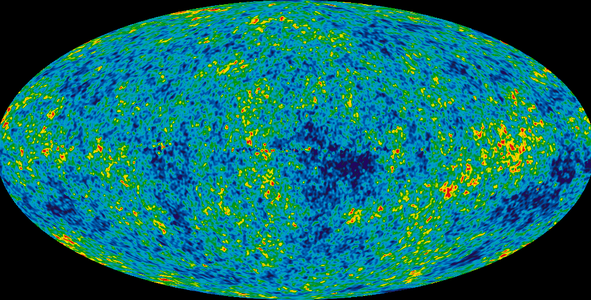
The cosmic microwave background is the heat remenant from the big bang. It dates to the epoch of recombination and hence called the relic radiation. In this project we focused on the findings of the probe which did a detailed study of the CMB, "The Wilkinson Microwave Anisotropy Probe". It was a NASA mission aling with princeton university launched in the year 2001. So i just focused on the findings of the probe and tried to explain in a simplied manner. The study about CMB is important as it tells about the past, present and future of the universe, the temperature and the fate of the universe. It also provides the detailed structural map of the universe.
Link to Project "Demo"
Link to Final Project
Detailed Project Description
The Cosmic Microwave Background (CMB, CMBR), in Big Bang cosmology, is electromagnetic radiation which is a remnant from an early stage of the universe, also known as "relic radiation. The CMB is faint cosmic background radiation filling all space. It is an important source of data on the early universe because it is the oldest electromagnetic radiation in the universe, dating to the epoch of recombination. With a traditional optical telescope, the space between stars and galaxies (the background) is completely dark. However, a sufficiently sensitive radio telescope shows a faint background noise, or glow, almost isotropic, that is not associated with any star, galaxy, or other object. This glow is strongest in the microwave region of the radio spectrum. The accidental discovery of the CMB in 1965 by American radio astronomers Arno Penzias and Robert Wilson was the culmination of work initiated in the 1940s, and earned the discoverers the 1978 Nobel Prize in Physics.
CMB is landmark evidence of the Big Bang origin of the universe. When the universe was young, before the formation of stars and planets, it was denser, much hotter, and filled with a uniform glow from a white-hot fog of hydrogen plasma. As the universe expanded, both the plasma and the radiation filling it grew cooler. When the universe cooled enough, protons and electrons combined to form neutral hydrogen atoms. Unlike the uncombined protons and electrons, these newly conceived atoms could not scatter the thermal radiation by Thomson scattering, and so the universe became transparent instead of being an opaque fog. Cosmologists refer to the time period when neutral atoms first formed as the recombination epoch, and the event shortly afterwards when photons started to travel freely through space rather than constantly being scattered by electrons and protons in plasma is referred to as photon decoupling. The photons that existed at the time of photon decoupling have been propagating ever since, though growing fainter and less energetic, since the expansion of space causes their wavelength to increase over time (and wavelength is inversely proportional to energy according to Planck's relation). This is the source of the alternative term relic radiation. The surface of last scattering refers to the set of points in space at the right distance from us so that we are now receiving photons originally emitted from those points at the time of photon decoupling.
About the "WMAP"-
The Wilkinson Microwave Anisotropy Probe (WMAP) is a NASA Explorer mission that launched June 2001 to make fundamental measurements of cosmology -- the study of the properties of our universe as a whole. WMAP has been stunningly successful, producing our new Standard Model of Cosmology. WMAP's measurements played a key role in establishing the current Standard Model of Cosmology: the Lambda-CDM model. The WMAP data are very well fit by a universe that is dominated by dark energy in the form of a cosmological constant. Other cosmological data are also consistent, and together tightly constrain the Model. In the Lambda-CDM model of the universe, the age of the universe is 13.772±0.059 billion years. The WMAP mission's determination of the age of the universe is to better than 1% precision.
The universe comprises only 4.6% atoms. A much greater fraction, 24% of the universe, is a different kind of matter that has gravity but does not emit any light --- called "dark matter". The biggest fraction of the current composition of the universe, 71%, is a source of anti-gravity (sometimes called "dark energy") that is driving an acceleration of the expansion of the universe.?WMAP has also provided the timing of epoch when the first stars began to shine, when the universe was about 400 million old. The upcoming James Webb Space Telescope is specifically designed to study that period that has added its signature to the WMAP observations.?WMAP launched on June 30, 2001 and maneuvered to its observing station near the "second Lagrange point" of the Earth-Sun system, a million miles from Earth in the direction opposite the sun. From there, WMAP scanned the heavens, mapping out tiny temperature fluctuations across the full sky. The first results were issued in February 2003, with major updates in 2005, 2007, 2009, 2011, and 2013. The mission was selected by NASA in 1996, the result of an open competition held in 1995. It was confirmed for development in 1997 and was built and ready for launch only four years later, on-schedule and on-budget.\
The WMAP science team has determined, to a high degree of accuracy and precision, not only the age of the universe, but also the density of atoms; the density of all other non-atomic matter; the epoch when the first stars started to shine; the "lumpiness" of the universe, and how that "lumpiness" depends on scale size. In short, when used alone (with no other measurements), WMAP observations have improved knowledge of these six numbers by a total factor of 68,000, thereby converting cosmology from a field of wild speculation to a precision science. WMAP's "baby picture of the universe" maps the afterglow of the hot, young universe at a time when it was only 375,000 years old, when it was a tiny fraction of its current age of 13.77 billion years. The patterns in this baby picture were used to limit what could have possibly happened earlier, and what happened in the billions of year since that early time. The (mis-named) "big bang" framework of cosmology, which posits that the young universe was hot and dense, and has been expanding and cooling ever since, is now solidly supported, according to WMAP. WMAP observations also support an add-on to the big bang framework to account for the earliest moments of the universe. Called "inflation," the theory says that the universe underwent a dramatic early period of expansion, growing by more than a trillion trillion-fold in less than a trillionth of a trillionth of a second. Tiny fluctuations were generated during this expansion that eventually grew to form galaxies.
Space Agency Data
For reference, we considered the data for our research work from https://map.gsfc.nasa.gov/. We used open data too and combined the data which we obtained from the official website and made an suitable output. The official data was used in my research work very actively and effectively to finalize the data and make a concrete output with minimum errors.
Hackathon Journey
This topic was chosen because it was interesting and researching about this topic gave a brief knowledge and information about the formation, temperature & initial stage of the universe. By researching about this topic i came across several interesting and astonishing facts and figures which gave me the base to start and understand several derivation and constants. It gave rise to several mind twisting thoughts and questions which were fun to solve. The approach to developing this project was a hardcore research and combining the 9 years data to form a single output about the Relic Radiation provided by the Wilkinson Microwave Anisotropy Probe (WMAP). No such coding language was used neither any special hardware or software were used in this project. This project is a research based project which do not indulge the use of any coding language, hardware or software.No as such major problems were faced during the research work and obtained very high quality results about the topic. After completing the research and study we were able to understand the concrete value of Hubble constant, Baryon Density, Cold Dark Matter Density, Physical Baryon Density, Physical Dark Energy Density, Density Fluctuations, Scalar Spectral Index, Reionization Optical Depth, Curvature of the Universe, Tensor to Scalar Ratio, Running Scalar Spectral Index, the hint how the universe begin and probably how will it end, when will the temperature drop to absolute zero.
References
https://map.gsfc.nasa.gov/news/
https://en.wikipedia.org/wiki/Wilkinson_Microwave_Anisotropy_Probe
https://en.wikipedia.org/wiki/Cosmic_microwave_background
Tags
#cosmicmicrowavebackgroun #spaceappschalleneg2k21 #cmb #wmap #cosmology