
High-Level Project Summary
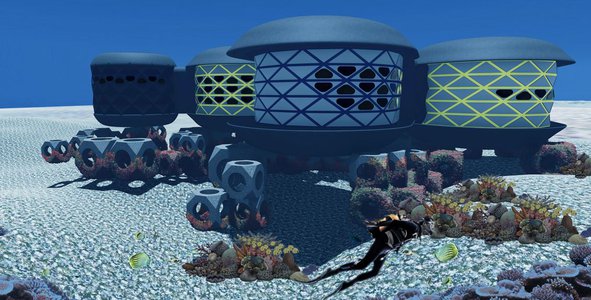
We define our challenge as finding new ways of living, due to the necessity of inhabiting new extreme environments that emerge from state of climate emergency and the New Space Age. In order to achieve this, we propose to live under water through a nomadic underwater station that allows training and investigation using origami-type deployable structures and flexible materials. CREATUS is the first step towards new and more resilient ways of living, which is why we seek to innovate and "break the mold" by making unexplored environments habitable and allowing us to seek answers to challenges such as the climate emergency.
Link to Project "Demo"
Link to Final Project
Detailed Project Description
Our proposal
CREATUS (Costa Rica Exploration and Advanced Training Underwater Station) is an initiative of independent origin, made up of professionals and university students of different fields.
CREATUS proposal is to open the possibility of living underwater through an underwater station that functions as a training and experimentation base in which we could learn to live in extreme spaces autonomously and in a symbiotic relationship with the environment. Studies in this field are not only necessary but urgent due to the state of climate emergency and the New Space Age, both phenomena characterized by the necessity of developing human life in inhospitable environments.
The specific problem
According to the article “The dichotomy of ecological bankruptcy and the space industry”, climate change has evolved into a global state of emergency. Evidence shows that measures that have been taken to offset climate change have very little effect in changing the trend. Humanity is facing a moment that will define whether we can overcome the paradigm of our continuity as a species or we will fail. This implies the need to rethink new ways of conceptualizing progress and necessarily new ways of inhabiting new environments such as the moon, Mars or the sea.
The challenges of living in these places involve considering requirements regarding isolation, dangerous environments, human-friendly designs that consider housing facilities, physiological and psychological needs, life in micro-society and sophisticated engineering systems with a focus on good financial practices.
Our solution and how it solves the problem
We are in the first stage in which we focus on an underwater station for research, this is proposed to achieve its sustainability over time as it will allow the possibility to make alliances with educational institutions and research centers with financial capabilities.
The design is contemplating a nomadic concept that is based on a structure capable of changing locations periodically with little or minimal effort, enabling a greater opportunity for exploration and research in extreme habitats.
Part of the solution focuses on working with deployable origami-type structures, flexible materials, auxetics, algorithmic design and technologies for life support systems, taking inputs from the space industry for application in the ocean, through prototyping and iterative design processes.
Why is this Solution innovative?
Our solution is innovative because it is the initial stage in the development of a new comprehensive life model that pursues the utopia of generating cities symbiotic with the environment. To achieve this, we define the following stages:
1. Investigate: A nomadic submarine station for research and advanced training located from 20 to 30 m deep in Latin American coasts that allows the permanence of a crew for prolonged periods of time.
2. Specialize: Creation of specialized modules that promote the autonomy of life in extreme environments
3. Take advantage: Take advantage of the resources and research generated and apply it to everyday life
4. Living: (our utopia) Generating cities symbiotic with the environment
These stages allow us to progressively scale in a process that leads us to all the solutions to live in extreme environments.
Our mission in a near future
This project, in addition to solving how to live underwater, has more research areas. This station can also be used as a research center of the ocean and its depths, astronaut training place, tourism and ocean awareness, safe structures for populations at risk from climate change and for allowing us to live also in space.
About us
We are a group of students and young professionals in different fields, interested in science and technology as the first source of information and that allow research and development of the society.
If you are interested in our project and want to give any type of support, you can contact us here:
· Nayla Carvajal – Architect – nayla.carvajalcalvo@ucr.ac.cr
· Diana – Systems Engineer – dianavalerin@gmail.com
· Gabriela Flores -Psychology/International Business– gabriela.flores@ucr.ac.cr
· Laura Juliana Zambrano – Chemical Engineer – laurajulianazm97@gmail.com
· Luis Carranza – Civil Engineer – luis.carranzaneurohr@ucr.ac.cr
Space Agency Data
NASA and space agencies are institutions specialized in creating the conditions to make life possible in environments where humans could not do so without the assistance of science and technology. We take as a starting point that the ocean is one of the environments that Is the most analogous with the one on the space, therefore, the research and experience of these institutions can be applied or adapted for life in the ocean.
Life in these environments consists of recreating the whole ecosystem that allows human beings to develop.
Regarding life support technology, NASA currently has the International Space Station - Environmental Control and Life Support System (ISS ECLSS). This is responsible for the production of freshwater, waste management and oxygen, and sequestration of CO2. The experience operating this system for more than 13 years is a valuable input that could be applied in underwater stations. Despite having this operational system, NASA's innovative spirit has prompted even more research on the following topics:

Energy production
NASA has invested in new research on lithium batteries such as Mars Li-CO2 batteries, batteries that generate a reaction between lithium and CO2 to generate energy. Regarding more direct applications, NASA has worked with robotic concepts powered 100% by ocean thermal energy and projects on harness tidal energy.
Freshwater production
NASA has extensively studied the production of fresh water, one of the solutions that are most used is to recycle water by eliminating impurities using two processes: concentration by freezing and evaporation of porous media.
O2 production and CO2 sequestration
Regarding the creation of an atmosphere suitable for human life, NASA has shown interest in projects such as Bosch Reactors, NGLS life support systems, and Bio-Electro-chemical type support systems. All these systems try to optimize the existing processes of oxygen production and carbon dioxide disposal.
Waste management
Technologies for collecting, treating, recovering useful materials, and storing fecal waste are being explored, both for the safety and comfort of the crew. One of NASA's projects is a compact toilet system that can be used in multiple vehicles and habitats that also contributes to the water reclamation system.
Food production
For many years NASA has focused its efforts on creating self-sufficient systems. NASA is currently working on the Advanced Plant Habitat (APH), a closed plant growth system that will be used on the ISS. On the other hand, a team from Freight Farms, Inc. has partnered with Clemson University to merge knowledge of sustainable agriculture with engineering expertise to create the self-sustaining plant growth infrastructure that will help NASA with its goals. Freight Farms' current product Leafy Green Machine (LGM) serves as the foundation for this project. Additionally, the System and Materials Research Corporation is using 3D printing technology to create nutritionally competent foods for long-term missions.
Psychological considerations
Through its research, NASA has strived to find out how the human being develops in austere spaces. In these studies, it is possible to learn about the risks of food systems, adaptations, executive functions, interactions, coexistence with strangers, and health, apart from aspects related to the environment such as radiation which can affect the central nervous system. Research highlights that this occurs both in space and in homologous spaces.
Material science
On the other hand, NASA has a range of research referring to flexible materials with applications in extreme environments, as is demonstrated by the document "Flexible Material System Testing". This is extremely useful for the concept of deployable habitats. The concept of a deployable habitat presents a number of advantages which places the concept among the first options for moon and mars habitats. As for the ocean floor, the advantages of a lightweight inflatable model remain the same.
Space architecture and habitability
NASA has already identified and categorized various risks when living in extreme environments, some studies have already developed recommendations for their elimination or care and other studies are being developed to mitigate impacts. The risks that have already been identified, allow us to establish an action plan for the application of guidelines and strategies that will keep the crew safe and in good psychological and mental health conditions. The condition of isolation and confinement, adequate nutrition, alterations to the immune system, sleep disorders are some of the risks that must be mitigated.
The Human Integration Design Handbook developed by NASA is an extensive guide of conditions to consider for the formulation of space missions and the different risks, needs, and systems that the crews must face. In the same way, a space mission is formulated, an underwater mission can be formulated.
Location
NASA has a database fed by the sensors of different projects that include geophysical parameters that characterize the oceans and that are fundamental factors to define the possible locations of our station such as temperature, waves, wind, salinity, density, the topography of the ocean surface, ocean circulation, ocean heat gains, and losses.
Ocean Surface Current Analyses Real-time (OSCAR) is a NASA-funded database and research project that provides real-time information on surface currents and conditions in the Pacific.
Hackathon Journey
Our motivation
The CREATUS team sets itself the mission of generating discoveries that make a difference. It is our mission to obtain the answers of tomorrow and enrich ourselves as humanity with the knowledge that surrounds us because we think that our future is not to improve the existing habitability model, it is to change it completely.
Any proposed habitat that is based on the current system will soon be outdated and will contribute to the state of climate emergency. CREATUS is the first step towards new ways of living that are more resilient, therefore we seek to innovate and "break the mold" by making unexplored environments livable and allowing us to seek answers to these challenges.
Space Apps Experience
Nasa Space Apps became a space for deepening and exchanging knowledge. An invitation to solve what seems impossible and work collaboratively for a common goal. We understood that the scientific information NASA makes available encompasses all parts of a system that can be assembled and reimagined to build new things that work better. We verify that the combination of different disciplines generates a result greater than the summary of the parties and curiosity and discipline are the way to break down any border. We thank everyone who makes this event possible!
References
Energy generation
Glenn Research Center. (2017, October). Mars Li-CO2 Batteries. NASA’s Open Data Portal. https://data.nasa.gov/dataset/Mars-Li-CO2-Batteries/gi58-yg3b
CFX Battery, Inc. (2010, January). Advanced Li/CFx Primary Batteries with Non-Flammable Electrolytes, Phase I. NASA Open Data Portal. https://data.nasa.gov/dataset/Advanced-Li-CFx-Primary-Batteries-with-Non-Flammab/6kgp-e7t8
Jet Propulsion Laboratory. (2010). NASA - NASA Demonstrates Ocean-Powered Underwater Vehicle. Nasa.Gov. https://www.nasa.gov/topics/earth/features/earth20100405.html
Jet Propulsion Laboratory. (2009). NASA - Turning the Tide to Energy: New Concept Could Harness the Power of Ocean Waves. Nasa.Gov. https://www.nasa.gov/topics/earth/features/tideenergy.html
Freshwater production
Makel Engineering, Inc. (2010, January). Production of Electrolysis-Purity Water, Phase I. NASA’s Open Data Portal. https://data.nasa.gov/dataset/Production-of-Electrolysis-Purity-Water-Phase-I/duc8-8gav
Rainey, K. (2015, October 21). Water Production in Space: Thirsting For A Solution. NASA.Org. https://www.nasa.gov/mission_pages/station/research/benefits/water_in_space/
NASA. (2000, November 1). Water on the Space Station | Science Mission Directorate. https://science.nasa.gov/science-news/science-at-nasa/2000/ast02nov_1
O2 generation and y CO2 secuestration
Cambrian Innovation, Inc. (2012, February). Bio-Electrochemical Carbon Dioxide Removal for Air Revitalization in Exploration Life Support Systems, Phase I. NASA Open Data Portal. https://data.nasa.gov/dataset/Bio-Electrochemical-Carbon-Dioxide-Removal-for-Air/e7jt-zfim
Johnson Space Center. (2014, September). Next Generation Life Support (NGLS): Continuous Electrochemical Gas Separator. NASA Open Data Portal. https://data.nasa.gov/dataset/Next-Generation-Life-Support-NGLS-Continuous-Elect/c66w-b7qu
UMPQUA Research Company. (2011, February). Regenerative Bosch Reactor, Phase I. NASA Open Data Portal. https://data.nasa.gov/dataset/Regenerative-Bosch-Reactor-Phase-I/d9ws-6gh5
Waste management
Johnson Space Center. (2014, October). Logistics Reduction: Universal Waste Management System. NASA Open Data Portal. https://data.nasa.gov/dataset/Logistics-Reduction-Universal-Waste-Management-Sys/4mt2-ys7u
Advanced Fuel Research, Inc. (2015, June). Torrefaction Processing for Human Solid Waste Management, Phase I. NASA Open Data Portal. https://data.nasa.gov/dataset/Torrefaction-Processing-for-Human-Solid-Waste-Mana/9bk4-3rhj
Food production
John F. Kennedy Space Center. (s.f.). Advanced Plant Habitat. NASA.Org. https://www.nasa.gov/sites/default/files/atoms/files/advanced-plant-habitat.pdf
Freight Farms, Inc. (2016, June ). Self-Sustaining Crop Production Unit, Phase I. NASA Open Data Portal. https://data.nasa.gov/dataset/Self-Sustaining-Crop-Production-Unit-Phase-I/vmbn-v4id
Systems & Materials Research Corporation. (2013, May). 3D Printed Food System for Long Duration Space Missions, Phase I. NASA Open Data Portal. https://data.nasa.gov/dataset/3D-Printed-Food-System-for-Long-Duration-Space-Mis/j7rs-xqnn
Psychological considerations
Behavioral Monitoring and Evaluation for the Delivery of Interactive Cognitive Behavioral Therapy (B-MEDIC), Phase I | NASA Open Data Portal. (2011, February). Nasa Open Data Portal. https://data.nasa.gov/dataset/Behavioral-Monitoring-and-Evaluation-for-the-Deliv/bkdc-3xx8
Aptima, Inc. (2011, February). Behavioral Monitoring and Evaluation for the Delivery of Interactive Cognitive Behavioral Therapy (B-MEDIC), Phase I. NASA Open Data Portal. https://data.nasa.gov/dataset/Behavioral-Monitoring-and-Evaluation-for-the-Deliv/bkdc-3xx8
Vakoch, D. A., National Aeronautics and Space Administration, National Aeronautics and Space Administration, United States. NASA History Program Office, & United States. National Aeronautics and Space Administration. (2011). Psychology of Space Exploration: Contemporary Research in Historical Perspective. US National Aeronautics and Space Admin. https://www.nasa.gov/pdf/607107main_PsychologySpaceExploration-ebook.pdf
Progressive Management. (2011). Human Health and Performance Risks of Space Exploration Missions: Evidence Reviewed by the NASA Human Research Program - Radiation and Cancer, Behavioral Health, EVA, Spacesuits (NASA SP-2009-3405). Smashwords Edition. https://books.google.co.cr/books?hl=es&lr=&id=fVBk0z2adEcC&oi=fnd&pg=PR3&dq=nasa+psychology+research&ots=phUEP7ZmN0&sig=tfz45W2R9U_6fe4-a1gMMK1amTc#v=onepage&q=nasa%20psychology%20research&f=false
Material science
Lin, J., Shook, L., Ware, J., & Welch, J. (2010, October). Flexible Material Systems Testing. Nasa.Org. https://ntrs.nasa.gov/api/citations/20100038749/downloads/20100038749.pdf
Safety management
Stennis Space Center. (2017, October). Prediction of Safety Incidents. NASA Open Data Portal. https://data.nasa.gov/dataset/Prediction-of-Safety-Incidents/4zm9-wwjp
NASA. (n.d.). HRR - Explore. Nasa.Org. https://humanresearchroadmap.nasa.gov/explore/
NASA. (n.d.-b). The 5 Hazards of Human Spaceflight. https://www.nasa.gov/hrp/hazards/
Space architecture and habitability
NASA (2014) Human Integration Design Handbook. NASA. N 1a ed. Washington. https://www.nasa.gov/sites/default/files/atoms/files/human_integration_design_handbook_revision_1.pdf
Location
Earth and Space Institute. (n.d.). OSCAR Surface Currents. Esr.Org. https://www.esr.org/research/oscar/oscar-surface-currents/
Jet Propulsion Laboratory. (n.d.). Physical Oceanography Distributed Active Archive Center (PO.DAAC) Home Page. Physical Oceanography Distributed Active Archive Center (PO.DAAC) | JPL / NASA. https://podaac.jpl.nasa.gov/
Tags
#underwater, #life, #changeofperspective, #lifeonearth, #newwaysofliving
Global Judging
This project has been submitted for consideration during the Judging process.