T
Tuğçe Nükhet Ertaş

A Research Associated With Waste Battery On Growing Of Plant
THE EFFECT OF WASTE BATTERY MATERIAL ON ORGANIC PLANT GROWTH.
The environment is a fragile organism; living things must have a healthy environment in order to grow and produce, unhealthy environment results in unhealthy living organisms that can not grow nor produce.
Technology has improved daily life making jobs easier, using batteries as the power source. Modernization however, has it's danger's, some having the potential to kill.
Our project demonstrates the effect of these same (waste) batteries on plants, gives definitive proof of the necessity for a more responsible application and disposal of batteries.
The Ecological cycle: Soil-water-plants-animals/humans require a delicate balance between man and nature, irresponsible or negligent waste disposal disturbs this balance and an unhealthy environment results.
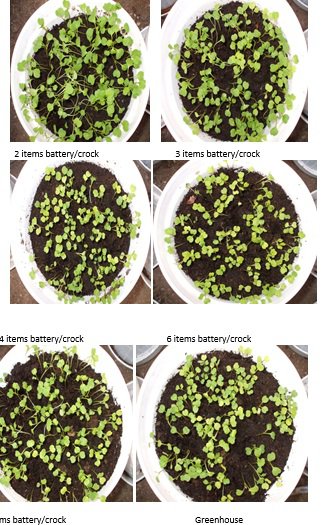
Using (28) 4 litre planting pots, grouped into 4's; each group receiving from 0 to 8 batteries measure of powder mixed with pure potting soil. Seedlings (Eruca Sativa) were placed in the soil, watered on schedule and placed in a heated greenhouse . The plants had a scheduled observation recorded and photographed to the present date.
Findings were recorded by:
- Length of plant - Number of leaves on each plant
- Diameter of leaf -Length of root -Material dryness of root, stem, and leaf
The experiments findings are counter checked by our university agriculture and veterinary team. With the findings of this experiment, it is obvious that a more reliable, responsible and effective means of waste battery disposal must be initiated. Two criteria for improvement would be:
Public awareness announcements and campaigns;
Our technology has increased astoundingly over the last several decades, and the potential for environmental damage from the same technology. Radiation from Computer monitors and mobile phones were widely publicized, effort by battery manufacturers to warn of the dangers of improper disposal was by a "Do Not" symbol on their packaging. These efforts were minimal and insufficient for the potentials of sickness, environmental damage and possible death waste batteries pose.
Governments are responsible for the public, people are the ultimate responsible offender for the situation. A continuous "Hazardous Material Clean-up" campaign is a necessity in today's society.
Results of the experiment showed specifically and dramatically the effect of battery powder has on plant life.
Governments are responsible for the public, people are the ultimate responsible offender for the situation. A continuous "Hazardous Material Clean-up" campaign is a necessity in today's society.
The Name of Project:
A research associated with waste battery on growing of plant, conditions of soil and plant accumulating the heavy metal in Roquette.
The Objective of Project:
Environment is an ambient physical, biological, social, economic and cultural. And human beings and other living beings during life maintain their relationships and their interaction reciprocally in this environment. In this connection, to maintain a healthy life is only possible with a healthy environment. An impairment of environment that is an associations system and environmental issues aroused generally has been started with man-made factors by spoiling the natural balances.
Nowadays, ecocide also immediately increases in parallel with growing of technology. One of technologic productions caused an environment destruction is batteries used immensely by us during everyday life (home, working places, industry and so on). But the level of adequate awareness has not been created unfortunately about waste batteries in our country.
However batteries included mercury, cadmium, lead, zinc, mangan, lithium, iron, nickel, cobalt and chemicals engender a considerable danger on human beings and environmental health. These substances can be flow into soil and ground water via soil, so initially soil and then water, plants and also animal and humans fed with these plants are damaged. It is appeared that diseases associated with waste batteries are initially neurologic disorder, central nervous system diseases, cancer, renal and liver diseases.
Besides, the damage of all substances in batteries can be reached to deadly magnitude. When taken into account that a small alkaline battery pollutes a soil area of 4 of square meter and that this soil is rendered to not be able to production the danger of magnitude can be understood. Therefore, waste batteries engender a considerable danger in terms of environmental and human health as well as we also mentioned above by their thrown into the dump as haphazard and their presentation directly or indirectly to the receiving environment.
But we don’t ignore that the technology improving provides easiness in our life. As we will not be able to discard technologic improvements, suitable environmental programmes are the most correct way to be ensued for environmental pollution and impairment of natural balance within acceptable limits. Two main criteria are implemented to decrease heavy metal level in batteries using heavy metal in the world. These,
- To decrease the level of heavy metal in batteries.
- To minimize the environmental damage with battery by collecting it separately.
Considering also above mentioned reasons, this project has been implemented to determine the negative effects of waste batteries on plants and to increase the level of awareness in our society in this particular.
Material and Method:
In this research, Rocket plant and six different doses of batteries were used to determine its effects on the growing of plant of waste batteries. The study was established with 4 of repetitive, and according to this 28 crocks were used in the study (1 type X 7 battery doses X 4 of repetitive).