
High-Level Project Summary
An application was developed where it will be possible for partners and volunteers to consult quickly and easily, where there are greater concentrations of marine debris and, subsequently, register quantities and types of marine debris found in cleaning actions. This solution solves the challenge through better monitoring, detection and quantification through citizen science in places where the tool still exists and the information is not accessible. Cleaner Beach aims to concatenate data and turn it into useful information for the entire community.
Link to Project "Demo"
Link to Final Project
Detailed Project Description
The project aims to use data from satellites to monitor marine plastic debris and users will also be able to enter relevant data on the subject to feed the database that will be used later by the general public.
•How it works?
With Cleaner Beach, the user will upload information about garbage collected on beaches and oceans to the database, using their smartphone. In the app you can still check your cleaning history at any time. Anywhere you can see the impact of your action contributing to a cleaner and healthier ecosystem.
The application will basically have two functionalities: inputs and outputs of data and information about plastic marine debris.
1) Inputs: will provide users with information on the concentration of garbage and residues on beaches, oceans and waterways closest to the user's own GPS activation. This information will be collected via satellite and subsequently decoded in a simple and objective way so that ordinary citizens can interpret the need for voluntary collection of plastic marine debris.
2) Outputs: each volunteer passionate and committed to cleanup actions on beaches and oceans selects their current location and sends significant information about the collection carried out. Users will feed the app with data on the date, time, location and amount of debris removed from the sea.
The app will use data generated by NASA's satellite and data entered by users that will be stored in a database for later reference. Satellites will use Machine Learning to distinguish marine debris more and more accurately. Artificial Intelligence will be used to obtain, categorize and filter data for viewing in a way that is more accessible to the public.
• What benefits does this bring?
This application intends to concatenate random and difficult-to-understand data and transform them into useful information for the entire scientific community, government agencies and the general public.
Through this data, instant reports of the garbage found and collected on beaches and in the ocean can be delivered, providing researchers and policy makers with information for better insight in decision-making.
• What do you hope to achieve?
We intend this application to become a database focused on the preservation area of the seas and oceans with easy, simple and effective usability.
Space Agency Data
Through the website https://www.epa.gov/trash-free-waters/toxicological-threats-plastic, the AI will categorize the plastic debris that will be filtered by Machine Learning.
https://www.nasa.gov/feature/esnt2021/scientists-use-nasa-satellite-data-to-track-ocean-microplastics-from-space. Research that shows how satellites are being used to track micro plastics.
https://earthdata.nasa.gov/learn/discipline/ocean. Site that shows maps in real time and that can be used to identify marine debris.
Hackathon Journey
We learned that only with local and regional efforts can we contribute to advances in preserving a healthy ecosystem.
The choice of the challenge was due to the perception of the lack of a regional and accessible tool.
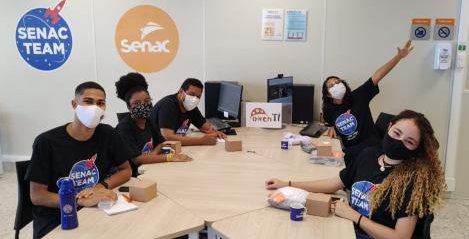
Thanks to the institution Senac for supporting the construction and implementation of this project.
References
NASA REFERENCES
https://www.nasa.gov/audience/forstudents/5-8/features/F_Remote_Sensing.html
https://appliedsciences.nasa.gov/
https://www.nasa.gov/audience/forstudents/5-8/features/F_Remote_Sensing.html
EXTERNAL REFERENCES
https://www.aoml.noaa.gov/phod/gdp/interpolated/data/subset.php
https://abrasat.org.br/2019/07/03/o-lixo-plastico-dos-oceanos-ja-pode-ser-monitorado-por-satelite/
https://www.esri.com/pt-br/what-is-gis/overview
http://www.dgi.inpe.br/documentacao/satelites/landsat
http://www.cbers.inpe.br/sobre/index.php
https://earthobservatory.nasa.gov/blogs/fromthefield/2012/09/18/plastic-ocean/
https://conexaoplaneta.com.br/blog/video-da-nasa-revela-as-ilhas-de-lixo-no-planeta/
https://www.moneytimes.com.br/rastrear-detritos-plasticos-pode-ajudar-a-limpar-oceanos/
https://socientifica.com.br/cientistas-usam-satelite-da-nasa-para-rastrear-microplasticos-no-mar/
https://www.youtube.com/watch?v=YQqBBmCzPiM
https://cryptoid.com.br/inteligencia-artificial/robo-vai-limpar-oceanos-com-inteligencia-artificial/
https://aiotbrasil.com.br/microsoft-apoia-ong-que-ajuda-a-limpar-os-oceanos/
https://jornal.usp.br/artigos/um-plano-para-a-compreender-e-combater-o-lixo-no-mar/
https://ciclovivo.com.br/inovacao/tecnologia/robo-vai-limpar-oceanos-com-inteligencia-artificial/
https://marinedebris.noaa.gov/partnerships/marine-debris-tracker
https://www.onlineathens.com/article/20140605/NEWS/306059951
Tags
#app #local marine debris #citizen science #monitoring
Global Judging
This project has been submitted for consideration during the Judging process.