
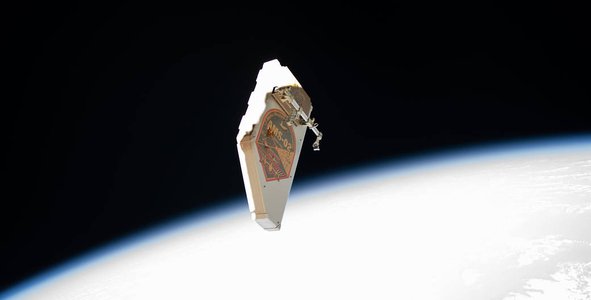
The increasing amount of debris orbiting Earth could potentially limit our access to space, impacting not only exploration efforts, but routine aspects of our life on Earth. Your challenge is to develop an open-source geospatial application that displays and locates every known debris object orbiting Earth in real time.
Summary
Details
Background
Though artificial satellites are not usually regarded as natural resources, the increasingly crowded orbits that they utilize very much are. Orbits around Earth provide us with invaluable vantage points to deploy spacecraft that allow us to study our planet and the rest of the universe. They also allow us to set up global telecommunication networks and satellite navigation systems that are used for a wide assortment of things from managing global airline traffic to requesting a cab. Low Earth orbits are also essential for crewed space exploration missions even when the final mission destination lies further away. Space debris endangers space operations and could potentially limit our access to space if it's not addressed.
Today there are nearly 22,000 artificial objects in Earth orbit, including 6,444 spacecraft (active and defunct). However, these statistics include only the objects large enough to be tracked. More than 128 million pieces of debris smaller than 1 cm (0.4 in), about 900,000 pieces of debris 1–10 cm, and around 34,000 pieces larger than 10 cm (3.9 in) are estimated to be orbiting Earth.
Over the years, spent rockets, satellites, and other space trash have accumulated in orbit increasing the likelihood of collision with other debris. Unfortunately, collisions create more debris, creating a runaway chain reaction of collisions and more debris. This phenomenon is known as the Kessler Syndrome after the man who first proposed the issue, Donald Kessler, or collisional cascading.
This cascade of collisions first came to NASA’s attention in the 1970s when derelict Delta rockets left in orbit began to explode, creating shrapnel clouds. Kessler demonstrated that once the amount of debris in a particular orbit reaches critical mass, collisional cascading begins even if no additional objects are launched into the orbit. Once collisional cascading begins, the risk to satellites and spacecraft increases until the orbit is no longer usable.
Kessler proposed it would take 30 to 40 years for such a threshold to be reached and today some experts believe we are already at critical mass in low-Earth orbit at about 560 to 620 miles (900 to 1,000 kilometers).
Objectives
Your mission is to develop an open-source geospatial (i.e., map-based, or virtual globe-based) application that displays and locates every known debris object orbiting Earth, in real time.
Potential Considerations
Your strategy might (but is not required to) include the following steps:
- Choose an open-source, geospatial virtual globe or mapping library (e.g., NASA WorldWind or OpenLayers).
- Obtain the orbital parameters for every currently tracked space debris object in Earth orbit (e.g., from Celestrak or Space-Track).
- From the orbital parameters of an object, obtain its geographical position (latitude, longitude, altitude) at the current time (a library such as SatelliteJS or Python's SGP4 can be used for this).
- Using its geographical position, locate the object in your geospatial library.
- Repeat from step 3 for all space debris objects in your chosen catalog.
- A fraction of a second afterwards, update the time, and repeat, providing a real-time animation of every space debris object in the catalog.
Your application could also include options for the following:
- Include debris clouds consisting of smaller objects for which we can only estimate the locations.
- Incorporate a user interface (UI) timeline feature to allow the user to see the orbital environment at a different point in time.
- Add satellite tracking capabilities. Predict when a particular object is going to pass over a user-selected location on Earth's surface.
Potential search keywords:
- Mapping/virtual globe libraries: openlayers examples, leaflet tutorials.
- General orbital parameter information to map space debris: two line element sets, AIAA 2006-6753, sgp4 propagator, celestrak space debris tle, space-track documentation.
- Software libraries to read orbital parameters in two-line element set (TLE) format: satellitejs library, nsat/jspredict library, pypi sgp4.
- Examples of open-source satellite trackers: stuffinspace, jsattrak, worldwind spacebirds
For data and resources related to this challenge, refer to the Resources tab at the top of the page. More resources may be added before the hackathon begins.
NASA does not endorse any non-U.S. Government entity and is not responsible for information contained on non-U.S. Government websites.