
High-Level Project Summary
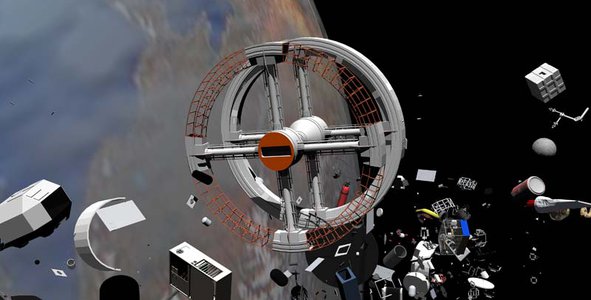
Contrary to popular beliefs, space around Earth is far from empty.Our project’s goal is to counter the “out of sight, out of mind” careless approach of the general public towards the issue of space debris. In order to make it memorable, entertaining and funny, we decided to show space debris from an Earthling’s perspective but with a twist: we have marked known space debris with oversized rubber duckies.
Link to Project "Demo"
Link to Final Project
Detailed Project Description
Live version available at: https://theduckening.earth/
Source files available at: https://github.com/mrcne/space-rddt-stellarium
It raises awareness about trash in space by allowing users to observe space debris from the Earthling’s perspective and makes people share fun videos with ducks.
Initially we were researching different approaches on
1. Data sources available.
2. Debris detection and monitoring methods & technologies.
3. Debris collision prediction algorithms.
4. Existing visualization solutions.
What we’ve found is that there are lots of existing websites and apps that can show you things orbiting near Earth or visualize the night sky.
But they are not engaging and fun enough! And they show a globe, and not a planetarium view.
So our focus was on building a website, where every person can learn more about what space trash flies above their heads. And to make the experience fun, people would love to share it.
Here comes the duck!
We’ve researched a few existing projects: cesiumjs, virtualsky, stuffinspace, stellarium or build our own using react-fiber-three. Picked stellarium due to its planetarium view and its popularity among astronomy enthusiasts and professionals.
Our duckbris in action:

Languages & Tools:
- JavaScript / HTML / CSS
- NodeJS, Vue.js, WebGL/WebAssembly
- AWS, github, github actions
- Python, C++
Projects:
- https://stellarium-web.org/ as our frontend
- https://www.space-track.org as data for backend
Basic functionalities we didn’t manage to finish:
- In wide Field Of View not limiting number of debris visible at one time
- Option to display debris as dots, not like ducks
- Rotating debris
- More transparent debris background
Future plans:
- Add the option to switch to globe view based on NASA WorldWind
- Orbit trace visualization
- Collision prediction and visualization
- Collision energy calculation
Space Agency Data
https://space-track.org - _the_ source of orbital elements for space debris etc.
https://orbitaldebris.jsc.nasa.gov/ - source materials for educational side panels
https://celestrak.com/ - secondary source for orbital elements, used for testing and debugging purposes
https://data.nasa.gov/browse?q=space%20debris&sortBy=relevance
https://data.asc-csa.gc.ca/users/OpenData_DonneesOuvertes/pub/NEOSSAT/ASTRO/ - for the initial idea of computer-vision based tracking
Scientific papers:
https://ntrs.nasa.gov/api/citations/20070024897/downloads/20070024897.pdf -"The predicted growth of the space debris environment - an assessment of future risk for unmanned spacecraft"
https://www.hou.usra.edu/meetings/orbitaldebris2019/orbital2019paper/pdf/6048.pdf - "Refined Study of Space Debris Collision Warning Techniques"
Hackathon Journey
Our journey started from familiarizing ourselves with the grave importance and dangers of the space debris orbiting Earth - both to our astronauts and spacecraft in/enroute to orbit and to us Earthlings.
After reviewing https://orbitaldebris.jsc.nasa.gov/ and the physical basics of space debris origins, behavior and tracking solutions - physics and orbital mechanics primer by our team’s resident astrophysics PhD student - we decided to raise awareness about space debris by making the issue memorable - or even a bit haunting - as well as funny.
In order to do so and to increase the “impact factor”, we opted on putting the observer on the surface of the Earth instead of a “canonical” outside-in view of classical satellite tracking software -that is quite a disembodied and impersonal experience - as well as representing space debris with extravagantly oversized rubber duckies.
In order to achieve this, we decided on Kanban-style approach to software development which was something quite new for the science part of our team.
During development, we faced numerous problems that we persevered through or hacked our way around, starting from many hours spent on finding a proper and up-to-date source of orbital elements for space debris and a proper API to propagate and visualize them. To streamline the acquisition of orbital parameters we decided to setup an AWS cloud proxy server. We’ve built a script to get data from space-track, so the next step might be to have a cron job that queries and updates the data for our backend and caches it in a suitable interval, so our frontend gets up-to-date data, which is more frequent than existing solutions.
References
Planetarium/GUI: https://stellarium-web.org/
Source of debris’ orbital data: https://www.space-track.org and https://celestrak.com for debugging and testing purposes
Tools: VUE.js, Python, Spyder IDE, WebGL/WebAssembly, Microsoft Visual Studio Code, JavaScript / HTML / CSS, NodeJS, WebGL/WebAssembly, AWS, github, github actions, C++
Tags
#spacedebris, #spacejunk, #earthbound,#outofsight-outofmind,#rubberduckies
Global Judging
This project has been submitted for consideration during the Judging process.