
High-Level Project Summary
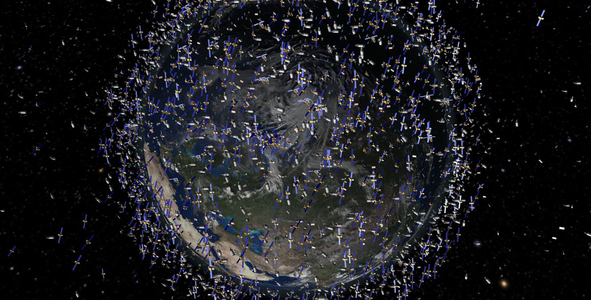
The project that we chose is ''Mapping Space Trash in Real Time'' Starting with Sputnik 1 in 1957, space debris is starting to be one of the most important problem for the future. With the technology constantly progressing this problem is starting to be even more dangerous. According to the latest researches, United States Department of Defence (DOD) says that they have discovered more than 27.000 space debris around Earth. How we solve this problem is pretty easy to acknowledge. We plan to solve it by designing multiple satellites using data transmission between themselves and the Earth, and collecting and judging data about space trash (e.g its location, its momentum and what it's made of)
Link to Project "Demo"
Link to Final Project
Detailed Project Description
The project that we chose is ''Mapping Space Trash in Real Time'' Starting with Sputnik 1 in 1957, space debris is starting to be one of the most important problem for the future. With the technology constantly progressing this problem is starting to be even more dangerous. According to the latest researches, United States Department of Defence (DOD) says that they have discovered more than 27.000 space debris around Earth. Even though this number seems low it definitely is high enough to not ignore it. One of the biggest threat that space debris poses us is, it obligating satellites to change their orbits. Though we can't say that this is the only threat. If these space debris grow more and more in the future we probably will need to somehow exterminate it when we want to do any kind of space travel. Another one of our problem being, even though it isn't very likely, space trash can also fall on Earth and it can bring harm to some locations or people. With mapping these space debris we can predict where their locations will be and prevent the harm that they will cause. Our work on this issue is like this: First of all, we are going to use two digital telescopes (one being in the equatorial trajectory and the other one being in the polar trajectory) that are going to calculate the location and momentum of space debris. These digital telescopes will be capable of detecting every wavelength between radio waves and gamma rays, it will also be capable of detecting the electromagnetic wave spectrum that space trashes absorb. With this we are going to understand what kind of metal the trashes are. After this step we are going to have the two telescopes send the information that they gathered to our main satellite. Our main satellite is going to send the information to the computers on Earth and these computers will name the space trash they gathered. These computers will also predict the next locations of the space junk that they named and they are going to make 3D orbit models that shows the space debris location
Space Agency Data
We have gathered the data of space debris' increase per year from (esa.int) and satellite tracklng from CelesTrack and similar sites (in the Reference)
Hackathon Journey
We have worked for this project for 2 days nonstop and finally finished it. When we saw this project topic it caught our eyes. We knew this topic was serious and we wanted to solve this. This was our basic mindset. Everyone in our team had cram school so we had limited time. This was the most challenging issue. But with distributing tasks, we managed to work it out. We would want to thank our biology teacher for letting us know and helping us participate this Hackathon.
References
DigitalGlobe (https://www.digitalglobe.com/) JSC Vimpel (http://spacedata.vimpel.ru/) LeoLabs (https://www.leolabs.space/) Planet (https://www.planet.com/) SeeSat-L ( http://www.satobs.org/seesat/seesatindex.html, https://www.prismnet.com/~mmccants/tles) Union of Concerned Scientists ( https://www.ucsusa.org/nuclear-weapons/space-weapons/satellite-database) USSPACECOM (https://www.space-track.org/) CelesTrak (https://celestrak.com/) European Space Agency (esa.int) LeoLabs https://www.leolabs.space Planey https://www.planet.com
Global Judging
This project has been submitted for consideration during the Judging process.