
High-Level Project Summary
We created a lesson plan, a Bill of Materials as well as a novel & cost-effective HAB design to help students launch their HABs following proper guidelines. We were able to come up with a design that reduced the total budget of producing the HAB to almost $400, compared to the standard $1000 allocated by NASA for programs like BalloonSat. The affordability of our project aims to encourage more students to venture into scientific ballooning. This provides an opportunity for the students to understand and explore how HABs work, get hands-on experience, and understand their importance as an economical way of carrying out scientific experiments in near-space conditions.
Link to Project "Demo"
Link to Final Project
Detailed Project Description
LESSON PLAN DESCRIPTION
Our team has designed a detailed, comprehensive study plan which is meant to assist instructors in planning schedules and courses targeted at the higher-secondary students interested in scientific ballooning.
We began by identifying standard correlation matrices, or topics that one must be proficient in, to comprehend the workings and structures of a High Altitude Balloon. We compiled a list of key topics in the field of Science, Mathematics, Technology, and Arts along the lines of Planetary Sciences, Algebra, Data Handling, Multicultural Interpretation, etc.
India has a rich history of scientific ballooning. However, it is unfortunately undervalued. Our lesson highlights the diligent efforts of the TIFR (Tata Institute of Fundamental Research) and Late Dr. Homi J Bhabha - an exemplary pioneer in the field of Indian Research and Science. The reason behind including this is to inspire and intrigue the younger generation of India to carry a patriotic sentiment and stimulate the growth of scientific knowledge. The Indian Scientific ballooning community of today owes its legacy to the blood, sweat, and tears of all those who dedicated their lives to reaching for the skies.
We have included a section called ‘engineering possibilities’ where we have highlighted segments of traditional design, which are constantly in a state of upgrading. We at team MOVIS believe that there’s always room for improvement, and this notion is something which we want to impart to the future generation.
HABs are commonly used to conduct studies with weather and associated anomalies, but they may also be utilized for a variety of other purposes. Some of these unusual notions, such as cosmic rays, magnetospheric physics, and sprites study, have been categorized as "scientific possibilities."
“The strength of the team is each individual member. The strength of each member is the team.” - Phil Jackson.
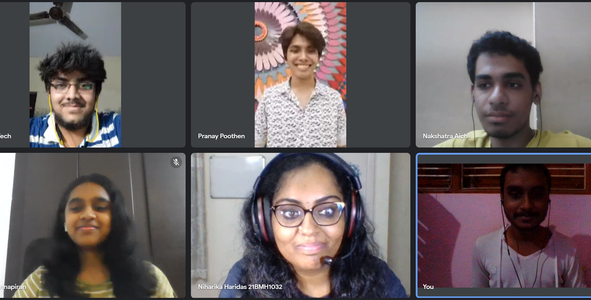
Team Movis is made of people coming from different backgrounds, united for one challenge. We strongly believe in teamwork, which is why we included a section called "Build a Team". Here, We've discussed how to efficiently delegate work by awarding titles such as Mission coordinator, launch coordinator, and payload recovery coordinator to personnel assigned to a particular segment of the HAB project.
The purpose of the "Roadmap" is to assist instructors in teaching students about what happens behind the scenes of the HAB process. It splits the entire process into phases so that students may be taught in a clear and understandable manner and are not overwhelmed by the amount of information available. It examines what should be taught to students both conceptually and practically in the weeks running up to the HAB launch. In order to assist educators, we included a thought-out Roadmap that provides a detailed overview of how a teacher can introduce the project to their students and keep them engaged.
We felt it would be irresponsible to disregard the present global pandemic and devised an innovative way to keep the students as well as the instructors motivated during these trying times. We call it our “COVID Modification Plan”. We thought of some distinct scenarios and created several techniques to conduct activities and experiments in those circumstances.
More details regarding it can be followed by this link - https://drive.google.com/file/d/195x_wZG3v8IwfqRYVGrNiS8MGFIRpEcm/view?usp=sharing
 BILL OF MATERIAL & TECHNICAL REPORT
Our bill of material showcases how efficiently we have used our resources to minimize the cost while not compromising on the functionality also providing all the necessary technical details involving the Calculations, Measurements & Assembly of all the Components .
Details of the Bill Of Materials - https://drive.google.com/file/d/1beja8lbE1cDYVk-8oEJBjhaSFYRCsGXn/view?usp=sharing
Details of the Material Links (Where can they be accessible) -
https://drive.google.com/file/d/1EZt06nQchbdfRD9SNhs7spSVTwVgdYmL/view?usp=sharing
Details of the Technical Report and Assembly - https://drive.google.com/file/d/14jYclXrD6sEzwf5aP1EMPeBKirAnGa8f/view?usp=sharing
 POTENTIAL CONSIDERATIONS AND INNOVATIONS INVOLVED
Our team tried to Cover all the necessary potential consideration provided by the SpaceApps Challenge team in our Lesson Plans and Bill of materials.
The Final cost that we calculated is less than 50 % of cost that NASA allocates for BalloonSAT project per year.
How we covered all the points ?and What are the innovations involved in the reports are discussed in the following Document -
Document Link for Potential Considerations - https://drive.google.com/file/d/1AmEoQfNe7IGh4riTI4DOA0X21OUsqe82/view?usp=sharing
Space Agency Data
We have made use of data from different research organization’s (like NASA) open source data from a variety of space organizations as well as scientific publications related to the topic. Following is the listing of different resources we have used to assist our project in their respective topics,
DIY Balloon designing
- Scientific Balloons-Types of Balloons – from NASA.gov
- Scientific Balloons – Columbia Scientific Balloon Facility - NASA
- Scientific Balloons – Goddard Space Flight Center - NASA
Assembly and Launch
- B-Line to Space: The Scientific Balloon Story – NASA Wallops
Hackathon Journey
Team Movis is made of people coming from different backgrounds. We have members who have won a challenge (NASA rover challenge 2021- Overall Award 3rd) to people who have no past experience in such competitions. Our initial research for the NASA space app challenge started with reading and analyzing the basic components of professionally made and launched High Altitude Balloons. We did not restrict ourselves to theoretical knowledge but conducted different activities like a survey(which had over 500 responses - picture attached ), STEM activities in rural areas by teaching the underprivileged about experiments like DIY HABs, model rockets.
We revised our fundamentals completely to work on this project and substituted various components with DIY projects as they not only reduce the cost drastically but also helps students in learning various important life skills. All the DIY projects are included in the report to aid the students and teachers in the process. We also thought of incorporating remote learning in the lesson plan because of the current situation the world is in.
For the final run, we started presenting our project to our teachers and peers for their opinion and suggestions regarding our project because first hand reviews are essential for any practical project.

References
References from webpages
- Scientific Balloons-Types of Balloons – from NASA.gov
- Scientific Balloons – Columbia Scientific Balloon Facility
- Scientific Balloons – Goddard Space Flight Center
- How much hydrogen is needed to lift 220 lbs. at least 100 ft high – answered by Les Mclean ON Quora
- Balloon Performance Calculator Tutorial – High Altitude Science
- Velocity During Recovery – Glenn Research Center
- Balloon Burst Calculator – habhub.org
- Weather Balloon – from Wikipedia
- High-Altitude Balloon – from Wikipedia.org
- Solenoid Valve-How they Work – from Tameson.com
- Lifting gas – from Wikipedia.org
- Superpressure balloon – from Wikipedia.org
- Zero Pressure Balloons – from ravenaerostar.com
- Space Camp Lesson#3-Flight Path Prediction - from launchwithus.com
Video References
- B-Line to Space: The Scientific Balloon Story – NASA Wallops
- DIY model rocket parachute. Simple, cheap, easy – Something Crawfishy!
- How to Calculate Burst Altitude for Balloons and HabHub Overview - SciJoy
- The Ultimate Weather Balloon Guide to Sending Anything to Near-Space – Science Filmmaking Tips
- Building an Arduino based APRS Radio Tracking System for High Altitude Weather Balloons – Overlook Horizon
- Model Rocket Flight Computer with Arduino – LabRatMatt
- ESP32 GPS Tracker Circuit Build Tutorial - CETech
- Introduction to APRS the Automated Packet Reporting System - Ham Radio Q&A – KB9VBR Antennas
- How to build a High Altitude Balloons – The Space Gal
- How to Build, Launch, and Recover a High Altitude Balloon. - Dwayne Kellum
- How to track & recover a NWS weather balloon & radiosonde – Overlook Horizon
- Features Not Standard: Weather Balloon Launch and Recovery! - Adam Savage’s Tested
References from Journal
Nayak A., Sreejith A.G., Safonova M., Murthy J., (2013) High-altitude ballooning programme at the Indian Institute of Astrophysics. Current Science, 104: 708-713
Davidsen A.F., Hartig G.F., Fastie W.G. (1977) Ultraviolet spectrum of quasi-stellar object 3C273. Nature 269: 203 cite
Sreejith A.G., Nayak A., Murthy J. (2012) Bal-loon Observations at the Indian Institute of Astrophysics. 39th COSPAR Scientific Assembly, Aug.2012, Mysore, India. TFS-C-057PSB.1-0043-12, COSPAR Abstract Book, p. 234
David J.S. (2013) Microbes in the Upper Atmosphere and Unique Opportunities for Astrobiology Research. Astrobiology. 13(10): 981-990
Narlikar J.V., Lloyd D., Wickramasinghe N.C., Harris M.J., Turner M.P., Al-Mufti S., Wallis M.K., Wainwright M., Rajaratnam P., Shivaji S., Reddy G.S.N., Ramadurai S., Hoyle F. (2003) A Balloon Experiment to detect Microorganisms in the Outer Space. Astrophysics and Space Science, 285: 555-562
Smith D.J., Griffin D.W., Schuerger A.C. (2010) Stratospheric microbiology at 20 km over the Pacific Ocean Aerobiologia 26: 35-46
Nirmal K., Sreejith A.G., Mathew J., Sarpotdar M., Ambily S., Safonova M., Murthy J. (2015) Pointing system for the balloon borne telescope. The 33rd Meeting of the ASI, Feb. 2013, NCRA, Pune
Sreejith A.G., Mathew J., Sarpotdar M., Mohan R., Nayak A., Safonova M., Murthy J. (2014) A Raspberry Pi-Based Attitude Sensor. Journal of Astronomical Instrumentation, 3, 1440006: 1-10
Tong W. (2010) Wind Power Generation and Wind Turbine Design. Kollmorgen Corp. USA
Sarpotdar M., Murthy J., and Agarwal V.K. (2014) Development of a Miniature Star Sensor. XXXII Meeting of the Astronomical Society of India, March 20-24, 2014, Mohali
Ambily S., Mayuresh S., Mathew J., Sreejith A.G., Nirmal K., Safonova M. and Murthy J. (2015) Development of Detectors for Balloon and Space Flights. Proc. Golden Jubilee (XXXIX) Conference of the Optical Society of India, February 20-22, 2015, Calcutta
Sreejith A.G., Safonova M. and Murthy J. (2015) Near ultraviolet spectrograph for balloon platform. Proc. SPIE 9654, International Conference on Optics and Photonics 2015, 96540D
Vasudevan R., Sreenivasan S., Suneel K.B. and Kulkarni P.M. (2012) Report on the Activities of National Balloon Facility, Hyderabad. 39th COSPAR Scientific Assembly, 39, 2061
Fuke H., Akita D., Iijima I., Izutsu N., Kato Y., Kawada J., Matsuzaka Y., Mizuta E., Namiki M., Nonaka N., Ohta S., Saito Y., Seo M., Takada A., Tamura K., Toriumi M., Yamada K., Yamagami T. and Yoshida T. (2010) A new balloon base in Japan. Advances in Space Research, 45: 490-497
Smith I.S. (2002) The NASA balloon program: an overview. Advances in Space Research, 30: 1087-1094
Nuttall W.J., Clarke R.H. and Glowacki B.A. (2012) Resources: Stop squandering helium. Nature, 485, 7400: 573575
Navick X.-F., Carty M., Chapellier M., Chardin G., Goldbach C., Granelli R., Herv ́e S., Karolak M., Nollez G., Nizery F., Riccio C., Starzynski P. and Villar V. (2004) Fabrication of ultra-low radioactivity detector holders for Edelweiss-II. Nuclear Instruments and Methods, A 520: 189-192
DEVELOPMENT OF ULTRA-THIN POLYETHYLENE BALLOONS FOR HIGH ALTITUDE RESEARCH UPTO MESOSPHERE (B. Suneel Kumar*†, N. Nagendra†, D. K. Ojha†¶, G. Stalin Peter†, R. Vasudevan†, D. Anand†, P. M. Kulkarni†, V. Anmi Reddy†, T. V. Rao†, and S. Sreenivasan†)’
Creation of Western Oregon University Weather Ballooning Program: GPS Tracking, Heating Circuitry, and Balloon Filling Procedure (Justin Schepige ,Janet Tate, William Schoenfeld)
Overview of Zero Pressure Balloons and Independent Manufacturing Design (Grant G. Ransdell and Austin S. Mills. University of Alabama in Huntsville, Huntsville, Alabama, 35816)
Tags
#space #science #research #hab #vitian #india #report #billofmaterials #technology #Artemis #nasa #knowledge #isro #innovation
Global Judging
This project has been submitted for consideration during the Judging process.