
High-Level Project Summary
We developed a Lesson-Plan and Bill of Materials (BOM) that teaches students how to build alow-cost, High-Altitude Balloon (HAB)capable of reaching near-space. It includes:1.How does physics determine the size/weight/design of the (HAB)?2.The materials needed and the places to purchase them3.The different types of technology used to track a (HAB)4.What government organizations that the students must coordinate with to launch the balloonand regulations must be followed?5.What cautions must students take when launching a (HAB) and how can predict the flightpath?We strongly believe the lesson-plan we are developed it is very important because will it becomea reference for each student
Link to Project "Demo"
Link to Final Project
Detailed Project Description
The Balloon Applications:
Scientists use scientific data collected during balloon flights to help answer important questions about the universe, atmosphere, the Sun and the space environment. Questions such as "How did the universe, galaxies, stars, and planets form and evolve?" and "Are there Earth-like planets beyond our solar system?" are being answered by NASA with the help of experiments flown on scientific balloons.
The Balloon Flighting Principle:
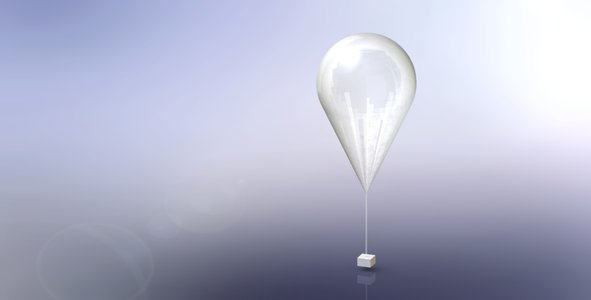
The idea of the balloon flight is based on the scientific principle that the helium gas inside the balloon is lighter than the air surrounding the balloon (lower density) as it rises above it, the balloon is filled with helium gas, and then the helium gas inside the balloon becomes lighter from the air surrounding it from the outside, it is thus able to rise in the atmosphere of the sky. And this process is called buoyancy, we also know from Archimedes’ principle that a body immersed in fluid experiences a buoyant force equal to the weight of the fluid it displaces.
Scientific Balloons Advantages:
1.Can be launched from locations worldwide to support scientific needs.
2.Can be readied for flight in as little as six months.
3.Offer a low-cost method of conducting science investigations.
4.Provide a stable platform for longer flight durations.
We hope our lesson-plan “as we believe” it be as a useful reference for students, where students will find all the means available to them to build their own balloon in a scientific way; it includes (Planning, Materials, Tracking, Preparation, and Launching).
We two programs one for determines exactly how much helium you need, and calculates the altitude at which the balloon will burst, as well as the ascent rate; it call (Balloon Performance Calculator), and other one for flight prediction, it call (CUSF Landing Predictor).
We aim to launch development ideas that serve the challenge in the near future.
Space Agency Data
1. https://www.csbf.nasa.gov/balloons.html
2. https://www.nasa.gov/scientific-balloons/types-of-balloons
3. https://www.grc.nasa.gov/www/k-12/WindTunnel/Activities/buoy_Archimedes.html
We used these resources to explain Archimedes’ principle for buoyancy, and define the cautions
must be taken when launching a High-Altitude Balloon, and much more.
Hackathon Journey
Our experience was full of enthusiasm, especially when we found the challenge of our passion
and dream, the challenge of the High-Altitude Balloon (HAB). We increased our passion to work
on it, develop it and gain additional knowledge about (HAB).
The approach we used to develop the project was based mainly on three methods:
1. Open resources, for example (NASA).
2. Previous research experiences of our team.
3. Direct communication with experts in this field.
The students will get the full lesson and find simple ways to build a balloon, also they will find
websites that will make it easier for them, that will simply enter some values to obtain the
amount of helium gas to be added, burst altitude, the prediction of the flight path, landing area,
etc., as well as the locations where the materials are purchased and at a low price.
Our previous research experiences in this area are the main reason that inspired our team. We
strongly believe that we have sufficient skills to offer innovative solutions that serve this
challenge, as well as our desire to help students to create their own balloon in a simple and low-
cost way.
Our team overcomes difficulties and challenges depending on our previous research experiences
in this field, and our collaboration, as well as our deep knowledge in this field.
Last but not least we would like to thanks two people:
Firstly; His Royal Highness Prince Mohammed bin Salman bin Abdulaad Al Saud, who was
interested in hosting such events, which in turn gave us an opportunity to participate in this
challenge.
Secondly; Professor Mohammed Hashim Siddig, of the University of Khartoum for providing
many consultations for us, and his supervision of our previous research.
References
1. https://www.csbf.nasa.gov/balloons.html
2. https://www.nasa.gov/scientific-balloons/types-of-balloons
3. https://www.grc.nasa.gov/www/k-12/WindTunnel/Activities/buoy_Archimedes.html
4. https://www.overlookhorizon.com/flight-safety/
5. http://web.physics.ucsb.edu/~lecturedemonstrations/Composer/Pages/36.39.html
6. https://www.stratoflights.com/
7. https://www.highaltitudescience.com/pages/tracking-a-weather-balloon
8. http://habhub.org/
9. Archimedes, H.T.L. (ed): The works of Archimedes, New York, (2002)
10. A field visit to the monitoring management experts in the General Authority for
Meteorology and Environmental Protection in the KSA.
Tags
#Sitl_Scientific_Balloon #High_Altitude_Balloon(HAB) #Scientific_Balloon #Weather_Balloon
Global Judging
This project has been submitted for consideration during the Judging process.