Awards & Nominations
THE OCTOPUS TEAM has received the following awards and nominations. Way to go!
Global Nominee

THE OCTOPUS TEAM has received the following awards and nominations. Way to go!
According to NASA, most users of its open data portal find it difficult to start searching due to the large volume of data that is not intuitively organized on the site. With this in mind, The Octopus group created a platform that, through the process of language and machine learning, makes an intelligent, fast search that allows the user to understand all the possible relationships between the search term and the eight major categories provided by NASA. In addition, the Webapp delivers an intuitive interface, which allows the user to create a new interaction with data inside and outside NASA's portal, through the octopus system.
We are the team The Octopus, which is composed of members Jonathas Ribeiro, Maria Luiza R., Milena Barbosa and Pedro Lucas A. We chose the challenge 'Ontologies and interactive network visualizations' because we saw a great potential of this technological term, which arises by first time in ancient philosophy, founded mainly by Aristotle, a philosopher and a great initiator of the conception of classical science. Ontology in philosophy is part of metaphysical studies, which, unlike what many may think that metaphysics is a study of something outside the world of phenomena, is knowledge about reality, or the possible realities to be known by us. Thinking about ontology is thinking about the search for “being as being”, as defined by Aristotle, a search for the essence of what guarantees being.
This search for the essence of being allows us not only to capture the thing we intend to know, but it is through the essence that we are given the possibility of defining things, seeking their origins and, the main thing for solving our challenge here, because the study of ontology is what will allow for the categorization and classification of things. Therefore, in technology, ontology will receive from this tradition the need to know things and order them through what we will later call taxonomy in biology, showing the relationships and hierarchies between beings. Thus, when a good ontology analysis is done, it is possible to discover new and precise rules for the organization of beings, defining their relationships and their logical rules, allowing us to know not only the things given there, but making us understand the meaning and the connection of those different beings to each other.
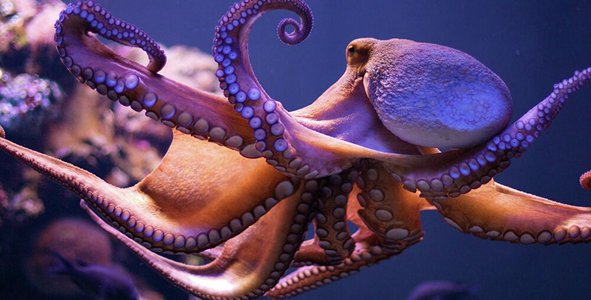
In the animal kingdom, categorization through 'being' is common, and for other areas they serve as more didactic examples, so we created the Octopus System. Here, the octopus will be an example of being that fits in perfectly with NASA's needs, as well as being an extremely curious example.
As it is a solitary animal, the octopus learns many things through observation, they are intelligent beings and, thus, the Octopus Web app will work. A system with machine learning and natural language processing (NLP)
Polvo is a new fast, intelligent and intuitive search tool, allowing the user, when entering the page, to recognize the eight large tentacles of Polvo, which represents the categories already existing on the NASA portal; Aerospace, Applied Science, Apps, Earth Science, Management/Operations, Raw Data, Software and Space Science.
For the development of the front-end the Javascript language was used together with the ReactJs framework, allowing a more dynamic and reactive interaction with the functionalities that are presented to the user on the homepage. When choosing the area, he will be directed to the keyword search page, and the search will narrow and be refined, not only being presented to him the searched terms in the desired area, as indicated on the side, the subject of his interest and his connection with the other tentacles.
Since the platform aims not only at categorization, but also at facilitating research and interconnecting the areas, two API's were created in the back-end. The first API is responsible for querying other API's, organizing the data obtained by it so that they can be presented in a coherent and pleasant way and returning the results to the front-end. The API's consulted are GeneLab Public API, NASA Image and Video Library and Data.gov CKAN API.
In addition to being sent to the front-end, the obtained data is also sent to a second API, responsible for performing Natural Language Processing (PLN). This action aims to classify the relevance of the data queried by the user in a given area. It is by discovering which terms are most present in the data that it will be possible, based on this information, to recommend to the user other tentacles that are related to those that have already been consulted. This information is later saved in a database and will be investigated to recommend data not only for the user who queried it, but also for future queries from other users who used the same keywords. Thus, when people search on sun data, for example, other future users who researched on the same subject, received indications of the most used and viewed data from that search/term.
The site has a very effective internal improvement, apart from the Webapp's intention to promote fantastic results for the scientific encouragement of countries that adopt such system, since the user, when logging in, will be able to create a research profile and feed the platform as a new insertion of data and being able to generate research engagement, as it will be possible in future steps, to cross-reference researchers from certain areas that are studying and are close to each other.
https://github.com/jonribeiro23/nasa-cluster-1
https://github.com/jonribeiro23/nasa-cluster-2
We use the data by searching the search for API's made available by NASA and the American Government. The most used fields were those that detailed and described the studies, such as description, methods and results. Through the data obtained in these fields, it was possible to carry out Natural Language Processing.
We've learned a lot from Space Apps, especially time management and teamwork. The biggest challenge was understanding the problem and what should be done. After that we had a lot of fun.
We chose this challenge because we are students and we understand the pains of researchers who depend on databases to work. Our inspiration was the university routine and, of course, the octopuses!
Resources - libraries
· lask-JWT-Extended
· Flask-RESTful
· flask-cors
· Flask~=1.1.2
· Werkzeug~=1.0.1
· pymongo~=3.11.2
· PyJWT~=1.7.1
· dnspython
· psycopg2
· requests~=2.25.1
· uwsgi
· fsspec
· pandas
· nltk
· sigma.js
Languages
· Python
· Javascript
Frameworks:
· React
· Flask
DATABASE:
· MongoDB
#ontology
This project has been submitted for consideration during the Judging process.
Tens of thousands of NASA datasets are publicly available online, but with so many files available, how can potential users determine those that will meet their needs? Your challenge is to (1) create an ontology to integrate descriptions of disparate NASA data sets, and (2) develop an interactive network visualization to depict relationships among those data sets.