
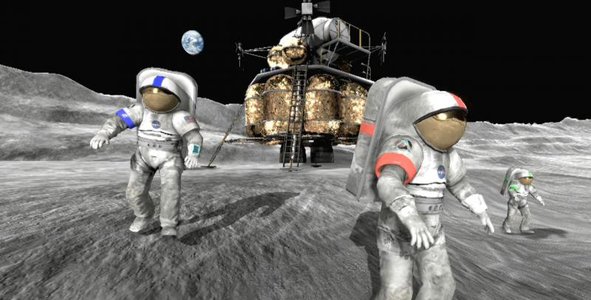
NASA’s near-term space exploration plans include returning to the Moon and future plans include landing a crew on Mars. Your challenge is to create an inspiring and educational video game or interactive 3D model to simulate a landing on the Moon or Mars!
Summary
Details
Background
NASA’s near-term space exploration plans include returning to the Moon and future plans include landing a crew on Mars. The Agency supports efforts to inform and educate the public about these important endeavors. Publicly available information about NASA's Artemis Program and the Apollo Lunar Excursion Module can provide data required to address this challenge, including information that will inspire the public to learn more about the NASA Artemis program and NASA history.
Objectives
Your challenge is to create an inspiring and educational video game web application or interactive 3D model to simulate a landing on the Moon or Mars! When developing the video game or 3D model, think about how it could educate or inspire the player.
Products from this challenge should be deployed as web pages that include embedded web apps. The web page may provide instructions on how to use the web app.
If you reuse free open-source assets or content released under a Creative Commons license (such as artwork, models, code bases, or textures), comply with all appropriate requirements.
Potential Considerations
As you develop your video game web application or interactive 3D model, you may (but are not required to) consider the following:
- Depending on your team's level of experience, your video game could range from an “old school” 2D side scroller to a first-person WebVR experience:
- Old school 2D video game - a profile of hills and craters scroll by as you control a lander with arrow keys to find and land on a surface that is relatively flat. Teams with intermediate programming experience could implement physics equations to create a more realistic simulator.
- First-person WebVR experience - a first-person game could be implemented with a game engine that provides some physics simulation of gravity. Research the gravity of the Moon or Mars to adjust the parameters for more realism. Teams with intermediate experience may want to develop or apply code to procedurally generate a rough surface. Moon Trek and Mars Trek (see Example Resources) are NASA web apps that enable you to download a small section of the 3D model of the Lunar or Martian surface.
- Objectives of a video game could be exploration, scientific, or commercial. For example, an exploration game could present a fuel gauge indicating near-empty status or a low propellant supply when the nearby surface is not suitable for landing. The player would then need to find a good place to land before the fuel or propellant runs out. A game with a science-driven objective could simulate a hopper that the player could maneuver to visit multiple sites to collect samples. A game with a commercial objective could involve planning the delivery of multiple payloads to the surface and successful delivery could result in payment. Development of surface infrastructure will require the delivery of heavy equipment and there could be multiple companies delivering payloads; so, a strategy-based game could involve placement of equipment to enable infrastructure development.
- If your team is more interested in design and visualization, consider developing an interactive 3D model of a planetary lander for humans, robots, or cargo and embed the model(s) into a web page. The Graphics Language Transfer Format (GLTF) or binary GLTF (GLB) models can be embedded in a web page. A model could present an exterior view of a lander on a surface, the interior, or both.
- Potential keyword search terms to find additional resources include: tutorial to embed 3D model in a web page, free open source game development, 3D JavaScript game engine, code repository, creative commons. Inclusion in this list of search terms does not constitute an endorsement.
For data and resources related to this challenge, refer to the Resources tab at the top of the page. More resources may be added before the hackathon begins.
NASA does not endorse any non-U.S. Government entity and is not responsible for information contained on non-U.S. Government websites.