
High-Level Project Summary
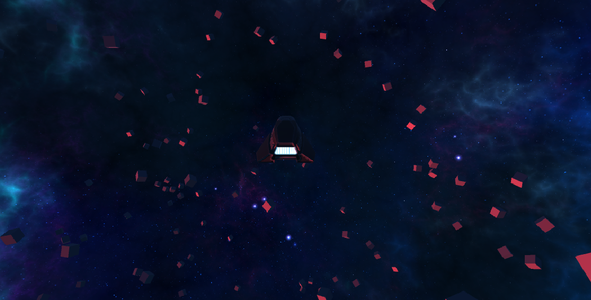
Our team developed an exploration game that focuses on the trials of a deep space voyage to an exoplanet to discover life. The game would focus on both the journey and the challenges of exploration that humanity would face to find habitable planets beyond Earth. It will explore how advanced probes and AI can be used to explore an exoplanet hundreds of light years away from us.
Link to Project "Demo"
Link to Final Project
Detailed Project Description
Our project is a video game that focuses on exploration, puzzle solving and story. It is set on the distant planet Kepler 186f, an Exoplanet that NASA discovered in 2014 that was in the habitable zone of it’s solar system. The planet is Earth-sized and is in a Solar System with a red sun, making it extremely good to sustain life. We wondered what the surface of such a planet would look like and how we could reach such a distant planet; a planet that is more than 500 light years away from us.
We thought about the possibility of Cryogenics to keep humans in stasis for such a long time but we believe that it is unfeasible and dangerous to send humans like that to a planet that has no guarantee of finding life. Hence, we believed that the best method would be to send an artificial intelligence such as a robot on this voyage instead to collect the information and send it back. Of course in space there are many challenges one would face while traveling to such far places, such as Cosmic ray bombardments and moving celestial objects. However, we believe that in the distant future humanity will have discovered ways to circumvent the difficulty of attaining energy (perhaps by using nuclear fusion or harnessing cosmic rays) to provide enough energy for a lone spacecraft to travel great distances.
An AI will lower the risk of such travel and allow humanity to observe these planets safely and send this data back to Earth for further study. This in turn will allow us to make actual missions to send people to colonize a planet. To send an AI will ensure that we can collect as much data as we need with minimal risk.
The challenge of discovering life comes from what we can find. Our video game represents the surface of Kepler 186f and we believe that the surface of such a planet would be rocky, if it is similar to Earth. Currently, we do not know if there is any form of life on the surface but it is possible that Kepler 186f might be a young planet and has yet to develop intelligent species of life. Furthermore, NASA’s discoveries indicate that Kepler 186f may have a very low surface temperature hence our game would focus on the exploration of not only the surface of Kepler 186f, but the inner caverns as well. These caverns could easily hold oceans of water and other organisms, with life being aided by the geothermal vents underneath the crust.
To develop our game, we used a combination of Unity and C#. C# is the main language used in Unity to create scripts to code behavior and interactions. Unity is a powerful game engine tool and we were able to make a 3D game in a very short period of time. It was challenging considering how new we were to this technology but we were able to create a functioning video game from it. For terrain creation and modelling we used Blender as it allowed us to visualize complex 3D models with ease. We are extremely proud of what we have created in such a short time but we believe we could do even better if we had more time. We had plans to create complex caverns underneath the crust for players to explore and see how a planet that has yet to completely develop life could look below the surface. Furthermore, we wanted to create oceans underneath the surface to see what it is like. We also would have developed a terrain scanning mini game and a chemistry game to see if any organisms exist in the liquid. Finally, we wanted to create an inverse kinematics system to allow players to scale the mountains and rocky terrain to explore an even more open world.
Space Agency Data
Our project used data from NASA, specifically from NASA's astrobiology website and details about exoplanets.
We used the data of exoplanets and decided to explore Kepler-186f, as it was the first Earth sized planet to be discovered in the habitable zone. The flight to Kepler-186f would be made by a small rocket ship propelled by nuclear fusion, with the help of gravity assists.
Since Kepler-186f is about 500 light years away from Earth, we deemed unfeasible for humans to make the journey, even with the aid of cryogenics. Thus, we decided on sending a robot to make the journey, test the surface of the planet and send back raw data back to Earth. The robot would roam the surface and subterranean areas of the planet and hope to find signs of life using knowledge of astrobiology.
Hackathon Journey
Our experience during the hackathon was challenging but very rewarding. Before we began this project, we had little to no experience with game development and using Unity. However, we believed that a videogame was the best medium to represent our idea so we pushed ourselves to learn as much as we could. We dove into the guides given by NASA to broaden our knowledge to try and implement our ideas into the game.
It was a difficult endeavor, and there were many struggles and times where we wanted to give up but we persevered. We are proud to have made this game with the limited time we had and it was a journey that allowed us to gain a keen interest in space and game development. We will look back on this hackathon as a great experience.
References
Exoplanet:
https://exoplanets.nasa.gov/what-is-an-exoplanet/overview/
Kepler-186f :
Astrobiology:
Gravity assist:
https://solarsystem.nasa.gov/basics/primer/
Fusion core:
https://www.nasa.gov/directorates/spacetech/niac/2012_Phase_II_fusion_driven_rocket/
Project Code:
https://drive.google.com/drive/u/0/folders/1boI5N-Y4QZrcCO6-8mD72CbViHkJEWz8
Tags
#game #exoplanet #unity #spacetravel #exploration #space #extraterrestial #astrobiology
Global Judging
This project has been submitted for consideration during the Judging process.