
High-Level Project Summary
Our game aims to educate children between the ages 10-14 while also being a valuable tool for researchers.It is split into 3 modes: Story, Explore, and Science.Story mode will introduce the player to the 5 main hazards of space travel and how to overcome them. It encompasses 6th-8th grade curriculum standards, making it adoptable in a classroom setting.Explore mode encourages further learning by allowing the student to build their own crew compliment and strategy to simulate their own missions.Science mode takes this a step further by allowing a student or researcher to customize the simulation, add their own variables to it, and run hundreds or thousands of crews simultaneously.
Link to Project "Demo"
Link to Final Project
Detailed Project Description
What exactly does it do?
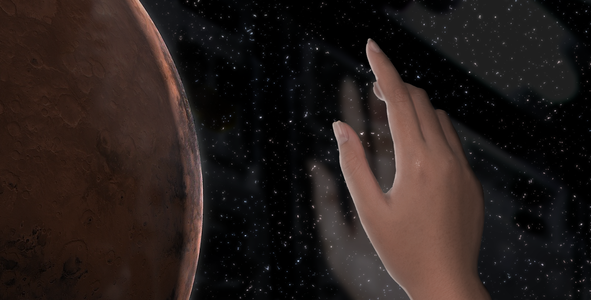
By The Time I Get To Mars is an educational classroom game and customizable research tool that explores the hazards related to long term space travel.
How does it work?
It is broken down into 3 modes: Story, Explore, and Science. Each mode increases in difficulty and complexity from the mode before it.
Story mode introduces the 5 main hazards of space travel and how they might be overcome, integrated into a compelling narrative to help students engage with the material. The student will learn about these hazards and then be presented with challenges and escape game style puzzles that reinforce the material.
Examples of some of the questions:
https://docs.google.com/document/d/10Wj5BjDE5QRtgNRZUznUFchvTotKbpePHN3GLwDe4ZI/edit?usp=sharing
After completing Story mode, the student will have all of the knowledge they need to experiment in Explore Mode. This mode allows the student to try different crew compliments, and strategies and simulate their own missions.
The goal of explore mode is to create a crew that not only survives the trip, but also collects the most data about Mars in the process. Students will have to make tough choices on crew specialties and equipment to make a successful mission that also achieves the top score. These metrics will further reinforce grade appropriate curriculum data, and will encourage them to study space agency research to optimize their strategy.
Science mode takes this a step further by allowing a student or researcher to customize the simulation, add their own variables to it, and run hundreds or thousands of crews simultaneously. This would allow researchers to refine our model and expand on it to study even more complex factors.
What benefits does it have?
This game encourages the player to think critically and make wise choices to tackle all the puzzles, missions and challenges before them. It encourages the development of leadership skills as the player is put into a position whereby one must take command of the mission. Teachers are always looking for engaging and relevant science activities for their students. Our game aligns with the Next Generation Science Standards for middle school, which has been adopted by most public K-12 schools in the United States.
What do you hope to achieve?
Our goal is to make an educational game that is not only useful to teachers in the classroom, but that is also engaging for students, therefore bridging the gap between the two in which the teachers can successfully deliver class materials to the students effectively whilst allowing the students to stay engrossed in the learning process. Our project is designed to inspire middle school students to become curious about space exploration and in particular, a future mission to Mars. The students whom we can inspire today with this game will be the astronauts and space explorers of the future. It is vital that we cultivate their fascination with space now so that we can have robust societal support for space exploration in the future.
What tools, coding languages, hardware, or software did you use to develop your project?
Google Forms, Blender, Adobe Premiere Pro, Adobe After Effects, Adobe Audition, Adobe Illustrator, Adobe Photoshop, Mixamo, and Canva.
Space Agency Data
NASA webpages: https://www.nasa.gov/hrp/bodyinspace, https://www.nasa.gov/centers/hq/library/find/bibliographies/Long-Term_Challenges_to_Human_Space_Exploration, https://www.nasa.gov/feature/can-space-gardening-help-astronauts-cope-with-isolation, https://www.nasa.gov/content/growing-plants-in-space,
Data from experiments performed on the ISS on the effects of space travel on the human body.
We gathered information relating to Mars using the above NASA resources. Our focus was in connecting this data to 6-8th grade curriculum materials and translating it into engaging game mechanics that would be approachable to 10-14 year-olds. What inspired the project is to educate students and assist researchers. This game will encourage students to believe that we have the capability to go to Mars and back and encourage the students to be more involved with space.
Hackathon Journey
Ashley:
The space apps experience was amazing. I get to work with many people that are talented in different fields and we collaborate to form a masterpiece. I've learned to work well with team members that have a different schedule with a different field than me. My approach in developing this app was to come up with an educational game that tells a story while interacting with students. I want the students to be able to be more connected with the game by asking them questions and letting them answer them. There are no setbacks except for compiling this would be extremely difficult with only two people. I would like to thank every single one of my team members for contributing so much to this project. Without them, we wouldn't be able to make this app possible.
Brooke:
Space Apps was a fun and rewarding experience. I am already looking forward to next year’s challenge! There is so much engaging content to explore on the Space Apps web page and YouTube channel. Working with my teammates was the highlight of this hackathon and I am extremely impressed with the product we were able to produce in such a short amount of time. As a middle school science teacher, our product is exactly what I have been looking for to inspire my students to become curious about space exploration. I look forward to developing this product further and deploying it in the classroom! Great work, team!
David:
I have enjoyed my experience with Space Apps immensely! I have met a lot of wonderful people in just the last couple of weeks since I found out about this program. The biggest thing that hit me was how little I knew about the space shuttle. I always imagined it as just a cockpit with rockets and wings, and I was surprised to learn just how much goes on inside that I’ve never known before. Researching for this challenge was a great opportunity to learn what is really involved in sending people into space.
I was personally inspired to choose this challenge because I love making educational games, and I really wanted to figure out how I could make an educational game that was also a valuable research tool.
We used Google drive collaboration tools and discord to handle coordination. And the main strategy I tried to employ was to get to a minimum viable product before we started exploring the details of the challenge.
I’d like to thank my fellow team mates, they are all amazing, and did a fantastic job. I would also like to thank the subject matter experts for being available in the chat and answering my questions.
Madeline:
This challenge has been a mind-blowing experience! I realized that there are so many things I have yet to learn and discover. The main reason why I chose this challenge over other challenges is due to the fact that I’ve always been intrigued with games that has engaging storylines and survival games that boosts your adrenaline! I find games like these super fun! This challenge has taught me about the various aspects of an astronaut’s struggle and the various solutions we can implement to tackle serious issues in a creative way.
This has been a wonderful experience!! I am very grateful that I had the opportunity to work with these amazing, creative and talented people, this entire journey has been a blast! I would like to thank everyone in my team for their dedication and effort in this project! Thanks so much!! I’m honoured to have been a part of this team! And I'm looking forward to collaborating with you all on further developing this game :)
References
https://www.nasa.gov/hrp/bodyinspace
https://www.nasa.gov/feature/can-space-gardening-help-astronauts-cope-with-isolation
https://www.nasa.gov/content/growing-plants-in-space
https://www.nasa.gov/hrp/hazards,
TCI Bring Science Alive! California Middle School textbooks, publisher TCI, 2020
Next Generation Science Standards 2020/21 framework
Demo video music licensed through Epidemic Sound
Stock photos licensed from Pixabay.com, Pexels.com, and Adobe Stock
Female model and animation acquired from Mixamo: https://helpx.adobe.com/creative-cloud/faq/mixamo-faq.html
3D textures licensed from Textures.com
Tags
#Mars #MissiontoMars #Spaceexploration #Spaceflight #TrailtoMars #ByTheTimeIGetToMars #RedPlanet
Global Judging
This project has been submitted for consideration during the Judging process.