Awards & Nominations
Gundruk Galactica has received the following awards and nominations. Way to go!
Global Nominee

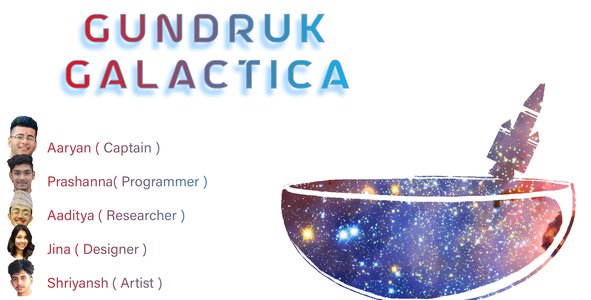
Gundruk Galactica has received the following awards and nominations. Way to go!
It has always been human to look to the horizon and imagine what is beyond. Gone are the days when our intrepid adventurers had to rampage head first into a void about which they knew nothing. Blessed with the power of computation, we now have foresight that our forefathers could only have dreamt of. Through SpaceTime Survival : Mars Edition we have tried to create an environment where young people (the one's that will actually explore our solar system), can enjoy the marvel of space travel while still appreciating the great risk that this endeavour entails. Based on NASA data, we now present an environment where awe meets knowledge, and adventure meets its limits.
Spacetime Survival: Mars began as a little thought experiment we had as a team a month or two ago in the blistering heat of the Biratngar Summer, when we decided to think about how different life on earth was to that on a place like Mars.
Very different it turns out. Our project puts the player through exactly the same process of awe and dazzlement that we went through as we researched the foundations of the game. Is humanity ready to become a space faring species. What are the challenges that we must overcome to finally be able to set up a base on Mars. These were the questions we set out to answer and they are the questions that'll hopefully be answered as the player traverses through space, taking care of their crew and themselves. It works to show the player the obvious and insidious effects that long term space travel can have, and also their ways of mitigation.
Apart from being fun, which is an incredibly ambitious goal in itself, we decided from the get go that the game had to have some real life application. Thus, while solving the issues that arise on board the Gundruk - 5 spacecraft to Mars, the player has to think about scenarios that may very well happen in real life. The reason behind this is that almost every event and object included in the space flight portion of the game has its basis in the literature provided by NASA Genelab and other open data sources.
A fresh perspective on age old problems can often be the deciding factor in helping to get them solved. We believe that our generation and those younger than us should be thinking about the issues related to spaceflight as through it, they can allow the field to grow so that they have a strong foundation to launch humanity throughout the cosmos. It is also remarkable to note that while researching methods to allow astronauts to survive in space, we have found numerous ways to decrease suffering and inefficiency on earth too. This in itself is a strong reason behind the existence of our project. An investment in space research is always bound to give back in abundance. This game is an investment in our colleagues of today and tommorow. We wish for fun and greater engagement in the science of space.
This project would not have been possible without the data provided by NASA GeneLab and other open data sources. For game development, our team members used Unity, and did the bulk of their programming in VS code. All of our model creation and animation happened through Blender and Mixamo. Group productivity and communication happened through Notion, Telegram and Discord.
The skills and knowledge that we have gained over the course of these few weeks are going to be useful for many years to come. We hope you have as much fun playing this game as we did making it.
NASA GeneLab was a major source of data:
This was mainly used to decide which health mishaps would be most common during long term space flight.
Reference articles:
https://humanresearchroadmap.nasa.gov/evidence/other/Arrhythmia.pdf
https://humanresearchroadmap.nasa.gov/Evidence/medicalConditions/De_Novo_Cardiac_Arrhythmia.pdf
https://www.nasa.gov/centers/johnson/pdf/163533main_ISS_Med_CL.pdf (ISS Medical Manual)
40 days ago today, we saw the article regarding THE SPACE APPS CHALLENGE 2021 and while reading the article we came across the term ‘Hackathon’ which surely ignited a spark of curiosity among us. As a group of mostly fresh learners of programing, computer science, space and medicine, we were intrigued by the challenges provided in the website. We decided to participate in the challenge: Trail to Mars, this being a broad concept which included game development, health risks related research and 3D objects creation and animation which was mostly new for us. We tried to enhance our skills over the period of 40 days in all the but we were not so very successful for our final product. Surely, we learned many things, we tried as per as our skills which surely will be of use in the future as well. Thank you, Team Space Apps, NASA. Looking forward for more of similar events
https://humanresearchroadmap.nasa.gov/evidence/other/Arrhythmia.pdf
https://humanresearchroadmap.nasa.gov/Evidence/medicalConditions/De_Novo_Cardiac_Arrhythmia.pdf
https://www.nasa.gov/centers/johnson/pdf/163533main_ISS_Med_CL.pdf (ISS Medical Manual)
https://www.nasa.gov/feature/nasa-investigates-how-dormant-viruses-behave-during-spaceflight
GeneLab:
#game #mars #Gundruk
This project has been submitted for consideration during the Judging process.
Long-distance space travel comes with a multitude of health risks, but it is difficult to imagine the combined effects of these risks, especially for those who are not fluent in NASA jargon. Your challenge is to create an educational game for middle schoolers (approx. ages 10-14) that focuses on keeping an avatar alive and healthy during a voyage from Earth to Mars and back, and that identifies the most difficult challenges and the biggest risks involved in human spaceflight.