Awards & Nominations
SpaceLife has received the following awards and nominations. Way to go!
Global Nominee

SpaceLife has received the following awards and nominations. Way to go!
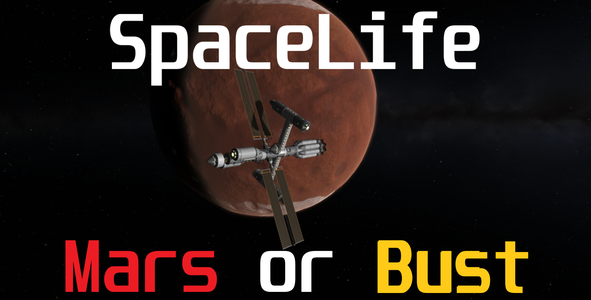
SpaceLife is an educational simulator targeting the problems that a crew may encounter during a voyage to Mars, and beyond. Combining NASA GeneLab data and publications from the NASA Human Research Program, we have successfully designed and developed a game that accurately depicts the real-life scenarios of spaceflight, simplified to fit the skillsets of middle schoolers.In modern society, there is a lack of education regarding the risks of spaceflight to human health. In SpaceLife, players are surrounded by the foreign concepts of spaceflight, to educate the player on the dangers and hazards that space travel may present on a trip to Mars and beyond.
SpaceLife Simulator is designed to educate and forewarn the player of the dangers of spaceflight, through visual and interactive tools. Designed for middle schoolers, SpaceLife encourages early-aged education into the hazards that spaceflight may present to humans. SpaceLife develops children's problem-solving skills in each obstacle that the game may present. Games lasting 28 minutes are equal to the 28 weeks in space that a journey to Mars would typically take. During the flight, players may encounter gradual effects such as; Radiation, Bone Density changes, Fatigue, and Stress, which are caused by; space radiation, microgravity, work, confined spaces, and loneliness. Moreover, certain events such as Solar Flares and Engine Failures require the crew to seek safety or certain crew members to repair the ship.
94 percent of Americans and 90 percent of Australians aged 10-14 engage in video games as a recreational activity. This makes games more appealing than traditional forms of learning. 70 percent of Australians and 76 percent of Americans are visual learners or kinesthetic learners. This makes interaction by trial-and-error type situations more memorable to their learning. Furthermore, 60 percent of Australians and 72 percent of Americans are interested in some form of space-related activity.
There is currently a large void of opportunity in the space education industry, and SpaceLife is the centerpiece.
SpaceLife, along with learning resources regarding the health hazards of space, will effectively and efficiently educate school kids of the dangers of space, so that they may pursue careers in STEM or other related fields, to better strengthen solutions, and create new innovative ideas.
Click Here to access the Website
 Scenario
NASA has collaborated with a variety of space agencies to launch the first manned mission to Mars. A crew of 8 brave astronauts from around the world will embark upon the Ares, a massive ship of more than 1000 metric tonnes, and begin their 28 week trip to Mars. This mission will mark the historic step in the advancement of humanity, and truly begin the age of space-faring and interplanetary travel, expanding our scientific ventures, our diplomatic collaborations, and our chances of survival as a species.
But can the 8 crew members of Ares survive?
The fate of the 8 crew members of Ares lies in your hands. In a fast-paced 28 minute game, you will encounter various hazards, obstructions, and events that will put your crew's safety in jeopardy.
We have chosen an 8 character crew which consists of the following:
Each crew member represents a core aspect of the game's mechanics.
Taking in the 5 possible hazards of Spaceflight; Radiation, Isolation, Distance, Gravity, and hostile environments, we have chosen certain scenarios to fit with all of the categories.
Gradually Changing:
To solve these, characters may need to:
Crew Scenarios:
To solve these, players may need to:
We wish to implement more events and health risks while improving the simplicity of the game for the player so that the game can accurately portray all of the known health risks of space travel, to further improve the game's accuracy to the multitude of health risks that space poses. Furthermore, we would introduce different difficulty levels, which would allow for school kids to progress to different planets. E.g. Once you get to Mars, you go to Jupiter, etc.
During the project, we utilized NASA's Genelab data to analyze the possible risks that space travel may have, then finetuned it to fit a 28-minute game. We used Ursina for Python to create the graphics for SpaceLife and used python for the game's code. For the presentation, we created an HTML-based website on GitHub pages to present the game and its features.
Using NASA's GeneLab data, we compiled a .xlsx file of datasets concerning the; Heart, Muscle, Bone, Brain, and the Immune System and the adverse health effects of space travel through the hazards of Micro-Gravity, Radiation, Isolation, Hostile & Closed Environments, and Distance. We then studied, calculated, and assessed each individual risk, and implemented the most common and dangerous hazards of spaceflight. Using the datasets provided, we made issues and hazards that the player must overcome to reach mars and complete the game.
Throughout our Space Apps journey, we were met with dozens of obstacles and issues in our code, and we are proud of the way we overcame these.
When we first saw this challenge we immediately knew this was what fit in best for us, and voted almost unanimously to complete the Trail to mars challenge. We all had so many ideas for ways to do this game and decided that it would be a great experience and that we could actually help the world by educating and inspiring kids to solve the issues of human spaceflight, so we can expand into a more inter-planetary space-faring civilisation.
While we did have a small plan or more of an idea in mind at the beginning, we have come up with so much along the way and changed so much of what we did have, that we really were just constantly growing and changing, and didn't follow a set path. While this did lead to some disorganization, we believe the outcome was great and this 'wing-it' approach ended quite well.
---------------------------------------
before we go, we would like to thank the NASA Space Apps team for giving us a chance to do all of this in the first place, as well as to all the references listed below as this would not have been possible without them.
Ursina Python Library https://www.ursinaengine.org/
Python.org https://www.python.org/
Pixel Art Maker http://pixelartmaker.com/
Lospec Pixel Editor https://apps.lospec.com/pixel-editor/
NASA Genelab https://genelab.nasa.gov/
NASA Human Research Program https://www.nasa.gov/hrp/hazards
Kerbal Space Program (For renders) https://www.kerbalspaceprogram.com/
Visual Studio Code https://code.visualstudio.com/
Github https://github.com/
Background space texture from Webtreats https://www.flickr.com/photos/webtreatsetc/5436446554/in/photostream/
#game, #mars, #space, #2D
This project has been submitted for consideration during the Judging process.