
High-Level Project Summary
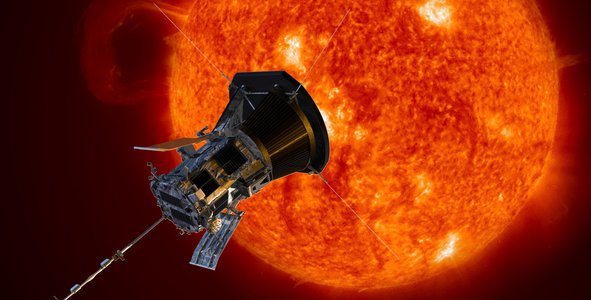
Orion-X is an arcade web-based video game that simulates Parker Solar Probe's mission. It starts and ends with an animated story-telling conversation that explains the dangers of Solar Wind, its effects, the importance of this spacecraft, and how the data collected can affect our future. In between is the actual gameplay where you experience everything from launching the rocket to its eventual spiral into the sun and burning up. Then, through the Orion-X Chatbot, you can talk to Dr. Eugene N. Parker himself and see what lays behind his genius mind.We really feel the need to tell people more about the many spacecraft and space exploration that have happened, are happening, and will happen.
Link to Project "Demo"
Link to Final Project
Detailed Project Description
Orion-X is an arcade web-based video game, designed to inform a broader range of people about the Sun and the importance of exploring it in a fun educational way.
As well as stimulating Parker Solar Probe's mission for further engagement with the user.
What surprised us more than NASA flying this close to the Sun is that very few people knew about it. We felt the need to let people learn more by a different method of learning.
Orion-X video game takes you further than you have ever been before. It encourages engagement, enthusiasm, and interest in finding new ideas for future exploration.
When the game starts, the user has two options, either starting the game or starting a conversation with a chatbot. On choosing the game option, the game starts with an animated story-telling conversation between an astronaut working at NASA and her student. The student is curious and asks questions as the astronaut explains the dangers of Solar Wind, how it affected our past here on earth, and why reaching the Sun can help us avoid the catastrophic events caused by space weather. This dialogue tells the user everything he needs to know to understand the purpose of such missions and will get an answer to all his questions After the educational dialogue ends, the user is directed to the game.
The game consists of several levels. At first, you experience launching the rocket through several stages. In the next level, you start approaching the Sun and travel through space, all the way from earth to the Sun. This stage is challenging and interesting in a way that engages the user more in the process. Then finally, you start orbiting the Sun and collecting data from its surface in a spiral motion until the spacecraft burns up. The game ends when the mission is successfully completed. By the end of the game, the user will have known everything about the sun, the mission, and why it is so important.
Orion-X is all about improving public knowledge of the many spacecraft exploring the Sun and its importance. That is why the game is not actually the ending of Orion-X, but the beginning. We aim to simulate more missions to discover other than parker solar probe, develop a realistic 3D game, and embed AI and machine learning in the Chatbot.
The website that hosts the game is written in HTML, CSS, JS markup languages. Then the game was written using information provided from Parker Solar Probe Science Gateway and Community Coordinated Modeling Center (CCMC), it is mainly written in Javascript and built using SDL Library.
In order to merge all these written codes using Microsoft Visual Studio Code, we used Git, the Github Version Control System. Mainly to ensure up-to-date versions using add, commit, push, and pull commands.
Furthermore, Orion-X Chatbot is here for you to ensure that you grasp all that is there to grasp where you can talk to Dr. Eugene N. Parker himself and see what lies behind his genius mind. Orion-X Chatbot is featured using Google Action, Dialogueflow, and Google Cloud platforms.
Space Agency Data
We used resources from the Website of the Parker Solar Probe mission science team to access actual instrument data and images, as well as orbit and instrument plans, schedules, and visualizations of the parker solar probe.
We used the Main science page for the NASA Science Mission Directorate Heliophysics Division, to study the nature of the Sun, and how it influences the very nature of space and in turn the atmospheres of our planet.
We also used animations and graphics from Parker Solar Probe animation and graphics created by the SVS, based at NASA's Goddard Space Flight Center, in coordination with the Parker Solar Probe science team.
In order to merge all these written codes using Microsoft Visual Studio Code, we used Git, the Github Version Control System. Mainly to ensure up-to-date versions using add, commit, push, and pull commands.
Hackathon Journey
The space apps hackathon bonded the team in a way that two semesters of academic learning didn’t.
Although we faced stressful times, the past two days have been more than amazing for us. Each one of us discovered more about his skills; one learned CSS in a very short period to help, the other binge-watched all those tutorials to design the graphics used in the project. We definitely pushed ourselves to the extreme through those couple of days!
When we first heard about the missions to explore the sun, we were definitely fascinated with the provided information and even more surprised that we didn’t know there were sun exploration missions. We believe that many other people don’t know either, so we decided to build a game that will increase public awareness about the sun exploration methods, as the parker solar probe. We hope that this game surprises people with this information as it did to us.
Throughout the hackathon, we learned to design and develop a video game, implement chatbots, and design needed assets. As for the non-technical part, we learned to work in an organized, precise way where each one has his own tasks and learns new things in a very short period to be able to use them.
Sometimes things got a little too hard, especially in developing the first level of launching, and there were things that none of us could do. We passed those stages by looking for alternatives that will give the same result and dividing the problem into several tiny parts, and then solving those parts one by one.
There were moments of doubt of course during which we were unsure about everything. However, there are 6 of us! Whenever someone or more was disappointed, there was at least one or two of us to back him up, help him through what was devastating him, and get him back in the mood for the hackathon. We helped each other through the mind blocks, stressful moments, and long nights.
We want to thank NASA space apps Cairo for being super cooperative and helpful, including all the mentors and organizers.
References
Various Resources that helped us during the project:
-https://sppgway.jhuapl.edu/
-https://svs.gsfc.nasa.gov/search/?search=parker+solar+probe&sort_by=relevance
-https://ccmc.gsfc.nasa.gov/iswa/
-We used CCMC for our research.
https://ccmc.gsfc.nasa.gov/
-We used freepik website to get photos we used in the game.
-https://www.freepik.com/
-Also,We used Canva online to make and design our presentation.
-https://www.canva.com/design/DAErrKimvVs/QhUeymj5BVtQPV1KJ5azHQ/edit
Tags
#gamedevelopment #webdevelopment
Global Judging
This project has been submitted for consideration during the Judging process.