Awards & Nominations
Jimmy In the Box has received the following awards and nominations. Way to go!
 Arts and Technology

The solution that most effectively combines technical and creative skills.

Jimmy In the Box has received the following awards and nominations. Way to go!
The solution that most effectively combines technical and creative skills.
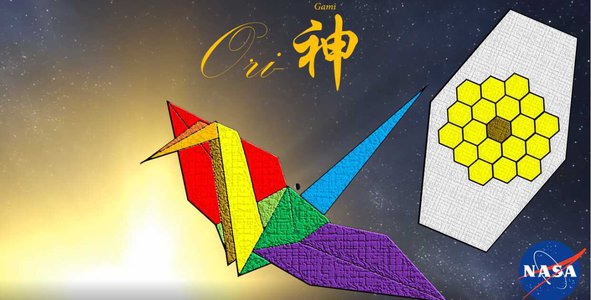
We are WOW-ed by how the James Webb Space Telescope (JWST) uses origami-like folding and unfolding for its launch and deployment. Using our diverse skills and experience, this project builds computerized origami models for JWST in order to showcase its amazing design and "satisfying" deployment steps.
We are a team of high schoolers and middle schoolers who LOVE, and are good at, origami crafting. We all are WOW-ed by how the James Webb Space Telescope (JWST) uses origami-like folding and unfolding for its launch and deployment.
In addition to origami crafting, we have programming experience with Raspberry Pi (credit card sized computer). So, using our diverse sets of skills and experience, this project builds computerized origami models for JWST in order to showcase its amazing design and "satisfying" deployment steps.
By the way, JWST's deployment process looks like a Jack-in-the-box for us! So, we decided to replace “Jack” with “Jimmy” for our project name, respecting Mr. James Webb, who supported many science projects at NASA.
We modeled JWST's primary mirror, secondary mirror and sun shields with origami crafts and assembled the origami crafts to produce 3 prototype telescope models. Since we want the models to actively do something, not only viewed passively, we integrated them with Raspberry Pi, so they can do what the real telescope does.
Our computerized origami models can work as Internet-of-Things (IoT) devices; they can access the Internet or can be accessed via the Internet. We wrote Python apps for the IoT telescope models. Currently, our apps can take pictures with cameras periodically (every 30 seconds, for example) or when a push button is pressed. They keep track of the current device location (latitude, longitude and elevation) with GPS receivers. They also upload captured photos and location information to a cloud database called Kintone, so the uploaded data can be browsed through the Internet later on (with browsers on remote laptops or the Kintone mobile app on smartphones/tablets).
Our project web site provides instruction videos, circuit diagrams and ready-to-run programs; anyone interested can immediately learn how to reproduce our origami crafts and IoT telescope models. We hope you find this project interesting and useful and then learn about something about JWST. JWST has not been launched yet. Let's get to know about it and watch its launch and deployment soon (maybe in this December).
We did not use any scientific data from NASA because this is an origami crafting project. We read, watched and leaned A LOT from NASA's web pages and videos.
We did not know anything about JWST when we were choosing a challenge for our project. The word "origami" caught our attention because we love origami crafting. This is how we came across the Webb Origami Design Challenge, and soon later we got excited about JWST's amazing design and "satisfying" deployment steps. Since then, we leaned A LOT about JWST by reading NASA's web pages and relevant Wikipedia pages and watching various YouTube videos, such as where it will go and work in space, how large it is, why it needs to be that large, why hexagons are used in its primary mirror, why it has two mirrors (primary and secondary mirrors), what infrared is, etc. We would have never learned about these if we did not work on this challenge. It was a big fun to craft, code, play and then learn something completely new for us.
If is very interesting to find that the state-of-the-art telescope uses simple and familiar designs like hinge or bellowing, which we can easily find in our everyday life. Some mechanisms look similar to folding an umbrella shaft. We learned these simple-looking mechanisms should not be underestimated. Some of them significantly contribute to the state-of-the-art telescope. The best approach in making would be to look around and learn from familiar things in our life.
We also learned that Jeff Bezos and Elon Musk are trying to find a way to build houses in space as quickly as possible. One of their challenges should be how to reduce the volume of a house to be transported with a rocket. Origami-inspired folding and unfolding can be a solution for the challenge. It may also contribute to the efficient transport of other large things in volume, such as ISS modules and complex satellites. We plan to study how NASA and other space agencies plan to transport bulky structures in the near future.
NASA's web pages about JWST.
NASA's videos about JWST launch and deployment process.
Eric Gjerde, Origami Tessellations: Awe-Inspiring Geometric Designs, A K Peters/CRC Press, December 1, 2008.
#jwst, #telescope, #deployment, #origami, #raspberrypi, #raspi #iot
This project has been submitted for consideration during the Judging process.