
High-Level Project Summary
Architects and engineers use Japanese art in building and robotics. Two-folded paper can be an aeroplane, hat, or peace crane. It shows that origami isn't just for kids. No one can deny that "it's not rocket science." Living conditions for scientists are minimal. In this context, a kindergarten talent could lead to a huge scientific breakthrough. It is an ancient art to fold paper without changing its volume or weight. Making a crane or a frog out of paper is one example. In space engineering, origami implies organising cargo, increase buildings, and fine-tune mechanical functions.
Detailed Project Description
Scientists Utilise Origami to Assist with Problem Solving
Origami, the centuries-old Japanese art of paper folding, has inspired a host of inventive creations because origami's delicate beauty is rooted in profound mathematical principles that apply to metal, plastic, and paper. "We can use origami principles, structures, and procedures," says Robert Lang, a former NASA physicist and origami consultant. "However, we may use mathematical tools to describe folding to create innovative folding structures that meet specific technical challenges." Massive origami creations can collapse for transport or storage. They can also use intricate folding patterns to build complex mechanical systems with single motor control.
'The Contemporary Life of Origami, an Age-Old Art Form'
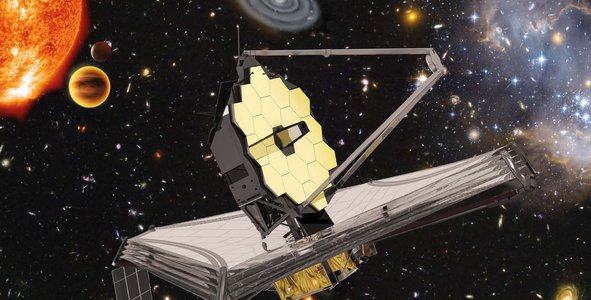
Individuals learn about origami and make their model of the Webb Space Telescope! We know more about origami's history, development, and current state. We made our own Webb Space Telescope origami as a Space Apps Challenge-response in a Going Further Future. Have you ever tried to make an origami masterpiece? Have you ever wished you could? Before you read our statement about the worked solution project, fold a piece of paper into an intriguing shape or object — like a box or a cube? Or is it anything else? Maybe a heavenly body? What was your experience? How much chance do you have? Did you succeed in producing anything? Perhaps real-world maths and science difficulties have always been hidden behind origami folds.
It is more than simply folded paper
We used cartridge sheets and adhesive for this project. Origami principles apply in many applications, from satellite design to cardiac stent design to self-assembling robotics. What does paper art have to do with any of this? Origami is a centuries-old art of folding paper into objects like birds and boxes. Origami advertises by Japanese origamist Akira Yoshizawa, who created a picture-based set of instructions that served as a universal language, encouraging partnerships between artists and scientists. This overlapping of fields has expanded since the 1960s, particularly in recent years.
Space Agency Data
JAMES WEBB SPACE TELESCOPE
GODDARD SPACE FLIGHT CENTER
An image of the "Easy To Build" model is the only data obtained from the agency. Jenny Chan submitted Origami Tree Telescope on JAMES WEBB SPACE TELESCOPE GODDARD SPACE FLIGHT CENTER'S WEBSITE So, as you may know, we adore Origami for Kids — we love the magic of turning a piece of paper into a functional product or a beautiful decoration. It is the most unusual papercraft. No shears. No glueing. In Origami, a single piece of paper can become an unlimited number of objects. Children and adults alike can learn a lot through Origami.
Origami Enhances Mental Health and Social Skills
Many people use Origami to treat their ailments. Our experience with Origami is that when it's perfected, the sense of accomplishment is impressive. To achieve this goal, people must learn to be patient, take their time, and try again if necessary. It also promotes cooperative learning, as youngsters learn to work together and aid one another. Age gaps can be bridged by older children teaching younger ones. It's also a great way to learn about various cultures and societies.
Origami Strengthens the Brain and Mind
A child's brain and mind benefit much from Origami because of its power and the child's involvement in "making it happen." Also, working with BOTH hands has various benefits. Improving eye-hand synchronisation has several advantages. To enhance their memory, children must also practice reading and listening skills.
Hackathon Journey
The History and Present-Day Applications of Origami
Origami has recently achieved great appeal, attracting children and adults as an engaging and valuable skill-building activity. Origami is the art of folding paper into various shapes and colours. Origami uses only simple folding or flattening tools, no scissors or glue. After the invention of writing around 700 CE, the Japanese used origami for the first time. Origami, contrary to popular belief, originated in Japan.
Techniques in Origami
Onsink and Closed Unsink are complex folding strategies. It is possible to mix numerous ways to create multiple forms. Its use in several scientific fields saw a quantum leap in the mid-century.
Applications of Origami in the Past
We once used Origami to decorate. Utilised coloured sheets and easy folding techniques to create animal and bird motifs and toys. Origami has few practical applications and implies fun. Origami has recently been applying in a surprising number of industries.
Applications of Origami in the Present Time
- Origami is used in architecture and civil engineering to create miniature models of bridges and stadiums.
- Paper folding techniques employ to represent the cell membrane and proteins in medicine.
- They utilised Origami techniques in the pipes of Japan's high-speed trains. Internal supports were employed to absorb excess pressure, hence lowering the danger of accidents.
- Mathematics: Some teachers are now using origami as an instructional tool to aid in clarifying geometry, explaining fractions, and problem-solving.
- There are plans to launch an origami-based spacecraft into orbit. Although tests began in 2008, the program has not yet started.
Yes, hackathons are well worth the time and effort!
It took us a few seconds to Google "Hackathon" and found that it is a multi-day event in which large groups of people come together to solve problems. And it's been a lovely experience since then. Many teams had finished their jobs ahead of time and were hanging around. A participant can prepare as much as they want for specific hackathons. You should go for this choice if you value your sleep and wish to relax during the show. (Shame on us for our tardiness.) The advisers are often professionals who specialise in the issue of hackathons. Therefore we recommend speaking with them as much as possible. This group can not only point out weaknesses in your plan but also make suggestions. Naturally, networking is a component of the hackathon experience. (By which we mean that you are essentially stuck with everyone for the duration of the event). Even though everyone was working during the event developing every teams' prototypes and bringing their ideas to life, we still managed to mingle and make new friends. Naturally, working hours without sleep and electronically presenting in front of a panel of specialists must be nerve-wracking for the majority of you. However, this is an experience that we will never forget.
References
JAMES WEBB SPACE TELESCOPE
GODDARD SPACE FLIGHT CENTER
Make Your Own Paper Model! Webb Telescope/NASA. (n.d.). Make Your Own Paper Model! Webb Telescope/NASA. https://www.jwst.nasa.gov/content/features/educational/paperModel/paperModel.html.
Tags
#SciArt #ActualLivingScientist #origamiartist #origamiwork