
High-Level Project Summary
Our goal was to create a high-fidelity origami model of the James Webb Space Telescope (JWST) with the purpose of not only artistic beauty but also as an educational tool. We wanted to showcase the primary components of the JWST and their folding mechanisms while adhering, where possible, to classic origami principles (i.e. no glue). Assembling and manipulating a high-fidelity model can be a hands-on learning experience to discover the main parts of an instrument, pique curiosity about components' functions, and make tangible the relationship between different parts. Origami itself demonstrates many mathematical principles and has several applications in space engineering and beyond.
Link to Project "Demo"
Link to Final Project
Detailed Project Description
“Almost any subject is suitable for an origami model, despite the stringent limitation of using an uncut sheet” , so it was said by Robert Lang, and these are apt words which describe this origami design challenge.
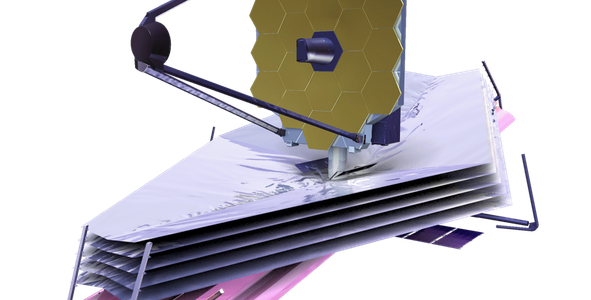
To approach this project, the telescope was divided into four components: primary mirror, secondary mirror, and supporting arms; instrument module; sunshield; and sunshield hull with spacecraft bus and trim flap. The pieces are made completely of paper and do not require glue or other adhesives to complete or put together.
Compared to existing paper/cardstock models, this one aims to maximize the use of paperfolding and origami principles to create the form. We hope to create models of varying levels of complexity/abstraction to make it more accessible to wider audiences.
The design behind each component is explained below:
The primary and secondary mirrors and supporting arms are folded from a single piece of paper. The arms are formed from three strips extended from the shape of the primary mirror (this is the design from Folding And Unfolding Webb). Thanks to the natural flexibility of the paper, they can be easily folded into the middle. One of the arms has a circular shape at its end, which represents the circular secondary mirror; another has a square that was later wrapped around the mirror, which represents the instrument holding the secondary mirror. The upper arm is connected to the square. The square is cut in the middle, the slightly longer arm serves as a "hook".
The instrument module is inspired by the design of the Masu box. The upper flap is extended and represents the deployable radiator. A smaller Masu box is integrated into the Masu box. This smaller Masu box provides support for the primary mirror.
The two components are combined by inserting a water bomb base between the cuts from the primary mirror and the instrument module. Similarly, the same structure is used to combine the instrument module and sunshield.
The design of the sunshield is inspired by the frog base. Frog base divides the center of the paper into eight equal angles. The design of the sunshield divides the center into ten equal angles.
The sunshield hull with spacecraft bus and trim flap is inspired by the 'box gadget' designed by Prof. Erik Demaine (found in this lecture). The four flaps are then cut out into the appropriate shape, to represent the two solar panels, the apt flat, the membrane launch restraints.
The final model measures 21cm x 8cm x 11cm
Materials:
- A1 100 gsm watercolour paper, A1 70 gsm tracing paper
- Craft Knife
- Foldback Clips
- Ruler
- Pencil & Eraser
Space Agency Data
For details of JWST aesthetics, telescope folding, and function:
JWST Deployment and Beauty Animations
Hackathon Journey
Our team comprised of origami enthusiasts of varying levels of experience. We were drawn to the challenge of exploring how this art form could be used to create a replica of one of the most complex and iconic contemporary scientific instruments of our time; similarly, we were interested in seeing what we could learn about origami design and JWST in the process.
Our general approach was to: (1) learn about the actual design and components of the JWST; (2) break down the overall JWST shape into geometric sub-components; (3) divide tasks among team members related to designing sub-components and/or documentation; (4) intermittently touch base to update, share ideas, and iterate.
For the actual design of the sub-components, we drew from existing knowledge or information learned by searching for analogous origami models. For example, the hexagonal arrangement of the primary mirror can be seen as a "tessellation", and hexagonal tessellation is a known tessellation pattern. The folds can be derived from the Double Pleat Hexagonal Tessellation (by Eric Gjerde), and a prior NASA feature on Folding And Unfolding Webb shows a simplified crease pattern (by Robert Lang) for this. There was a lot of experimentation and iteration for other sub-components, playing with tradeoffs between ease-of-folding, form, and function. For example, while "accordion" type folding for the sunshields would allow collapsibility, we found it challenging with the thickness of typical folding paper to elegantly create 5 parallel sunshields which can each be collapsed (or all sunshields collapsing simultaneously) and maintain a sturdy, diamond-shaped base when unfurled.
---
We would like to thank the NYC Space Apps leads for their organization of the local event and encouragement!
References
Double Pleat Hexagonal Tessellation
Virtual Astronomy Live: Featuring Keith Parrish & Charlene Morrow
JWST Deployment and Beauty Animations
James Webb Space Telescope Launch and Deployment
Origami Design Secrets by Robert J. Lang
Geometric Folding Algorithms: Linkages, Origami, Polyhedra by Prof. Erik Demaine taught in Fall 2012. MIT OpenCourseWare
Tags
#art #origami #JWST #JamesWebbSpaceTelescope #WebbAtHome
Global Judging
This project has been submitted for consideration during the Judging process.