
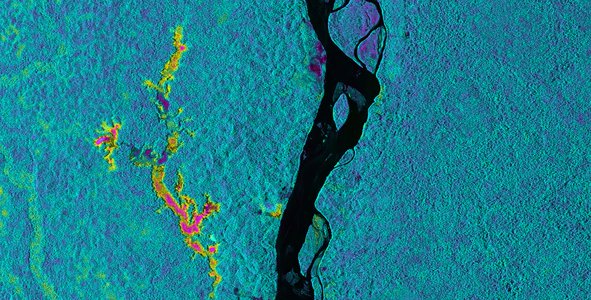
Upcoming space missions will provide an abundance of Synthetic Aperture Radar data; however, the tremendous impact this data can have will only be realized if the public understands the data and its potential. Your challenge is to create a 2-5 minute video explaining Synthetic Aperture Radar technology to the public in your own language with English subtitles.
Summary
Details
Background
Synthetic Aperture Radar (SAR) satellites provide imagery independent of sunlight and unaffected by the cloud cover. The European Space Agency’s Sentinel-1 satellites, Canadian Space Agency’s Radarsat Constellation Mission, and the Japan Aerospace Exploration Agency’s (JAXA) Advanced Land Observing Satellite-2 (ALOS-2) are some examples of current SAR missions. In addition, the NASA-Indian Space Research Organisation SAR (NISAR) mission and JAXA's ALOS-4 will be launched soon, and many commercial satellite companies are beginning to provide SAR data as well.
A SAR satellite forms images from the echoes of electromagnetic signals sent by its antennas. These SAR images are used to study the changing shape and properties of the surface of the Earth and can therefore be valuable for a wide variety of applications ranging from monitoring wildfires, to mapping floods, to understanding earthquakes. However, SAR technology and its family of powerful techniques like interferometric SAR (InSAR), polarimetric SAR (PolSAR), and polarimetric interferometric SAR (PolInSAR) are complex and can be difficult to explain to the public.
How can we further the use of SAR data? SAR data is already available to the public (e.g., data from Sentinel-1) and upcoming SAR missions will dramatically increase the abundance of publicly accessible radar data. At the end of its three-year nominal mission, the NISAR satellite will have generated a larger data volume of products than all the data that is currently stored in NASA’s Earth Observing System Data and Information System (EOSDIS). This tremendous amount of data will only reach its full potential if many people understand what SAR data is, and how it can impact them and their communities.
Objectives
Your challenge is to explain SAR technology and its capabilities to non-experts, whether they be scientists from other disciplines, or your family members. Create a 2-5 minute video that describes "Synthetic Aperture Radar" technology and measurement methods to the public and explains how SAR measurements can positively impact your community. The video should be in your own language with English subtitles.
Potential Considerations
As you develop your video, you may (but are not required to) consider the following:
- Your video could be as simple as a screen recording of a PowerPoint slideshow with English subtitles shown on the slides.
- If you are unfamiliar with SAR technology, check out the list of example resources for introductions to the basics of SAR.
Remember to make sure you and others, including NASA, have the rights to use any text, images, video, sound, or artwork that are not your own.
For data and resources related to this challenge, refer to the Resources tab at the top of the page. More resources may be added before the hackathon begins.
NASA does not endorse any non-U.S. Government entity and is not responsible for information contained on non-U.S. Government websites.