
High-Level Project Summary
We developed a user-friendly program for students to explore what variables of asteroid- shape, rotation axis, angular velocity, precession, albedo, craters and so on- can affect a light curve of it. So it not only allows to play with shape, but also with other important parameters. It is important, because it shows that not only shape can affect the light curve, and having a tool to explore everything helps to understand how asteroid variables change the light curve.
Link to Project "Demo"
Link to Final Project
Detailed Project Description
This fall NASA Lucy mission will begin its journey to investigate Trojan asteroids in Jupiter’s orbit). Trojan asteroids are small, which means that they have non uniform shapes, and that also means that observing them from Earth is remarkably difficult – you can only see them as point-like objects, which doesn’t give much information, but we would like to know the shape of an asteroid in order to better understand the history of the asteroid itself, Jupiter, and our Solar system. And this is where light curves come in – we can measure the light intensity of the asteroid over time.
And what can we get from that? Well, that is our challenge – what information can we get from a light curve. In order to solve it, we developed a user friendly program to explore exactly how different variables influence the light curves.
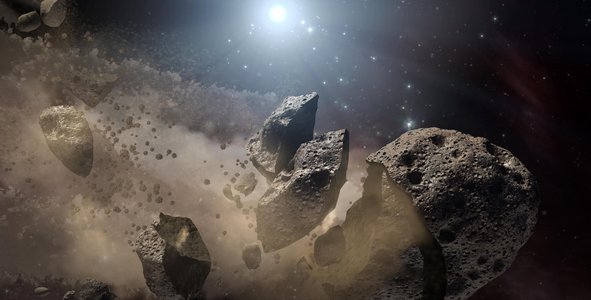
Asteroids can be very diverse in their form, rotation, material abundance and albedo, surface texture and so on.
Shape is the variable we are mainly set out to identify when looking at a light curve, it is the most impactful, and the most valuable variable for our intents and purposes.
In our experiment of a cigar versus pancake shaped asteroid, a rather peculiar observation can be made - it is almost impossible to distinguish the two if they rotate around the one and the same axis.
A great example of a light curve spiking is when the visible surface area is bigger due to changes in terrain. The opposite can be observed from craters and crevices.
Rotation axis, precession and Angular velocity, also known as Rotation speed, influence the rotation period, establishing it happens to be crucial to even begin guessing at the shape of the object and can give us the first hints about its properties.
Returning to the example of a cigar vs pancake shaped asteroid - an important thing to note - the light curve is very different now, due to precession - meaning rotation around multiple axes.
After 2 days of development we successfully were able to reproduce the major characteristics of a light curve from real asteroid observations. This was accomplished by manually adjusting the shape, rotation and surface texture to turn a sphere into a potentially realistic asteroid shape.
Evidently, using the tool, we are able to conclude how alteration in variables contribute to specific characteristics of a light curve experimentally. We had a great time exploring the influence of different parameters, learning a lot in the process, and would like for students to also be able to experience and study this subject with ever evolving tools.
This would help them to better understand celestial mechanics, 3D modelling and characteristics of asteroid light curves.
Space Agency Data
https://nasa3d.arc.nasa.gov/models
https://iopscience.iop.org/article/10.3847/PSJ/abb942
Hackathon Journey
Awesome, we learned so much about asteroids and their observations - what affects the light curve, what shapes does it have and so on. It was very interesting, as there is a lot to consider, so there are a lot to play with. We were inspired to do this challenge because the Lucy mission itself is extremely interesting, as it will see 8 Trojan asteroids, and we wanted to see if we can try and make a program which can predict the shape of them. We did not yet reach the automated level of it, but it is also fun to try and match the light curve manually. Our approach was to implement everything that might affect light curves and make it as user friendly as possible. Mostly we had challenges with the actual programming stuff so we tried to keep it simple. We also did not include variables that are not of any use, for example, a spherical sun-like object, because it would complicate the program, but there would be no actual use for it.
References
https://unity.com/
https://www.blender.org/
https://svs.gsfc.nasa.gov/4719
Tags
#astronomy #lightcurves
Global Judging
This project has been submitted for consideration during the Judging process.