Awards & Nominations
Illuminat3D has received the following awards and nominations. Way to go!
Global Nominee

Illuminat3D has received the following awards and nominations. Way to go!
We developed a tool used to produce light curves from a user given 3D model and some user given parameters. It solves the challenge by being an elegant, and as far as we know, novel, resource efficient solution to the requested problem.
Our project is Illuminat3D and it participates in the NASA Space Apps Challenge 2021. More specifically it participates in the challenge “When light curves throw us curve balls", and aims to provide a light curve of every 3D mode, with some initial input parameters like the rotation axis of the object and its albedo. To calculate the brightness of an object at any moment of its rotational phase, we are using an innovative combination of physics, mathematics and informatics. Based on a theoretical model for the reflectance, called Lambertian reflectance, we constructed a method to calculate the whole irradiance (W/m2) detected by an observer at some distance from an object. That is done via the separation of the object in elementary surfaces, then the calculation of the irradiance of each elementary surface, and lastly adding all the individual irradiances. This procedure has been implemented using python. The most significant benefit is the freedom that it provides to the users. This approach does not require a 3d representation of the model and therefore does not consume graphical processing resources. Our goal was to create a tool which can be used by anyone in order to explore the relation between the several available parameters and the produced light curve. There are also ambitions about the use of this project to develop a reverse engineering algorithm in order to give clues about the shape of an asteroid based on the given light curve. There are several parameters that the user can assign: source-observer angle, albedo, initial rotation axis and initial rotation angle, basic rotation axis and the number of points for the plot. Also, a user-friendly, explanatory and educative GUI is designed so that every user of every background can use this program.
See our repository for more details regarding our physics and mathematical background.
We used everything in the “Resources” Tab of the Challenge, in different stages of our project. At first, during the brainstorming process, the resources in the “Example Resources” section, as well as the “Paper on Light Curves”, provided the basic information about the challenge that we wanted to tackle, and inspired us to come up with our solution. The two NASA’s 3D Model Libraries, in the “Shape Models of Asteroids” section, played a crucial role in our project, as they were used to test our app. We produced a great number of light curve plots using the 3D models of many asteroids displayed in those two libraries, in order to make sure that our coding was effective. We, also, included a link of the “Asteroid Shape Model” library in our app, so the users have the ability to choose to analyze one of the 3D model included in this library.
With this being most of our members' second year in the competition we were looking forward to this year 's event. We came even more prepared, starting from the day the challenges were released. We were immediately drawn to this challenge due to our background in physics and programming.
Our resources:
· NASA’S Space Apps Challenge Resources.
· https://iopscience.iop.org/article/10.3847/PSJ/abb942
Our tools:
· Python: python-math, numpy-stl, matplotlib, tk, shapely.
· GitHub.
· Blender.
· Microsoft Word, Power Point.
· Microsoft 3D Viewer.
#light-curves, #asteroids, #trojans, #3D-Models, #python
This project has been submitted for consideration during the Judging process.
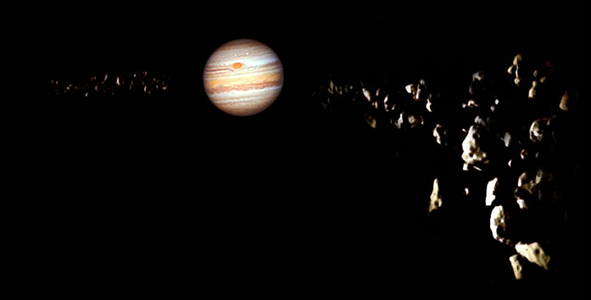
From Earth, the Trojan asteroids appear to be single points of light; their light curves—the way their observed brightness varies with time—are one of the few clues available to scientists working to determine the shapes of these distant bodies. Your challenge is to design a tool that allows users to explore how the shape of an asteroid affects the appearance of its light curve.