
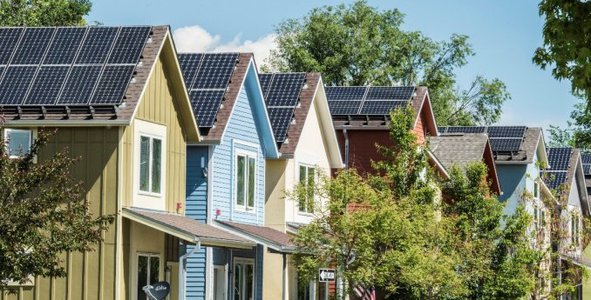
High-Level Project Summary
We decided to develop an mobile app called SolarView that can create an immediate impact focused on providing low-income communities with the ability to view the solar power levels in their local community, as well as explanations and resources available for them to get started toward installing solar panels. We felt the emphasis on low-income communities would ensure that access to solar panels would be equitable. (Use Case: Create a knowledge base/guide for low-income communities who want to understand how solar panels can benefit them and their local communities, and an explanation of the resources available for them to get started in solar.)
Link to Project "Demo"
Link to Final Project
Detailed Project Description
Vision & Target Audience:
- Aid lower income and marginalized communities who aren’t aware of solar solutions, tracking, and installation processes.
- Help educate and inform communities of whom are affected or being affected by Blue-Lining.
- Building knowledge on relative solar solutions within stem/steam in youth and community interested who might not have access to solar info or these type of programs due to financial gaps.
Front End Design:
- Created a progressive web application (PWA) in React and TypeScript
- PWAs are web applications that can be downloaded onto phone
- Provides a mobile native experience
- Application uses geolocation services to retrieve latitude and longitude information
- This information is then passed to the proxy API endpoint
Link to front-end code:
https://github.com/wowbob396/nasa-sunshine-app/
Back End Design:
- Designed a serverless API to mediate requests between the UI and the NASA POWER API
- Created AWS API Gateway endpoint with a lambda function using Node.js and Typescript
- This function acted as the proxy between the UI and the NASA POWER API
Infrastructure & Deployment
- To create the proxy API, AWS CDK was used to provision the resources such as the lambda function and the API endpoint
- To manage our code, we used the popular version control software called Git (We used GitHub to host our Git Repository)
- To deploy the React application, we used Vercel as the host (Vercel connects to our repository on GitHub and updates the site whenever changes are detected)
Space Agency Data
NASA POWER API & Other Open Sourced Data:
- Our application used the NASA POWER API to display data about solar levels in a given area
- Capable of displaying information such as average amount of sunlight per day and solar irradiance levels
- Solar irradiance is the power per unit received from sun
Residential data for the NYCHA Access Opportunities data-set was used for the app: https://data.cityofnewyork.us/Housing-Development/NYCHA-ACCESSolar-Opportunities/gbgg-xjuf
Hackathon Journey
Obstacles & Learnings:
Obstacle #1: The initial developer who organized our team together, quit the team the first meeting.
- The UI/UX designer had to take over as the team-lead, and develop a structure for seeing the team through the hackathon project
Obstacle #2: None of the team members had any knowledge of the community solar field
- The team did outreach via Slack channels and Facebook groups to find a set of users who could act as representatives of the user base.
Obstacle #3: The data from the NASA POWER site proved difficult to access from the API
- The backend developer cycled through several attempts to access the data, and was able to find a suitable workaround
Learning #1: The importance of pre-hackathon prep work was key.
- By the time we had started the hackathon, we had conducted our user interviews, developed the use case we wanted to focus on, and were able to focus on execution
Learning #2: The importance of prioritization
- We realized we couldn’t have our app do everything, so we focused on making sure we could fulfill the ‘must-have’ requirements articulated in the challenge
Learning #3: Having Plans B and C on Hand
- Our team ran into obstacles that prevented us from easily accessing data, or coming up with an initial set of viable use cases. We had to develop workarounds to allow our original goals to adapt to sudden environmental constraints.
References
- Link to Figma File with High/Low Fidelity Prototypes
- https://whimsical.com/nasa-space-app-challenge-user-flows-Lkj7WSJ3PgFpu8v3cg33rW
- https://docs.google.com/presentation/d/1FBfZTcZkVKgDxLL6lroZNMtdzDr8ETWIOeb2DYQbjNE/edit?usp=sharing
- https://data.cityofnewyork.us/Housing-Development/NYCHA-ACCESSolar-Opportunities/gbgg-xjuf
- https://data.cityofnewyork.us/Housing-Development/NYCHA-ACCESSolar-Opportunities-Map/q974-2uuf
- https://thenounproject.com/
- https://www.flaticon.com/
Tags
#Community #SolarEnergy #EquitableEnergySolutions #Sunshine #SolarView
Global Judging
This project has been submitted for consideration during the Judging process.