
High-Level Project Summary
Missions of NASA have always provided profound insights into humanity. Young students are always much excited and interested to know about such missions. Children have vivid imaginations, and nothing seems to spark that imagination more than outer space. With so many possibilities, youngsters like imagining what might be out there and love learning about what we currently know about space. Our project is a very fascinating and entertaining quiz-based learning game, which showcases some fun ways to get more familiar with outer space and space travel.
Link to Project "Demo"
Link to Final Project
Detailed Project Description
A lunar landing would be amazing, and it would be incredible to see the earth from the vantage point. One of the most striking things about some of the earliest fictional depictions of lunar flight is how the imagination surges in the absence of actual evidence, and how difficult it is to turn imagination into reality. Landing on the moon is completely different from dreaming of it. Both, as dreamers and inventors, should be honored as complementary facets of our humanity: every invention begins with a dream. This game is intended to simulate/display 2D images of a moon lander.
Benefits:
This self-guided space exploration adventure game has a wide range of interactive quizzes and some interesting information. It is a wonderful way to feel connected, especially for kids who are fascinated by everything related to space. In addition to learning about space through sessions of this game, children can enhance their academic skills by putting what they have learned into practice.
Methodology of the project:
A visual coding method involves coding in a graphically appealing way, via blocks and drag-and-drop processes rather than through text programming. Through Scratch, you can program you’re your own interactive games, stories, and animations, and share your creations with others in the online community. Scratch helps young people to think creatively, reason logically, and work collaboratively, which are essential skills for life in the 21st century.
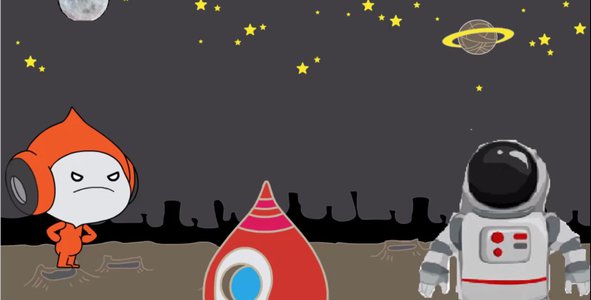
The game has three characters designed in scratch: a student (Pico), an astronaut, and a lunar lander. The astronaut challenges the student to answer a couple of questions about the moon. If the student competently answers two or more questions, the astronaut will take the student to explore the space in a lunar lander. The total number of questions and the levels could be extended as many as possible.
Execution Procedure:

Step 1: Click Flag

Step 2: Click the Sprite – SPACE-COSTUME-SPRITE


Step 3: Click UP arrow

Step 4: Click number 1 (one)

Step 5: Click the DOWN arrow

Step 6: Click “a” key

Step 7: Click number 2 (two)

Step 8: Click the RIGHT arrow

Step 9: Click the “b” key

Step 10: Click number 3 (three)

Step 11: Click the LEFT arrow

Step 12: Click the “c” key

Step 13: Click the “r” key

Step 14: If the score is greater than or equal to 2, then press the SPACE key

Step 15: END
Blocks Screenshots:


Space Agency Data
- NASA 3D Resources - Models | 3D Resources (nasa.gov)
- NASA Jet Propulsion Laboratory – Code a Mars Helicopter Video Game - Student Project: Code a Mars Helicopter Video Game | NASA/JPL Edu
- NASA Artemis Plan - The Artemis Plan (nasa.gov)
- NASA Humans on the Moon -More About the Human Landing System Program | NASA
Hackathon Journey
It is an honor to be a part of the world’s largest worldwide hackathon lasting 48 hours. Our university (University of Technology and Applied Sciences – Shinas, Sultanate of Oman) is one of the international participants. We opted to join despite our uncertainty about what the hackathon was and how it would be carried out. The NASA SPACE APPS CHALLENGE 2021 “The power of ten” presents a number of intriguing challenges.” PLANETARY LANDER GAME” is the challenge we have picked. The fascinating and inspiring factor is the available resources from NASA Space Centre and open space-based data from other agencies. We were inspired by the students' lust for knowledge about space and the need to tap their problem-solving skills. In response, we developed an interactive 2D learning game, " e-Mission Apollo 11", which simulates the space travel experience.
References
- https://www.jpl.nasa.gov/edu/learn/project/code-a-mars-helicopter-video-game/
- https://nasa3d.arc.nasa.gov/models
- https://scratch.mit.edu/about
- https://www.youtube.com/watch?v=PFQ6azFGfPk&list=PL37Yhb2zout05pUjr7OoRFpTNroq_wd9f&index=7
- https://www.nasa.gov/content/more-about-the-human-landing-system-program
- https://www.nasa.gov/press-release/nasa-names-companies-to-develop-human-landers-for-artemis-moon-missions
Tags
# Animation#2DGame#InteractiveVideoGame
Global Judging
This project has been submitted for consideration during the Judging process.