
High-Level Project Summary
Did you know that bees are the most important insects in the world?They are responsible for the production of 70% of the world's fruits,vegetables,seeds and cotton. This being the case, this species, the main engine of life. Unfortunately the extinction of these insects would trigger a food crisis.Well, now let's imagine that hives and their habitat conditions could be monitored in real time, collecting data of great importance such as temperature, behavior patterns, communication between them and, as an innovative contribution to the scientific community, improving the population count. Bee-bot is a combination of AI and species distribution modeling, which makes this challenge a reality.
Link to Project "Demo"
Link to Final Project
Detailed Project Description
GETTING TO KNOW THE WONDER OF MOTIVATION:
We will start by showing a place in Peru that contains a large population of bees. Here the bees are free to pollinate and live in harmony with the environment. Tarma, the city of flowers, has fresh air, a pleasant ecosystem, a variety of natural species and an incredible environment. The paradise of nature and healthy food. Who keeps the place like this? Well, our dear friends, the bees!
We share the beauty of the flora of the city of Tarma - Junín - Perú:

IMAGE: CAPTURED FOR THIS PROJECT.

IMAGE: CAPTURED FOR THIS PROJECT. (BEE POLLINATING)

IMAGE: PHOTO COLLECTED FOR THE PROJECT. (Flowers of the city of Tarma)
 IMAGE: PHOTO COLLECTED FOR THE PROJECT. (Good practices in organic agriculture)
GETTING TO KNOW THE BACKGROUND:
We take as an example, the situation of the records in Mexico, about the bee population between 1991 and 1994, showing us a drastic fall of the species, being a worrying situation. (GBIF, 2009)
In view of this, several studies have been carried out to counteract the effects caused by different agents and environmental factors. However, this solution only covers a small part of the great work done by bees. We can name 2 of them; the first one refers to the population census and its lamentable decrease due to the excessive use of pesticides and agrochemicals to improve crop yields. (Nazly Yolieth & Nelson Enrique, 2018)
And the second study about, the importance of taking care of our future, taking care of the bees, because their extinction represents a disaster in biological and medical terms. (Organización Mundial de Sanidad Animal, 2014)

IMAGE: CAPTURED FOR THIS PROJECT. (Sample of the bee population and its variation between 1991 and 1994). (CNIN/Abejas de México/Apoidea, n.d.)
OUR INSPIRATION:
Life itself as we know it needs more healthy, planet-friendly places. But what are we doing to conserve our environment?
Do we know the importance of insects on earth? And more than that, are we aware of how essential bees are? Throughout time we have thought about how to save the planet from extinction. Well, let's start by getting to know Bee Bot.
OUR SOLUTION TO THE CHALLENGE:
Bee - Bot knows the bees and predicts their behavior, it infiltrates as one more of the hive and analyzes their patterns, species and their way of communication. It is like the queen bee that has artificial intelligence, it does not invade natural genetics, but on the contrary, it expects to be the hero. Using sensors, cameras and AI code, Bee-Boot is able to detect danger zones in different hives around the world. It learns from what it observes and collects all the essential information about the biology and conditions in which the bees are found. All these data are sent in real time to the central server, which intelligently analyzes the situations and results, sharing the information with the interested scientific community, as well as making comparisons with the databases of the Global Biological Information Facility (GBIF), providing daily updated reports and improving the decision making process for the actions to be developed.
The construction went through the following phases:
Phase 1:
With environmental data provided by NASA, an artificial intelligence algorithm will be developed to predict potential bee habitats, and where there is a greater probability of damage, the Beebots will be released to collect, process and transmit data in real time on the status of the beehives or bee communities to the central server.
Phase 2:
The central, through the modeling of species distribution, will update the data shown in real time of demographic distribution of bees and states of their habitat on the map of our website.
Phase 3:
With the data stored in the servers, studies will be carried out that will lead to risk prevention plans in the areas with the highest population and predictive models of migration of hives to prevent them from ending up in dangerous areas.
Phase 4:
Once the studies and plans are completed, we hope to be able to work together with the ministry and/or local governments to take actions that will allow the preservation of the species.

IMAGE: MADE TO EXPLAIN THE PROJECT
SOFTWARE RESOURCES:
For the initial presentation of the project and due to time constraints, we will show the conceptualization of the idea of the central server as a pilot test, which will receive all the information for decision making and future actions of the scientific community. For this we use Html, css, Java script, PHP, Mysql, Java, Python, Django, GoDaddy, Wordpress, Apache, Ubuntu Server and Google Cloud.

IMAGE: DJANGO SERVER WITH PYTHON

IMAGE: INTERMEDIARY BETWEEN THE BACK END AND THE DATABASE

IMAGE: THE DATABASE

IMAGE: APACHE
Here we present the initial FRONT END of the project. By clicking on "Know now" the data will be sent to the monitoring system (Challenge solution).

IMAGE: PROJECT INTERFACE REDIRECTING TO FUNCIONALITY.

IMAGE: BACK END OF THE WEB.
 IMAGE: BEE BOT MONITORING
HARDWARE RESOURCES:
For the architecture of the Bee - Boot and the electronic design will require the use of a microcontroller, so we chose the stm32 model that will fulfill the functions of processing and data transmission to the central. Next, the main sensors implemented in the prototype will be detailed:
- Global Positioning System (GPS), which will be used for precise location updates and time synchronization measurements.
- A cellular communication(a CHIP basically), by using 5G technology for large geographical locations, it will be possible to transmit a large amount of data to the server.
- Sensors that allow to know the number of individuals that compose the colony and how it varies depending on the environmental conditions.
- A micro-camera that allows the classification of species using the digital image processing technique.
- Temperature and humidity sensors, important environmental variables to consider in the migrations of the species.
GREAT BENEFIT:
And what are the benefits? Well, there is no better result than prolonging the life and care of the environment, ensuring a solid ecosystem and more resources for living beings in their next generations. But, specifically, Bee - Bot will contribute to provide a great amount of information about the species, which will improve the activities that have been developed for the preservation of bees and their visibility as an essential resource for ecosystems. Therefore, all sectors will benefit, both agriculture, with the increase in food production, as well as the economy and health, with a transcendental impact on biodiversity and the environment.
WHAT WE AIM TO ACHIEVE:
With the results of Bee - Bot, we hope to raise awareness among farmers, local governments, ministries and countries about the problem that exists and grant alternative solutions that improve the quality of life and long-term preservation of bees without the use of invasive procedures, and on a large scale we hope that Bee-Bot can become an indispensable tool to generate life on other planets through pollination, care and preservation of life.

IMAGE: MADE TO EXPLAIN THE FUTURE OF THE PROJECT
Space Agency Data
To meet the challenge, we had to know the problematic reality with existing measurable data provided by NASA, thanks to the information from EARTH DATA OPEN ACCESS FOR OPEN SCIENCE, the study of the approximation of the number of bees in the world was conducted as part of the solution design.
Similarly, we used GBIF (Global Biodiversity Information Facility) to study the impact of the decline of the species over time and the effects it would have on the planet.
In the future, we will use NASA's FOREST FIRES, SLIDES AND FLOODS APIs (React) for the prevention and care of bee hives.
Hackathon Journey
Challenging and rewarding because it allowed us to gain new knowledge about various areas of scientific interest. We learned about the life and importance of bees for the planet, committing ourselves to encourage their care, providing greater visibility of their species in regional and local governments.
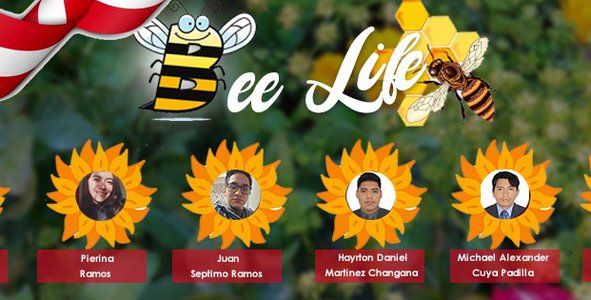
Our team is quite organized and disciplined, we solved setbacks intelligently and always had a plan B. We all committed to the goal, provided valuable ideas and exchanged experiences while enjoying the process of developing the challenge. We were able to recognize our strengths in order to assign each other the next tasks for further feedback:
Our friend Giovanni successfully performed the programming (back - end) of the solution.
Pierina did the strategic search for information and documentation of the project.
Juan, Dante and Michael were in charge of the audiovisual material and hardware support. (Multitask)
Daniel actively collaborated with the research by providing relevant data.
We are deeply grateful to our family, friends, teachers, local photographers and especially to NASA for creating this challenging Hackathon.
Finally, our project inspires us to create a promising future not only for planet Earth, but also for life outside of it.
References
NASA RESOURCES:
- EarthExplorer. (n.d.). Retrieved October 3, 2021, from https://earthexplorer.usgs.gov/
- Explore the NASA STI Repository (NTRS) - Scientific and Technical Information Program. (n.d.). Retrieved October 3, 2021, from https://www.sti.nasa.gov/
- NASA Earth Observations (NEO). (2021).
- NASA Technology Transfer Portal Home. (n.d.). Retrieved October 3, 2021, from https://technology.nasa.gov/
- Species Distribution Modeling Data | Earthdata. (n.d.). Retrieved October 3, 2021, from https://earthdata.nasa.gov/learn/pathfinders/biodiversity/species-distribution
- CNIN/Abejas de México/Apoidea. (n.d.). Retrieved October 3, 2021, from https://www.gbif.org/dataset/96b1aa66-f762-11e1-a439-00145eb45e9a
- Shrestha, R., & Boyer, A. (2019). Soil Moisture Data Sets Become Fertile Ground for Applications. Eos, 100. https://doi.org/10.1029/2019EO114329
- Turner, W. (2014). Sensing biodiversity: Sophisticated networks are required to make the best use of biodiversity data from satellites and in situ sensors. Science, 346(6207), 301–302. https://doi.org/10.1126/SCIENCE.1256014
OTHER RESOURCES:
- Alimentos Para Los Agricultores » La comunicación entre las abejas. (n.d.). Retrieved October 3, 2021, from http://food4farmers.org/es/2015/02/23/la-comunicacion-entre-las-abejas/
- Ciencias de la vida: Las abejas también desaparecen de los registros. (n.d.). Retrieved October 3, 2021, from https://www.heraldo.es/noticias/sociedad/2021/02/07/las-abejas-tambien-desaparecen-de-los-registros-1417795.html?autoref=true
- Reyes Tirado, G. S., & y Paul Johnston. (n.d.). El declive de las abejas. Retrieved October 3, 2021, from http://archivo-es.greenpeace.org/espana/Global/espana/report/Agricultura-ecologica/el_declive_de_las_abejas.pdf
Tags
#IA #bee #robot #life #hardware #software
Global Judging
This project has been submitted for consideration during the Judging process.